Professional CV vs LinkedIn Profile: What Should Job Seekers Update First?
By Paperza Editorial Team
|
26 Nov 2026
|
26 min read
Professional CV vs LinkedIn Profile: What Should Job Seekers Update First?
Finding a new job requires more than possessing the right qualifications, professional experience, and technical skills. Job seekers must also communicate their value effectively to recruiters, hiring managers, and potential employers.
Two of the most important tools for achieving this are a professional CV and a well-optimised LinkedIn profile.
However, many professionals struggle to determine which one deserves their attention first.
Should you invest in professional CV writing before applying for jobs? Should you optimise your LinkedIn profile to attract recruiters? Or should both be developed simultaneously?
The answer depends on your career objectives, current employment situation, and job search strategy.
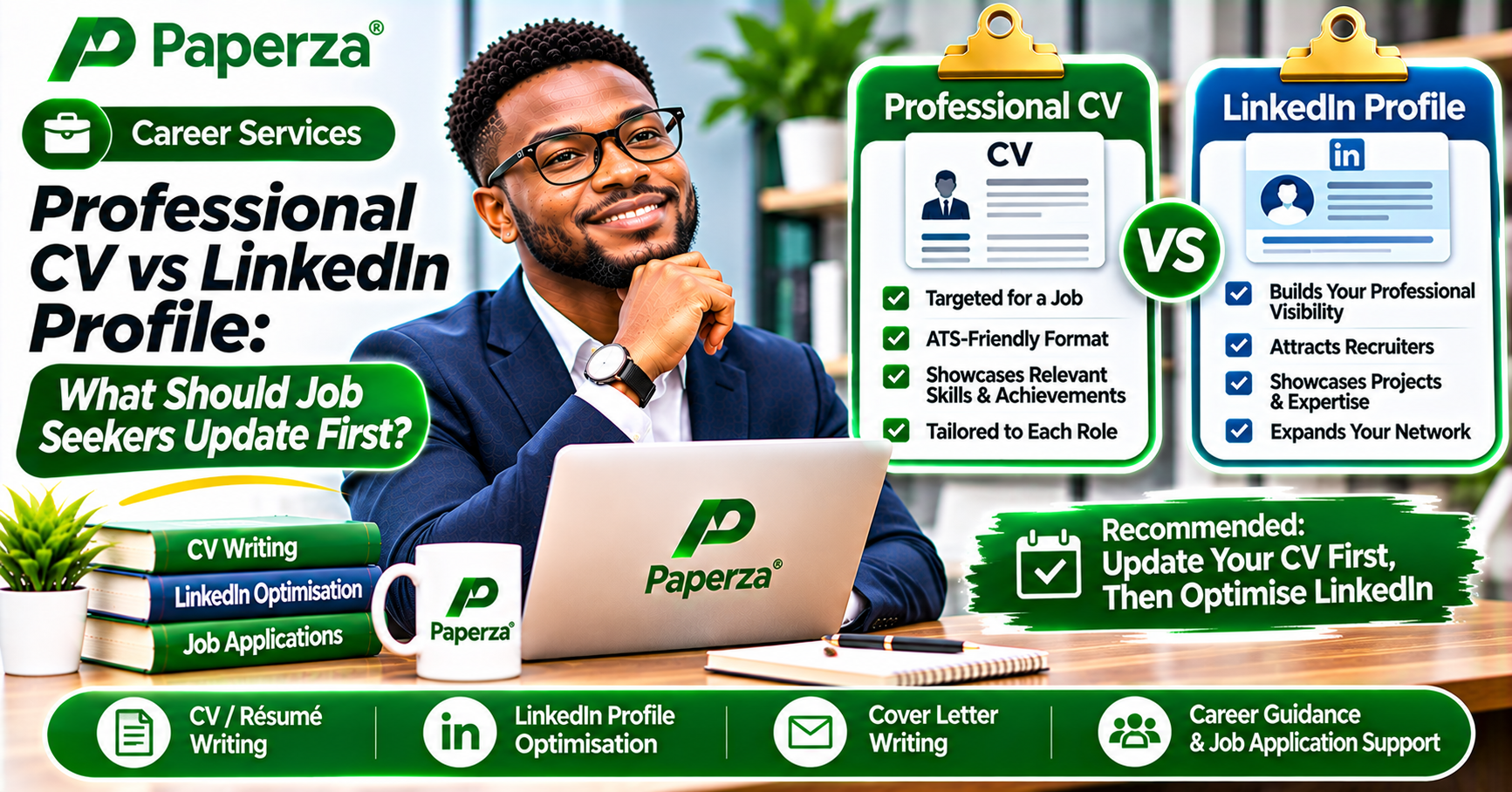
For most active job seekers, updating the CV first provides a strong foundation. LinkedIn optimisation should follow closely to improve professional visibility and ensure consistency across both platforms.
This guide explains the differences between a professional CV and a LinkedIn profile, how recruiters use them, and how to develop both into effective career development tools.
Job seekers requiring professional assistance can explore CV Writing, Résumé and LinkedIn Optimisation Services on Paperza.
What Is a Professional CV?
A curriculum vitae, commonly known as a CV, is a structured document presenting an individual's qualifications, employment history, professional accomplishments, education, and relevant skills.
In many countries, the terms CV and résumé are used interchangeably for employment applications. However, in the United States and certain academic environments, a CV may refer to a longer document containing detailed scholarly and professional achievements.
A professional employment CV generally focuses on information relevant to a particular job opportunity.
Its primary purpose is to demonstrate that the applicant possesses the experience, qualifications, and capabilities required for the position.
Essential Components of a Professional CV
A well-prepared employment CV typically contains:
- Professional contact information.
- Career summary or professional profile.
- Relevant technical and professional skills.
- Employment history.
- Measurable professional achievements.
- Educational qualifications.
- Relevant certifications.
- Professional projects or portfolio links.
Additional sections may be appropriate depending on the applicant's industry, country, and career level.
What Is a LinkedIn Profile?
LinkedIn is a professional networking platform that allows individuals to present their professional experience, establish industry connections, discover employment opportunities, and communicate with recruiters.
Unlike a CV submitted for a particular vacancy, a LinkedIn profile operates as an ongoing professional identity.
It can be discovered by recruiters, potential clients, business partners, colleagues, and other professionals, depending on the user's visibility settings.
A complete LinkedIn profile provides opportunities to communicate professional expertise, share projects, publish industry insights, and establish professional relationships.
Essential Components of a LinkedIn Profile
- Professional profile photograph.
- Relevant background banner.
- Professional headline.
- About section.
- Employment experience.
- Educational qualifications.
- Skills and endorsements.
- Professional recommendations.
- Licences and certifications.
- Featured projects and portfolio materials.
- Professional activity and industry engagement.
While a CV presents qualifications to a specific employer, LinkedIn helps communicate professional identity to a broader audience.
Professional CV vs LinkedIn Profile: Key Differences
| Feature | Professional CV | LinkedIn Profile |
| Primary purpose | Applying for employment | Professional visibility and networking |
| Audience | Recruiters and specific employers | Recruiters, employers and professional networks |
| Format | Structured document | Online professional profile |
| Length | Usually concise for employment applications | Flexible across multiple sections |
| Customisation | Tailored to individual vacancies | Aligned with overall career objectives |
| Search visibility | Generally limited unless uploaded to databases | Discoverable through platform searches |
| Multimedia | Usually limited | Supports projects, links and media |
| Recommendations | References provided when appropriate | Professional recommendations displayed online |
| Updates | Before applications and career changes | Regular professional updates |
| Interaction | Primarily static | Supports networking and communication |
| Privacy | Shared with selected recipients | Controlled through visibility settings |
Both tools serve important but different functions.
A professional CV communicates why an applicant should be considered for a particular position. LinkedIn helps potential employers discover and evaluate the applicant more broadly.
Which Should You Update First?
For professionals actively applying for jobs, updating the CV first is generally the more practical approach.
A well-prepared CV establishes the essential information that can subsequently be adapted for LinkedIn.
However, professionals who are not actively applying for jobs but want to attract recruiters or develop industry relationships may benefit from prioritising LinkedIn.
Recommended Priority Based on Career Objectives
| Career Situation | What to Update First |
| Applying for a job immediately | Professional CV |
| Recently graduated | Professional CV |
| Recently lost employment | CV, followed closely by LinkedIn |
| Seeking international employment | Professional CV |
| Exploring a career change | CV and career positioning |
| Attracting recruiter attention | LinkedIn profile |
| Currently employed but exploring opportunities | LinkedIn profile |
| Building professional recognition | LinkedIn profile |
| Seeking executive opportunities | Both |
| Freelancing or consulting | LinkedIn profile and portfolio |
The most effective long-term strategy is maintaining both documents so they are ready whenever opportunities arise.
Why Updating Your CV First Often Makes Sense
1. It Establishes Your Professional Foundation
Preparing a professional CV requires reviewing your qualifications, responsibilities, achievements, and career progression.
This process helps identify the strongest elements of your professional background.
Once these details are organised, adapting them for LinkedIn becomes easier.
2. It Prepares You for Immediate Job Applications
Many employers require applicants to upload a CV or résumé through their recruitment websites.
Even candidates discovered through LinkedIn may subsequently need to submit a formal application.
Having an updated CV enables job seekers to respond quickly to suitable opportunities.
3. It Helps Identify Important Career Achievements
Professionals often underestimate the value of their previous accomplishments.
Reviewing employment experience can help identify measurable contributions such as revenue growth, operational improvements, cost savings, successful projects, customer retention, and productivity improvements.
These achievements can strengthen both the CV and LinkedIn profile.
4. It Supports Targeted Job Applications
A professional CV can be customised according to the requirements of individual vacancies.
For example, a software engineer applying for a cloud engineering position may emphasise infrastructure experience, while an application for a backend development role may highlight programming and API development.
LinkedIn generally presents a broader professional identity.
5. It Helps Maintain Consistency
Developing an accurate master CV provides a reliable reference for employment dates, job titles, qualifications, certifications, and professional achievements.
This reduces the likelihood of conflicting information appearing across different professional platforms.
What Is an ATS-Friendly CV?
Many employers use applicant tracking systems, commonly known as ATS, to manage recruitment applications.
These systems may collect candidate information, parse CV content, organise applications, support recruiter searches, and assist with screening workflows.
An ATS-friendly CV is designed to make relevant information accessible to recruitment software while remaining easy for human recruiters to read.
There is no universal ATS score or document format that guarantees progression through every recruitment system.
Different employers use different software, screening criteria, and recruitment procedures.
How to Make Your CV ATS-Friendly
- Use clear and conventional section headings.
- Include relevant keywords from the job description.
- Use straightforward formatting.
- Present employment dates consistently.
- Include accurate job titles.
- Avoid unnecessary graphics and complex layouts.
- Follow the employer's requested file format.
- Ensure that important information appears as readable text.
- Highlight relevant qualifications and skills.
- Avoid excessive keyword repetition.
A visually attractive CV is not necessarily an effective recruitment document if its content is difficult to understand or extract.
Applicants requiring professional assistance can hire an ATS CV and Résumé Writer on Paperza.
How to Write a Professional CV That Communicates Value
Start With a Clear Professional Summary
Your professional summary should introduce your expertise, relevant experience, and the value you can bring to an employer.
Weak example:
Hardworking individual seeking a challenging position in a reputable organisation.
Improved example:
Data analyst with four years of experience developing business intelligence dashboards, automating reporting processes, and transforming operational data into actionable insights using SQL, Python, and Power BI.
The improved example communicates a specific professional identity rather than relying on generic personal qualities.
Highlight Achievements Instead of Responsibilities Alone
Many CVs focus exclusively on duties performed in previous positions.
Although responsibilities provide context, achievements demonstrate the results of an individual's work.
| Responsibility-Based Statement | Achievement-Based Statement |
| Managed social media accounts | Increased qualified social media enquiries by 35% over six months |
| Prepared business reports | Automated weekly reporting and reduced preparation time by eight hours |
| Managed customer complaints | Improved complaint resolution processes and reduced average response time |
| Developed company websites | Delivered five responsive websites for small business clients |
| Supervised construction activities | Coordinated construction activities to support timely project milestones |
| Managed recruitment activities | Reduced average recruitment turnaround from 30 days to 22 days |
These examples are illustrative. Applicants should only include figures and achievements they can accurately substantiate.
Use Relevant Professional Keywords
Review several job descriptions within your target industry and identify recurring requirements.
For example, a data analyst may encounter keywords such as:
- SQL.
- Python.
- Microsoft Excel.
- Power BI.
- Tableau.
- Data visualisation.
- Business intelligence.
- Statistical analysis.
- Data cleaning.
Include these terms naturally where they accurately reflect your experience.
Keyword stuffing, hidden text, and inaccurate skill claims can undermine the credibility of an application.
Why LinkedIn Profile Optimisation Is Important
A professional CV primarily supports job applications initiated by the applicant.
LinkedIn can additionally support opportunities initiated by recruiters and professional contacts.
Recruiters may use LinkedIn to search for candidates based on job titles, professional experience, location, skills, and other criteria.
An outdated or incomplete profile may make it more difficult for suitable professionals to communicate their expertise.
LinkedIn also helps job seekers maintain professional relationships, follow employers, discover vacancies, and share relevant work.
According to LinkedIn's official profile guidance, individuals can improve their professional presentation by maintaining relevant profile sections, showcasing their experience, and highlighting their expertise.
How to Optimise Your LinkedIn Profile
1. Use a Professional Profile Photograph
Choose a clear and recent photograph that reflects your professional identity.
The image should have appropriate lighting, a clean background, and a visible face.
Your photograph does not necessarily need to be taken in an expensive photography studio.
A suitable smartphone photograph may be sufficient when properly composed.
Unlike LinkedIn, employment CVs in countries such as the United States, Canada, and the United Kingdom generally do not require a photograph unless specifically requested for an appropriate purpose.
2. Write a Keyword-Rich Professional Headline
Your LinkedIn headline should communicate your professional expertise and career positioning.
Instead of using vague descriptions, include relevant job titles, specialisations, and skills.
| Industry | Example LinkedIn Headline |
| Software Engineering | Software Engineer — Python, JavaScript and Cloud Applications |
| Digital Marketing | Digital Marketing Specialist — SEO, Paid Advertising and Lead Generation |
| Data Analytics | Data Analyst — SQL, Power BI and Business Intelligence |
| Civil Engineering | Civil Engineer — Structural Design, Construction and Project Management |
| Human Resources | HR Professional — Talent Acquisition and Workforce Development |
| Cybersecurity | Cybersecurity Analyst — Security Monitoring and Risk Assessment |
| Project Management | Project Manager — Operations, Delivery and Process Improvement |
| AI and Automation | AI Automation Specialist — Workflow Automation and Business Systems |
A strong headline balances relevant industry terminology with a clear description of your professional expertise.
3. Develop a Compelling About Section
The About section provides an opportunity to communicate your professional story in a more conversational format than a conventional CV.
It should explain your background, principal skills, relevant accomplishments, and career interests.
Example LinkedIn About Section
I am a digital marketing and automation professional focused on helping businesses improve customer acquisition, streamline repetitive processes, and strengthen their online presence.
My experience includes search engine optimisation, social media marketing, paid advertising, workflow automation, and digital campaign management. I am particularly interested in using technology to improve operational efficiency and support measurable business growth.
I enjoy collaborating with organisations and professionals seeking practical digital solutions, and I am interested in opportunities involving marketing strategy, business automation, and technology-enabled growth.
This illustrative example communicates expertise, professional interests, and career positioning without relying on exaggerated claims.
4. Update Your Work Experience
Your LinkedIn experience section should accurately represent your employment history and professional contributions.
It does not need to repeat your CV word for word.
A CV may contain a concise description tailored to a specific vacancy, while LinkedIn can provide additional context about projects, responsibilities, and professional accomplishments.
Ensure that employment dates, job titles, and qualifications remain consistent.
5. Add Relevant Professional Skills
LinkedIn allows users to highlight skills associated with their professional background.
Prioritise skills relevant to your target roles rather than adding every skill you have encountered.
A software engineer may emphasise programming languages, cloud platforms, databases, software architecture, and development methodologies.
A business analyst may highlight requirements gathering, process improvement, stakeholder management, reporting, and business modelling.
6. Request Genuine Professional Recommendations
Recommendations from former managers, colleagues, clients, and professional collaborators can provide useful context about your work.
Request recommendations from individuals who have direct knowledge of your contributions.
A meaningful recommendation should describe specific professional experiences rather than generic praise.
Avoid purchasing fabricated recommendations or endorsements.
7. Showcase Projects and Portfolio Materials
LinkedIn's Featured section can help professionals showcase relevant work.
Suitable materials may include:
- Professional portfolio websites.
- GitHub repositories.
- Published research papers.
- Design projects.
- Case studies.
- Professional presentations.
- Business dashboards.
- Product demonstrations.
Only share materials you have permission to disclose.
Do not publish confidential employer information, customer data, proprietary source code, or restricted project documents.
8. Configure Your Job Preferences
Professionals actively seeking employment can use LinkedIn's Open to Work feature to communicate their interests.
Relevant preferences may include target job titles, geographic locations, employment types, and remote or hybrid working arrangements.
LinkedIn provides different visibility options, including sharing availability with recruiters rather than the wider professional network.
However, recruiter-only visibility does not guarantee complete confidentiality from a current employer.
Review LinkedIn's official Open to Work guidance before configuring your preferences.
Should Your CV and LinkedIn Profile Be Identical?
No.
Your CV and LinkedIn profile should be consistent, but their content and presentation do not need to be identical.
A CV is generally designed for a specific employment opportunity.
LinkedIn is intended to communicate a broader professional identity.
Information That Should Remain Consistent
| Information | Consistency Requirement |
| Employment dates | Accurate across both platforms |
| Job titles | Consistent and truthful |
| Educational qualifications | Identical qualification details |
| Certifications | Accurate credentials and awarding organisations |
| Professional achievements | Supported by genuine experience |
| Technical skills | Reflect actual capabilities |
| Career positioning | Aligned with professional objectives |
Information That Can Be Presented Differently
Your LinkedIn profile may include more detailed project descriptions, professional interests, broader experience, multimedia content, and networking-oriented information.
Your CV may prioritise a smaller selection of qualifications and achievements relevant to a particular vacancy.
It is reasonable to omit less relevant experience from a tailored CV, provided the document does not create a misleading impression.
How Recruiters Use CVs and LinkedIn Profiles
Recruitment procedures differ across organisations, industries, and countries.
However, employers commonly use a combination of application documents, professional networking platforms, interviews, technical assessments, and reference checks.
Typical Recruitment Journey
| Recruitment Stage | Role of the CV | Role of LinkedIn |
| Candidate discovery | Available through uploaded applications or databases | Supports recruiter searches |
| Initial screening | Presents relevant qualifications | Provides additional professional context |
| Shortlisting | Demonstrates alignment with job requirements | May support candidate research |
| Interview preparation | Provides a basis for interview questions | Highlights projects and professional activities |
| Final assessment | Supports employment verification | May provide additional information |
Not every employer reviews LinkedIn profiles, and having an optimised profile does not guarantee recruiter attention.
Nevertheless, maintaining both tools can support a more comprehensive job search strategy.
Professional CV vs LinkedIn for Recent Graduates
Recent graduates may have limited full-time employment experience.
Their CV should therefore communicate relevant coursework, academic projects, internships, volunteering, technical skills, and professional development activities.
LinkedIn can help graduates establish connections with alumni, recruiters, industry professionals, and potential employers.
What Recent Graduates Should Prioritise
- Develop a concise employment CV.
- Identify relevant graduate roles.
- Highlight academic and practical projects.
- Create a complete LinkedIn profile.
- Connect with professionals in the target industry.
- Apply for suitable internships and entry-level positions.
- Continue developing relevant professional skills.
Graduates should avoid exaggerating academic projects or presenting classroom assignments as commercial employment.
Professional CV vs LinkedIn for Experienced Professionals
Experienced professionals often have substantial employment histories and professional accomplishments.
Their CV should prioritise relevant achievements rather than listing every task performed throughout their careers.
LinkedIn can provide additional context about career progression, leadership responsibilities, industry expertise, and professional recognition.
For professionals seeking senior positions, it is particularly important to demonstrate business impact.
Relevant achievements may include:
- Revenue generation.
- Operational efficiency.
- Team leadership.
- Strategic project delivery.
- Business expansion.
- Technology implementation.
- Cost reduction.
- Organisational transformation.
The strongest accomplishments are those supported by credible information and relevant professional context.
Professional CV vs LinkedIn for Career Changers
Changing careers requires more than updating job titles.
Career changers must identify transferable skills and explain how their existing experience relates to a new profession.
For example, a civil engineer transitioning into data analytics may have relevant experience in numerical analysis, project reporting, technical problem-solving, and data interpretation.
The CV can emphasise these transferable capabilities alongside genuine data analytics training and projects.
The LinkedIn headline and About section can then communicate the individual's evolving career direction.
Applicants should distinguish between skills they are currently developing and established professional experience.
Professional CV vs LinkedIn for International Job Seekers
Professionals targeting employment opportunities in the United Kingdom, Canada, United States, Australia, Europe, or other international markets should consider local recruitment conventions.
CV requirements vary between countries and industries.
General International CV Considerations
| Destination | Common Employment Document Convention |
| United States | Concise résumé for most non-academic positions |
| United Kingdom | Professional CV, often one to two pages |
| Canada | Targeted résumé focused on relevant experience |
| Australia | Résumé or CV with relevant career detail |
| Germany | Requirements may vary between employers and industries |
| Academic positions | Detailed academic CV where requested |
These are general conventions rather than universal requirements.
Always follow the instructions provided by the specific employer.
International applicants should also accurately communicate work authorisation and sponsorship requirements when requested.
Do not claim eligibility to work in a country unless that information is correct.
How Long Should a Professional CV Be?
The appropriate CV length depends on career stage, professional experience, industry practices, and the type of position.
| Career Level | Common Starting Point |
| Student or recent graduate | One page |
| Early-career professional | One to two pages |
| Experienced professional | Two pages |
| Senior executive | Two to three pages where appropriate |
| Academic researcher | As required to communicate relevant scholarly achievements |
A longer CV is not automatically more impressive.
The objective is to provide sufficient relevant information without overwhelming the reader.
If a vacancy specifies a particular document length, follow that requirement.
Do You Need a Cover Letter as Well?
A cover letter complements the CV by explaining why the applicant is interested in a particular position and how their experience relates to the employer's requirements.
It can be especially useful when applying for competitive vacancies, changing careers, explaining relevant circumstances, or demonstrating knowledge of an organisation.
An effective cover letter should:
- Identify the position.
- Explain your interest in the opportunity.
- Connect relevant experience to the job requirements.
- Highlight selected professional achievements.
- Communicate your potential contribution.
- Conclude professionally.
Avoid submitting a generic cover letter that simply repeats the CV.
Job seekers can explore CV, Cover Letter and LinkedIn Profile Services on Paperza and request a package suited to their application requirements.
How Much Does Professional CV Writing Cost?
Professional CV writing prices depend on the writer's experience, the applicant's career level, the complexity of the document, and the required deliverables.
A recent graduate may require a relatively straightforward CV, while an executive may need extensive career analysis and professional positioning.
Illustrative Career Document Budgets
| Service | Example Budget |
| Basic CV proofreading | $5–$30 |
| Entry-level CV writing | $10–$75 |
| Professional ATS-focused CV writing | $25–$150 |
| Executive CV writing | $100–$500+ |
| Cover letter writing | $10–$75 |
| LinkedIn profile optimisation | $25–$150 |
| Combined career document package | $50–$300+ |
These figures are illustrative budgeting examples, not independently measured industry averages.
Actual quotations depend on the freelancer and agreed project scope.
Affordable Professional CV Services on Paperza
Paperza features a professional CV and résumé writing service with a basic package starting at $5.
The basic package covers CV or résumé writing and optimisation. Additional services such as cover letter writing and LinkedIn profile optimisation should be confirmed through the available packages or a custom quotation.
The $5 basic package costs $5.25 after Paperza's 5% buyer platform charge, before any applicable additional expenses.
View Professional ATS CV Writing Services on Paperza.
Is Hiring a Professional CV Writer Worth It?
Hiring a professional CV writer can be useful when an applicant struggles to organise their experience, communicate achievements, tailor applications, or identify relevant professional keywords.
An experienced career document specialist may help improve structure, clarity, grammar, and relevance.
Professional assistance can be particularly valuable for:
- Recent graduates entering the job market.
- Experienced professionals pursuing senior positions.
- Individuals changing careers.
- International job seekers.
- Professionals returning after a career break.
- Applicants receiving limited interview responses.
- Individuals with complex employment histories.
However, a professionally written CV cannot replace missing qualifications or create genuine experience that an applicant does not possess.
No writing service can guarantee employment, interviews, or successful recruitment outcomes.
The applicant should review the final document to ensure that every statement accurately reflects their professional background.
What to Look for When Hiring a LinkedIn Profile Writer
A LinkedIn profile writer should understand how to communicate professional expertise through relevant profile sections.
Before hiring, review the freelancer's experience, portfolio, service descriptions, and proposed deliverables.
Clarify whether the service includes professional headline development, About section writing, experience optimisation, relevant skills, career positioning, and profile improvement recommendations.
You should also confirm whether the freelancer provides an editable document containing the proposed content or expects direct account access.
For security reasons, it is preferable to receive the optimised content and update your LinkedIn profile yourself.
Do not share account passwords or authentication codes with external service providers.
Questions to Ask Before Hiring a Career Document Specialist
Before placing an order, consider asking the following questions:
- Have you prepared CVs for professionals in my industry?
- Can you tailor my CV to a specific job description?
- Does the service include ATS-friendly formatting?
- Will you deliver an editable Word document?
- Is a PDF version included?
- Does the package include a cover letter?
- Is LinkedIn profile optimisation included?
- How many revisions are available?
- What information do you need from me?
- How will you protect my personal information?
These questions help establish clear expectations and reduce unnecessary misunderstandings.
A Seven-Day CV and LinkedIn Optimisation Plan
Job seekers do not need to spend several months preparing their career documents.
A structured one-week plan can help establish a stronger foundation.
| Day | Recommended Activity |
| Day 1 | Identify target positions and review relevant job descriptions |
| Day 2 | Collect qualifications, employment details and genuine achievements |
| Day 3 | Prepare or update the master CV |
| Day 4 | Tailor the CV to selected vacancies |
| Day 5 | Update LinkedIn headline, About section and experience |
| Day 6 | Add relevant skills, projects and professional connections |
| Day 7 | Begin targeted job applications and professional networking |
This timeline can be adjusted according to the applicant's availability and career circumstances.
Why Your CV May Not Be Generating Interviews
If you are submitting numerous applications without receiving interview invitations, your CV may need improvement.
However, the document itself is not always the only issue.
Potential Problems and Solutions
| Problem | Recommended Action |
| Generic CV used for every vacancy | Tailor content to relevant requirements |
| Unclear professional summary | Establish a specific career identity |
| Responsibilities without achievements | Include substantiated professional results |
| Missing relevant skills | Highlight genuine qualifications and expertise |
| Difficult formatting | Use a clear, readable structure |
| Applying for unsuitable positions | Review experience and eligibility requirements |
| Outdated employment information | Update professional history |
| Geographic or work authorisation restrictions | Target appropriate employment opportunities |
| Weak portfolio | Develop relevant project examples |
| Limited professional networking | Establish meaningful industry connections |
Job market conditions, competition, hiring budgets, and employer preferences can also influence interview opportunities.
Review the overall job search strategy rather than assuming every unsuccessful application results from poor CV quality.
Common LinkedIn Profile Mistakes
Using a Generic Headline
Headlines such as Seeking Opportunities or Hardworking Professional may provide limited information about the individual's actual expertise.
Leaving the About Section Empty
An incomplete About section removes an opportunity to communicate relevant experience and career interests.
Maintaining Outdated Employment Information
Recruiters may find it difficult to assess the applicant's current career position.
Listing Irrelevant Skills
A focused selection of professional skills can communicate expertise more clearly than an extensive list of unrelated capabilities.
Using Conflicting Employment Dates
Inconsistencies between the CV and LinkedIn profile may create unnecessary credibility concerns.
Requesting Fabricated Recommendations
Professional recommendations should reflect genuine working relationships.
Connecting Without Meaningful Engagement
Building a professional network involves more than increasing connection numbers.
Relevant conversations, thoughtful industry contributions, and authentic relationships can provide greater long-term value.
Does LinkedIn Premium Replace Professional CV Optimisation?
No.
LinkedIn Premium provides additional platform features depending on the subscription selected.
However, purchasing a subscription does not automatically improve the quality of a CV, correct inaccurate information, or develop professional accomplishments.
Before investing in paid recruitment tools, job seekers should ensure that their core career documents and professional profiles are accurate and well organised.
A complete free LinkedIn profile and a targeted professional CV can already support many important job search activities.
How to Use LinkedIn After Updating Your Profile
Optimising a profile is only the beginning.
Professionals can use LinkedIn to maintain awareness of employment opportunities and industry developments.
Follow organisations that align with your career goals, establish relevant connections, participate in professional discussions, and share appropriate examples of your expertise.
When contacting recruiters, communicate your interest clearly and professionally.
Sample LinkedIn Message to a Recruiter
Hello,
I came across your profile while exploring opportunities in data analytics and business intelligence. My background includes SQL, Power BI, reporting automation, and operational data analysis.
I would appreciate the opportunity to connect and learn about relevant positions within your organisation or professional network.
Thank you for your time.
This type of message introduces the applicant without immediately demanding employment assistance.
Professional CV and LinkedIn Profile Checklist
CV Preparation
- Define your target job roles.
- Update your professional contact information.
- Write a relevant career summary.
- Verify employment dates and job titles.
- Include substantiated professional achievements.
- Add relevant technical and professional skills.
- Update qualifications and certifications.
- Use clear, readable formatting.
- Review the employer's file requirements.
- Proofread the final document.
LinkedIn Optimisation
- Upload an appropriate professional photograph.
- Add a relevant background image.
- Write a clear professional headline.
- Develop an informative About section.
- Update employment history.
- Add relevant skills and certifications.
- Showcase appropriate portfolio projects.
- Request genuine recommendations.
- Review job preferences and privacy settings.
- Confirm consistency with your CV.
Job Application Preparation
- Identify suitable employers.
- Tailor your CV to each relevant vacancy.
- Prepare a cover letter where appropriate.
- Maintain an application tracking document.
- Prepare for interviews.
- Continue developing relevant professional skills.
Where to Hire Professional CV Writers and LinkedIn Specialists
Paperza connects job seekers, graduates, experienced professionals, executives, and entrepreneurs with freelance career service providers.
Depending on your requirements, you can find assistance with professional CV writing, résumé editing, cover letter preparation, LinkedIn profile optimisation, and career document development.
Professional ATS CV and Résumé Writing
Hire a Professional CV Writer on Paperza.
The featured basic package starts at $5 and focuses on CV or résumé writing and optimisation.
LinkedIn Profile and Cover Letter Support
Explore CV, Cover Letter and LinkedIn Optimisation Packages.
Contact the freelancer to discuss your target industry, career objectives, and required deliverables.
Additional Career Development Services
Browse Career Services on Paperza to compare available professionals and find support appropriate to your career stage.
Whether you are applying for your first job, transitioning into a new industry, or pursuing an international career opportunity, professionally prepared documents can help communicate your existing qualifications more effectively.
Frequently Asked Questions
Should I update my CV or LinkedIn profile first?
If you are actively applying for jobs, update your CV first and then use it as a foundation for optimising LinkedIn. If your primary objective is professional visibility and networking, LinkedIn may deserve immediate attention.
Is LinkedIn more important than a CV?
Neither universally replaces the other. LinkedIn supports professional discovery and networking, while a CV is frequently required for formal employment applications.
Can recruiters find me without an updated CV?
Yes. Recruiters may discover candidates through LinkedIn and other professional databases. However, they may subsequently request a professional CV.
Should my LinkedIn profile match my CV?
Important facts, including employment dates, qualifications, job titles, and professional achievements, should remain consistent. The wording and level of detail can differ.
What is an ATS-friendly CV?
An ATS-friendly CV uses clear formatting and relevant, accurate information that can be interpreted by recruitment software and human readers.
Can I use my LinkedIn profile as a CV?
Some employers accept LinkedIn profiles or applications using profile information. However, many organisations still require a separately prepared CV or résumé.
How much does professional CV writing cost?
Prices vary according to the complexity and scope of the service. Paperza features a basic CV writing and optimisation package starting at $5, excluding the buyer platform charge.
Can a professional CV writer improve my interview opportunities?
Professional writing can improve the clarity, structure, and relevance of an application. Interview decisions also depend on qualifications, competition, employer requirements, and other recruitment factors.
How often should I update my LinkedIn profile?
Update your profile whenever you acquire relevant qualifications, complete significant projects, change employment, or develop important professional skills.
Where can I hire an affordable LinkedIn profile specialist?
You can explore Career Services on Paperza and compare freelancers offering professional career document and profile preparation services.
Conclusion
A professional CV and an optimised LinkedIn profile are complementary tools for career development.
A CV helps job seekers communicate their suitability for specific employment opportunities, while LinkedIn supports professional visibility, networking, and recruiter discovery.
For most active job seekers, developing a strong CV first is a practical approach. It provides the foundation for accurate employment information, relevant professional achievements, and targeted applications.
LinkedIn optimisation should follow, allowing professionals to establish a consistent and discoverable professional identity.
Rather than treating these tools as competing alternatives, job seekers should maintain both as part of a comprehensive career development strategy.
Ready to improve your CV and professional online presence?
Hire Professional CV Writers and LinkedIn Profile Specialists on Paperza and take the next step towards presenting your qualifications, experience, and professional achievements more effectively.
References and Further Reading
CONNECT WITH PAPERZA
Follow our official pages for daily publishing guides, expert advice & updates:


I will optimize your cv and github portfolio for uk global talent visa
Are you applying for the UK Global Talent Visa (Digital Technology route) and need a professional CV and GitHub portfolio? I will help you optimize your CV and GitHub profile to...
View Related Service >NEED PROFESSIONAL ASSISTANCE?
I will optimize your cv and github portfolio for uk global talent visa
Are you applying for the UK Global Talent Visa (Digital Technology route) and need a professional CV and GitHub portfolio? I will help you...
OFFICIAL SOCIAL CHANNELS
Stay connected with Paperza across our verified social profiles: