O-1A for AI Engineers: Petitioners, Work Plans and Career Evidence Explained
By Paperza Editorial Team
|
14 Nov 2026
|
16 min read
Artificial intelligence is transforming industries worldwide, creating opportunities for machine learning engineers, AI researchers, data scientists, software architects, and technology entrepreneurs.
For accomplished AI professionals seeking to work in the United States, the O-1A visa offers a potential immigration pathway based on extraordinary ability.
However, qualifying for O-1A requires more than technical expertise, professional experience, or employment in a high-demand industry. Applicants must demonstrate significant professional achievements, establish an appropriate petitioning arrangement, and provide evidence of their intended work in the United States.
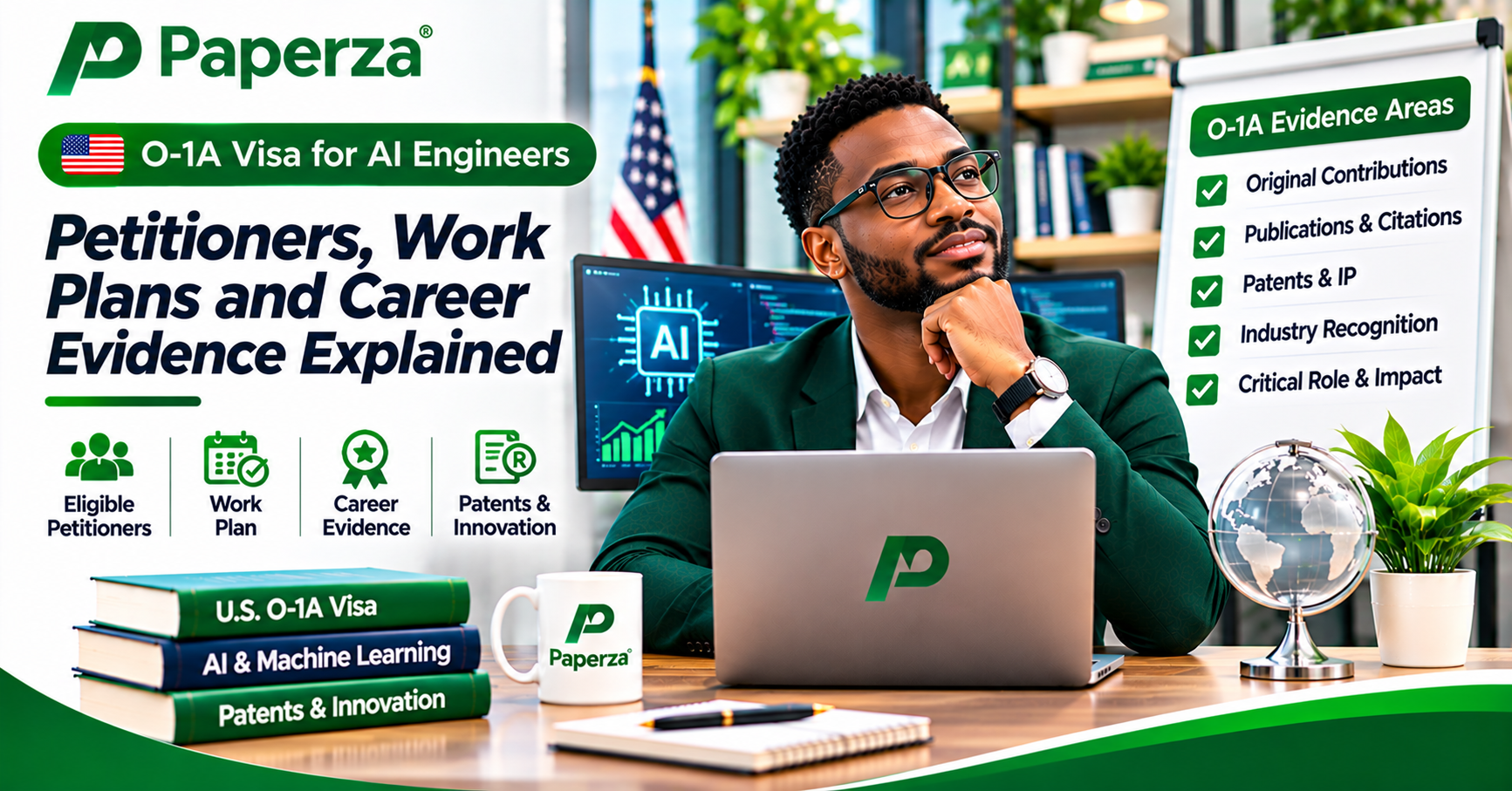
This guide explains the O-1A visa requirements for AI engineers, who can file a petition, how to prepare a credible work plan, and how professional achievements, including patents and technical innovations, may support eligibility.
AI engineers developing proprietary technologies can also explore Patent Filing Support on Paperza to find relevant intellectual property documentation services.
What Is the O-1A Visa?
The O-1A is a U.S. nonimmigrant classification available to individuals who demonstrate extraordinary ability in science, education, business, or athletics.
For AI engineers, the classification may be particularly relevant to professionals working in:
- Artificial intelligence and machine learning.
- Generative AI and large language models.
- Computer vision.
- Natural language processing.
- Robotics and autonomous systems.
- AI infrastructure and cloud computing.
- Responsible AI and cybersecurity.
- Advanced data science and engineering.
- AI-driven product development.
Unlike certain other employment-based visa classifications, O-1A is not subject to an annual numerical lottery.
Nevertheless, applicants must demonstrate sustained national or international acclaim and establish that they belong to the small percentage of professionals who have reached the top of their field.
Can AI Engineers Qualify for O-1A?
Yes. AI engineers may qualify when their documented achievements satisfy the applicable extraordinary ability requirements.
In January 2025, USCIS clarified its O-1 evidentiary guidance, including examples relevant to professionals working in critical and emerging technologies.
This guidance is particularly useful for AI professionals whose achievements may involve software innovations, technical research, commercial products, patents, and other forms of professional impact.
However, working in artificial intelligence does not automatically establish extraordinary ability.
The petition must demonstrate the individual's achievements and recognition rather than rely solely on the importance of the AI industry.
Understanding the Eight O-1A Evidence Criteria
An applicant may establish eligibility through a major internationally recognised award or by satisfying at least three of the eight regulatory evidence criteria.
| O-1A Criterion | Potential Evidence for AI Engineers |
| Recognised awards | Competitive AI, engineering, or research awards |
| Selective memberships | Associations requiring outstanding professional achievements |
| Published material about the applicant | Independent media coverage and professional features |
| Judging the work of others | Completed journal or conference peer reviews |
| Original contributions | Influential AI technologies, patents, or research innovations |
| Scholarly authorship | Research papers and scholarly technical publications |
| Critical or essential employment | Significant roles at distinguished technology organisations |
| High remuneration | Compensation records and relevant industry comparisons |
Meeting three criteria is not an automatic guarantee of approval.
USCIS also evaluates the evidence collectively to determine whether the applicant has demonstrated the required level of extraordinary ability.
Who Can File an O-1A Petition for an AI Engineer?
One of the most important differences between O-1A and certain employment-based immigrant classifications is the petitioning requirement.
An AI engineer cannot directly self-petition for O-1A as an individual.
An eligible petitioner must submit Form I-129 on the applicant's behalf.
1. A U.S. Employer
A U.S. technology company, research organisation, university, or other qualifying employer may file an O-1A petition for an AI professional.
The employer should provide documentation explaining the proposed employment, its terms, and the activities the engineer will undertake.
For example, an AI research company may petition for a machine learning engineer who will develop advanced language models or improve its AI infrastructure.
2. A U.S. Agent
A qualifying U.S. agent may petition on behalf of an AI professional under an appropriate arrangement.
This option may be relevant to individuals who intend to work on multiple projects or engagements involving different organisations.
For example, an AI engineer may have planned research collaborations, technical consulting engagements, and product development projects with several companies.
The agent must provide the documentation required for the particular arrangement, including relevant agreements and work details.
An agent-based petition does not automatically provide unrestricted permission to work for any employer.
3. A Foreign Employer Through a U.S. Agent
A foreign technology company may arrange for a qualifying U.S. agent to file an O-1A petition on its behalf.
This structure may be relevant to international AI companies with planned activities in the United States.
The petitioner must establish the relevant relationships and proposed work arrangements.
4. A Separate Company Owned by the AI Engineer
USCIS guidance clarifies that a separate legal entity owned by an O-1 beneficiary, such as a corporation or limited liability company, may file a petition on the beneficiary's behalf.
This may be particularly relevant to AI startup founders.
However, registering a company does not automatically establish O-1A eligibility. The entity must meet the applicable petitioning requirements, and the proposed work must be genuine and properly documented.
Founders considering this arrangement should obtain qualified immigration legal advice.
What Is an O-1A Work Plan?
An O-1A work plan is a practical description of the professional activities an applicant intends to undertake in the United States.
Although a standalone document called a work plan is not universally required, the petition must include the applicable information about the nature and duration of the proposed activities.
Depending on the petitioning arrangement, supporting documentation may include employment agreements, project descriptions, engagement contracts, and an itinerary.
A credible work plan should explain:
- The nature of the proposed AI engineering activities.
- The organisation or organisations involved.
- The applicant's responsibilities.
- The expected project duration.
- The location of the proposed work.
- Relevant employment or engagement terms.
- How the proposed activities relate to the applicant's area of extraordinary ability.
The proposed work should remain within the applicant's established area of expertise.
Example O-1A Work Plan for an AI Engineer
Consider a hypothetical machine learning engineer with documented achievements in generative AI and natural language processing.
A proposed work plan could include the following activities:
| Period | Proposed Activity | Expected Deliverable |
| Months 1–6 | Develop enterprise language model infrastructure | Tested AI system components |
| Months 7–12 | Improve model efficiency and reliability | Performance evaluation reports |
| Months 13–18 | Develop specialised AI applications | Functional product integrations |
| Months 19–24 | Lead AI research and engineering initiatives | Technical releases and documentation |
| Months 25–36 | Expand and maintain AI solutions | Product improvements and deployment records |
This example is illustrative. An actual petition should identify genuine work arrangements, relevant dates, contracting organisations, and other required details.
A generic schedule containing hypothetical projects is not a substitute for evidence of actual proposed employment or engagements.
Career Evidence That Can Strengthen an O-1A Petition
AI engineers should focus on documenting authentic achievements that demonstrate their technical expertise, professional recognition, and contributions to the field.
1. Original AI Innovations and Technical Contributions
Original contributions of major significance may be particularly relevant to accomplished AI engineers.
Potential examples include:
- Developing influential machine learning algorithms.
- Creating widely adopted AI software.
- Designing innovative neural network architectures.
- Improving large language model performance.
- Developing significant computer vision applications.
- Creating advanced AI security technologies.
- Introducing novel approaches to model deployment and optimisation.
Supporting evidence may include technical reports, independent evaluations, implementation records, product adoption statistics, and documented performance improvements.
The petition should explain not only what the engineer developed but also why the contribution matters to the wider field.
2. Patents and Intellectual Property
Patents can provide useful evidence of an AI engineer's technical innovations.
Potential patent-related achievements may involve machine learning optimisation, intelligent automation, computer vision systems, robotics, AI-powered cybersecurity, or data processing technologies.
Useful supporting documentation includes:
- Granted patent records.
- Patent application documents.
- Inventor identification records.
- Technical descriptions of inventions.
- Licensing agreements.
- Evidence of commercial implementation.
- Independent assessments of the technology.
However, a patent alone does not establish that an invention has made a contribution of major significance.
Evidence showing adoption, licensing, independent recognition, or measurable technical impact may help establish the invention's significance.
AI professionals seeking to document and protect genuine inventions can explore professional patent filing support services on Paperza.
3. Research Publications and Scholarly Authorship
AI engineers who contribute to academic or technical research may present relevant scholarly publications.
Potential publication areas include:
- Deep learning.
- Generative artificial intelligence.
- Natural language processing.
- Computer vision.
- Explainable AI.
- Reinforcement learning.
- AI ethics and safety.
- Distributed machine learning.
- Intelligent automation.
Publications in established journals and scholarly conference proceedings may help demonstrate professional authorship.
Supporting evidence can include published articles, journal information, conference proceedings, citation records, and independent discussions of the research.
There is no universal minimum number of publications or citations required for O-1A eligibility.
The relevance, credibility, and demonstrated influence of the work are important considerations.
4. Research Citations and Independent Impact
Citations may help demonstrate that other researchers have recognised or used an AI engineer's work.
Useful evidence may include verified citation records, independent research articles discussing the applicant's contributions, and comparisons with relevant publication or field benchmarks.
Commercial engineers may also demonstrate impact through software adoption, technical dependencies, customer implementation, or documented industry use.
Citation counts should be accurately represented. Artificially generated citations or coordinated citation manipulation can undermine the credibility of an immigration petition.
5. Peer Review and Judging Activities
AI engineers may qualify under the judging criterion by documenting genuine participation in evaluating the work of other professionals.
Relevant activities may include:
- Reviewing manuscripts for scholarly journals.
- Evaluating research papers for AI conferences.
- Serving on recognised technical competition judging panels.
- Assessing research proposals.
- Reviewing submissions for professional technical programmes.
Evidence should establish that the applicant actually completed the judging activity.
An invitation alone may not demonstrate participation.
Useful supporting records include review completion confirmations, official editorial correspondence, certificates, and documentation explaining the organisation's relevance to the applicant's field.
6. Critical or Essential Roles in Distinguished Organisations
Many experienced AI engineers make significant contributions through their employment rather than academic research.
A professional may demonstrate a critical or essential role by documenting responsibilities and achievements within a distinguished technology organisation.
Examples include leading an important AI engineering team, developing a core machine learning product, managing a significant research initiative, or designing infrastructure essential to business operations.
Supporting evidence may include employment verification letters, organisational charts, project records, technical reports, and independent evidence of the organisation's reputation.
A senior job title alone does not establish that the applicant performed a critical or essential role.
The evidence should explain the individual's actual contributions and their importance to the organisation.
7. Competitive Awards and Professional Recognition
Recognised awards may support an O-1A petition when they demonstrate excellence in the applicant's field.
Examples may include competitive engineering awards, research excellence awards, AI innovation competitions, and recognised technology industry distinctions.
Useful supporting evidence includes award selection criteria, information about the awarding organisation, competition records, and independent coverage of the achievement.
Routine participation certificates or awards without meaningful competitive selection may have limited evidentiary value.
8. High Salary or Other Remuneration
Experienced AI engineers may receive compensation that exceeds typical remuneration within their professional field.
Potential supporting documents include:
- Employment contracts.
- Salary statements.
- Tax documentation.
- Compensation letters.
- Relevant industry salary surveys.
- Documentation of other qualifying remuneration.
Compensation comparisons should account for relevant factors such as occupation, experience, geographic location, and the applicable labour market.
A high salary in absolute terms may not be sufficient without meaningful comparative evidence.
9. Selective Professional Memberships
Membership in a professional organisation may support an O-1A petition when admission requires outstanding achievements assessed by recognised experts.
Ordinary paid memberships generally do not establish this criterion.
Applicants should provide the organisation's admission requirements, selection procedures, membership documentation, and evidence explaining the qualifications necessary for the relevant membership grade.
The petition should demonstrate how the membership satisfies the regulatory standard rather than relying solely on the organisation's name or reputation.
10. Independent Media Coverage
Published material about an AI engineer and their work may provide evidence of professional recognition.
Relevant examples include independent technology news articles, professional magazine features, and established industry publications discussing the applicant's achievements.
The coverage should identify the applicant and meaningfully discuss their work.
Self-published promotional content or articles that mention the applicant only briefly may have limited evidentiary value.
Can AI Engineers Qualify Without Research Publications?
Yes. O-1A does not require every applicant to have research publications.
An experienced industry engineer may instead present evidence of original technical contributions, critical employment roles, recognised awards, judging activities, high remuneration, or other applicable achievements.
For example, an AI infrastructure engineer may have developed technology adopted by major organisations without maintaining an extensive academic publication record.
The most appropriate evidence strategy depends on the applicant's actual career achievements.
Can an AI Startup Founder Qualify for O-1A?
Yes. AI startup founders may qualify when they demonstrate extraordinary ability and establish an appropriate petitioning arrangement.
Potential supporting evidence includes:
- Proprietary AI product development.
- Patented technologies.
- Significant commercial achievements.
- Independent industry recognition.
- Competitive startup awards.
- External investment.
- Product adoption.
- Technical leadership.
However, startup ownership, funding, and revenue are not standalone O-1A criteria. These achievements should be connected to the applicable regulatory criteria and the applicant's individual contributions.
Founders developing innovative AI products may benefit from documenting their intellectual property and exploring Patent Filing Support on Paperza.
O-1A vs. EB-1A for AI Engineers
Although both classifications involve extraordinary ability, they serve different immigration purposes.
| Feature | O-1A | EB-1A |
| Immigration classification | Temporary nonimmigrant | Permanent immigrant |
| Direct individual self-petition | Not permitted | Permitted |
| Standard evidence criteria | Eight | Ten |
| Minimum criteria ordinarily required without a qualifying major award | Three | Three |
| Proposed U.S. work | Petition-based activities | Continued work in the area of expertise |
| Permanent residency | Does not directly grant it | Immigrant classification providing a pathway |
An O-1A approval does not automatically establish eligibility for EB-1A.
However, authentic professional achievements may be relevant to both classifications.
O-1A Petition Documentation Checklist for AI Engineers
| Documentation Category | What to Prepare |
| Petitioner information | Employer or agent documentation |
| Employment arrangements | Contracts or documented agreement terms |
| Proposed activities | Project descriptions and work itinerary where applicable |
| Professional background | CV and employment history |
| Academic achievements | Degrees and relevant qualifications |
| Research contributions | Publications and verified impact records |
| Technical innovations | Technical reports and patent documentation |
| Professional recognition | Awards, media coverage, and selective memberships |
| Judging activities | Evidence of completed reviews or evaluations |
| Critical employment roles | Employer letters and project impact records |
| Compensation | Salary documentation and comparative evidence |
| Consultation | Required advisory opinion or applicable exception |
| Petition form | Form I-129 and applicable supporting materials |
The specific documentation required depends on the applicant's circumstances and petitioning arrangement.
Common O-1A Mistakes AI Engineers Should Avoid
Assuming AI Experience Automatically Establishes Eligibility
Working in a high-demand technology sector does not establish extraordinary ability.
Choosing a Petitioner Without Genuine Work Arrangements
The petitioning entity and proposed employment must be legitimate and supported by appropriate documentation.
Submitting a Generic Work Plan
The proposed activities should reflect genuine professional engagements and relate to the applicant's established expertise.
Relying Entirely on Patent Ownership
Patent records may support innovation claims, but additional evidence may be needed to demonstrate major significance.
Submitting Peer Review Invitations Without Completion Evidence
Judging evidence should demonstrate actual participation in evaluating the work of others.
Using Unsupported Recommendation Letters
Expert letters should explain specific achievements and be supported by credible documentation.
Misrepresenting Professional Achievements
Fabricated publications, artificial citations, purchased recognition, and misleading employment records can undermine an application and create serious immigration consequences.
How to Prepare a Strong O-1A Career Portfolio
Begin by identifying your specific area of expertise within artificial intelligence.
Next, organise your professional achievements according to the applicable O-1A criteria. Identify which achievements can be supported by independent and verifiable evidence.
Prepare documentation explaining your technical innovations, professional responsibilities, research contributions, and recognised achievements.
Separately, establish a legitimate petitioning arrangement and gather evidence of your intended U.S. work.
Finally, review the entire portfolio to ensure that the career evidence, proposed activities, and supporting documents present a consistent and accurate professional record.
For individual immigration eligibility assessments, petition strategy, and legal representation, consult a qualified U.S. immigration attorney.
Frequently Asked Questions
Can an AI engineer apply for O-1A without a PhD?
Yes. A PhD is not a universal O-1A requirement. Applicants must demonstrate extraordinary ability through the applicable evidence framework.
Can an AI engineer self-petition for O-1A?
An individual cannot directly self-petition. However, an eligible separate legal entity owned by the applicant may file on their behalf.
Are patents mandatory for O-1A?
No. Patents are one potential form of evidence. Applicants may demonstrate extraordinary ability through other qualifying achievements.
How many research papers are required for O-1A?
There is no fixed minimum number of research publications. USCIS evaluates the applicable criteria and the overall strength of the evidence.
Can an O-1A engineer work with multiple companies?
Potentially, through properly structured petitioning arrangements, including qualifying agent petitions. The work must comply with the approved petition and applicable immigration requirements.
How long can an O-1A visa holder work in the United States?
An initial O-1 petition may be approved for the period necessary to complete the proposed activities, up to three years. Extensions may be available subject to applicable requirements.
Does an O-1A visa automatically lead to a green card?
No. O-1A is a temporary classification. Individuals seeking permanent residency must separately qualify for an appropriate immigrant classification.
Conclusion
The O-1A visa offers a potential opportunity for accomplished AI engineers, machine learning specialists, researchers, and technology founders seeking to continue their professional careers in the United States.
A persuasive petition requires more than technical expertise. It combines a legitimate petitioner, clearly documented professional activities, and credible evidence of extraordinary ability.
AI engineers should focus on documenting meaningful innovations, research impact, critical professional roles, independent recognition, and other authentic achievements.
For professionals developing proprietary AI technologies, intellectual property documentation can also form an important part of their broader career evidence portfolio.
Have you developed an innovative AI technology or engineering invention?
Explore Patent Filing Support on Paperza to discover professional services relevant to documenting and protecting your intellectual property.
Disclaimer: This article is intended for general educational purposes and does not constitute legal or immigration advice. O-1A eligibility is evaluated individually, and no particular achievement guarantees petition approval.
Official references:
CONNECT WITH PAPERZA
Follow our official pages for daily publishing guides, expert advice & updates:


I will draft compelling personal statement for eb1a and uk global talent visa
Are you preparing an EB1A or UK Global Talent Visa application and need a compelling, professionally written personal statement? I provide personalized statement writing services...
View Related Service >NEED PROFESSIONAL ASSISTANCE?
I will draft compelling personal statement for eb1a and uk global talent visa
Are you preparing an EB1A or UK Global Talent Visa application and need a compelling, professionally written personal statement? I provide...
OFFICIAL SOCIAL CHANNELS
Stay connected with Paperza across our verified social profiles: