How to Verify a Journal Is Legitimate Before Paying Publication Fees
By Paperza Editorial Team
|
24 Nov 2026
|
25 min read
How to Verify a Journal Is Legitimate Before Paying Publication Fees
Publishing research in a reputable academic journal is an important milestone for researchers, university lecturers, postgraduate students, and industry professionals.
A credible publication can contribute to academic recognition, research visibility, career advancement, professional development, and future funding opportunities.
However, not every journal advertising international publication, rapid peer review, or Scopus and Web of Science indexing is trustworthy.
Some publishers collect publication fees without providing meaningful editorial review. Others imitate established academic journals, advertise misleading impact factors, or falsely claim inclusion in recognised indexing databases.
Researchers who submit manuscripts to these journals risk losing money, compromising their academic reputation, and experiencing difficulties publishing the same research elsewhere.
Before submitting a manuscript or paying publication fees, independently verify the journal's identity, indexing status, editorial practices, and payment requirements.
This guide explains how to verify whether an academic journal is legitimate, identify predatory publishing practices, and make informed publication decisions.
Researchers requiring professional assistance can explore Research and Academic Services on Paperza.
What Is a Legitimate Academic Journal?
A legitimate academic journal is a scholarly publication operating through transparent editorial processes, established publication policies, and appropriate academic quality controls.
Reputable journals generally provide clear information about their publishers, editorial boards, research scope, submission requirements, peer review procedures, publication fees, and research ethics policies.
A legitimate journal may operate through a commercial publisher, university, research institution, professional association, or independent scholarly organisation.
It may publish articles through a subscription-based model, an open-access model, or a combination of both.
Importantly, a journal does not need to charge high publication fees or belong to a major international publisher to be legitimate.
Many respected academic journals operate without charging authors publication fees.
What Is a Predatory Journal?
A predatory journal is a publication that uses deceptive or exploitative practices to benefit from researchers without providing the scholarly services it claims to offer.
These services may include independent peer review, editorial quality control, legitimate indexing, publication ethics oversight, and long-term article preservation.
Predatory publishers frequently target researchers who need publications for academic promotion, postgraduate graduation, research funding, or professional recognition.
Their offers may appear attractive because they promise rapid acceptance, affordable publication fees, international recognition, or guaranteed indexing.
However, the resulting publication may have limited academic credibility.
Legitimate Journals vs. Predatory Journals
| Feature | Legitimate Journal | Potentially Predatory Journal |
| Peer review | Transparent academic evaluation | Minimal, unclear or nonexistent review |
| Acceptance | Based on editorial assessment | Frequently guaranteed before review |
| Editorial board | Verifiable academic professionals | Unverifiable or unauthorised names |
| Indexing | Independently verifiable | Misleading or fabricated claims |
| Publication fees | Clearly disclosed | Hidden or unexpectedly introduced |
| Impact metrics | Recognised and traceable | Invented or misleading metrics |
| Research ethics | Published policies and procedures | Limited or absent policies |
| Communication | Professional editorial correspondence | Aggressive or persistent solicitation |
| Payment | Documented institutional arrangements | Suspicious or unexplained payment requests |
| Publication scope | Defined academic disciplines | Excessively broad or inconsistent subjects |
No single characteristic establishes that a journal is predatory. Researchers should assess the combined evidence.
1. Verify the Journal's Official Website
The first step is confirming that you are dealing with the genuine journal rather than an unauthorised website.
Fraudulent publishers sometimes create websites using the names, ISSNs, logos, and indexing information of established academic journals.
These publications are commonly described as hijacked or cloned journals.
A researcher may find a legitimate journal listed in Scopus but unknowingly submit a manuscript through a fraudulent website impersonating that journal.
How to Verify the Official Website
Start by searching for the journal through its recognised publisher, professional society, university, or official indexing record.
Compare the journal's full title, publisher name, ISSN, website address, editorial contact information, and submission portal.
Do not assume that the first Google search result is the authentic website.
When publishing with an established organisation such as IEEE, Springer Nature, Elsevier, Wiley, Taylor & Francis, or Emerald Publishing, navigate through the organisation's official website to locate the journal.
If you identify conflicting website addresses, contact the genuine publisher before submitting your manuscript or sending money.
2. Check the Journal's ISSN
The International Standard Serial Number, commonly known as ISSN, is an eight-character identifier assigned to serial publications.
Academic journals may have separate print and electronic ISSNs.
An ISSN helps distinguish publications with similar names, but it does not certify scholarly quality or establish that a journal is indexed in a particular database.
Visit the ISSN Portal and search using the journal's identifier.
Compare the available bibliographic information with the information displayed on the journal website.
A mismatch between journal title, publication medium, publisher details where available, or other identifying information requires further investigation.
Fraudulent websites may copy the ISSN of an authentic publication.
Therefore, an ISSN should always be considered alongside other verification methods.
3. How to Verify Whether a Journal Is Indexed in Scopus
Scopus is a major abstract and citation database widely used by universities, researchers, and academic institutions.
Some journals advertise Scopus indexing even when they are not included in the database or their coverage has been discontinued.
Researchers should verify these claims directly through Scopus rather than relying on journal advertisements or screenshots supplied by publication agents.
Steps to Check Scopus Indexing
- Visit the official Scopus Sources database.
- Search using the journal's full title or ISSN.
- Open the matching source profile.
- Confirm that the publisher and journal identifiers correspond to the intended journal.
- Review the current coverage status.
- Examine the Scopus coverage years.
- Check the available journal metrics and subject categories.
- Confirm that the journal's genuine website matches the publication you intend to use.
Understanding Scopus Coverage Status
| Status | What It Means for Researchers |
| Active coverage | The journal is currently covered, subject to Scopus policies |
| Discontinued coverage | Future issues may fall outside the database's accepted coverage |
| Historical coverage | Earlier articles may remain indexed even though new content is no longer covered |
| No matching source | The journal's Scopus indexing claim has not been established |
A discontinued journal may still contain articles that appear in Scopus.
Finding older indexed articles does not establish that a newly published manuscript will also be indexed.
Furthermore, active journal coverage does not guarantee that every document will be indexed or that future coverage will continue indefinitely.
Researchers should check the journal's status before submission and again before making publication payments.
For help preparing a manuscript for an appropriately selected journal, explore Scopus Manuscript Editing and Formatting Services on Paperza.
4. How to Verify Web of Science, SCI, SCIE, SSCI and AHCI Indexing
Web of Science is another major research indexing platform used for scholarly evaluation.
Researchers should verify journal coverage through the official Clarivate Master Journal List.
Search for the journal using its exact title or ISSN and examine the collection in which it is indexed.
Major Web of Science Core Collection Indexes
| Index | Full Name | General Coverage |
| SCIE | Science Citation Index Expanded | Scientific and technical disciplines |
| SSCI | Social Sciences Citation Index | Social science disciplines |
| AHCI | Arts & Humanities Citation Index | Arts and humanities |
| ESCI | Emerging Sources Citation Index | Scholarly journals across multiple disciplines |
The term SCI is also commonly used in academic publishing discussions, but researchers should verify the precise collection required by their institution.
A journal appearing in ESCI is not automatically an SSCI, SCIE, or AHCI journal.
This distinction is particularly important for researchers whose universities, funding organisations, or promotion committees require publication in a specific index.
Do not rely solely on statements such as "ISI indexed," "Web of Science recognised," or "international impact factor journal."
Verify the exact database coverage independently.
5. Does Google Scholar Indexing Mean a Journal Is Legitimate?
Google Scholar is a scholarly search engine that helps researchers discover academic literature.
It covers a wide range of scholarly materials, including journal articles, conference papers, theses, books, and institutional repository documents.
However, appearing in Google Scholar does not automatically demonstrate that a journal follows rigorous peer review or recognised publication ethics standards.
Google Scholar does not provide a selective journal accreditation system equivalent to Scopus or Web of Science.
A journal can have searchable articles without satisfying the quality requirements of other academic databases.
Researchers should therefore treat Google Scholar visibility as one aspect of publication discoverability, not definitive proof of journal legitimacy.
6. Verify the Journal in the Directory of Open Access Journals
The Directory of Open Access Journals, commonly known as DOAJ, lists open-access journals that meet its applicable inclusion requirements.
Researchers considering an open-access journal can visit DOAJ and search for its title or ISSN.
Where a matching record exists, review the publisher, website, publication fees, licensing arrangements, and other available information.
DOAJ inclusion can provide useful supporting evidence of transparency.
However, not every legitimate open-access journal is listed in DOAJ, and subscription-based journals generally fall outside its scope.
Absence from DOAJ is not sufficient to classify a journal as predatory.
7. Verify PubMed and MEDLINE Claims
Medical, healthcare, pharmaceutical, and life sciences researchers frequently seek journals associated with PubMed or MEDLINE.
These services are related but not identical.
PubMed includes records from MEDLINE and other sources, including certain content deposited in PubMed Central.
MEDLINE is a specifically selected bibliographic database maintained by the US National Library of Medicine.
To verify MEDLINE status, search for the journal through the NLM Catalog.
Review the journal's current indexing status and coverage information.
Finding an individual article in PubMed does not necessarily establish that the entire journal is currently indexed in MEDLINE.
Researchers should confirm the precise indexing requirement applicable to their academic or professional objectives.
8. Check the Journal's Impact Factor and Ranking Claims
Academic journals frequently advertise impact factors, citation metrics, and quartile rankings.
These measurements can help researchers evaluate a journal's citation performance and position within a particular subject category.
However, misleading or fabricated metrics are common warning signs.
Recognised Journal Metrics
| Metric | Associated Platform |
| Journal Impact Factor | Clarivate Journal Citation Reports |
| CiteScore | Scopus |
| SCImago Journal Rank | SCImago |
| Source Normalized Impact per Paper | Available through Scopus |
| Journal quartile | Depends on the ranking system, category and year |
The official Journal Impact Factor is provided through Journal Citation Reports.
Researchers can also use SCImago Journal & Country Rank to review historical journal rankings and subject categories.
A journal may have different quartile rankings across different subject categories or ranking systems.
When assessing a Q1, Q2, Q3, or Q4 claim, confirm the relevant year, subject category, and ranking methodology.
Do not assume that an older SCImago listing proves current Scopus coverage.
Always verify current indexing separately.
An impressive-looking numerical impact score is not meaningful unless its source can be established.
9. Investigate the Editorial Board
A credible academic journal should identify the individuals responsible for its editorial decisions.
These may include an editor-in-chief, associate editors, editorial board members, and subject-area editors.
Review whether the named individuals possess relevant academic or professional expertise.
Where possible, verify their identities through university websites, institutional research profiles, ORCID records, or other reliable sources.
Check whether their academic specialisations correspond to the journal's subject area.
Fraudulent publishers sometimes list respected academics without their knowledge or permission.
The presence of well-known names on a journal website is therefore not sufficient proof of credibility.
If an editorial board appears suspicious, contact the relevant institution or named editor using independently obtained contact information.
10. Examine the Journal's Peer Review Process
Peer review is an important scholarly quality-control mechanism.
Although academic journals use different review models, a legitimate research journal should clearly explain its editorial assessment procedures.
Common approaches include single-anonymised review, double-anonymised review, and various forms of open peer review.
Questions to Ask About Peer Review
- Does the journal explain how submitted manuscripts are evaluated?
- Are appropriate subject experts involved in the review process?
- Can editors reject unsuitable or insufficiently developed manuscripts?
- Are revisions requested when necessary?
- Does the journal distinguish editorial screening from external peer review?
- Are decisions communicated through an identifiable editorial process?
A promise to publish every submitted research article within 24 or 48 hours, regardless of its quality, should raise serious concerns.
However, a short editorial screening period or a rapid rejection does not establish that a journal is predatory.
Some legitimate journals also operate efficient review processes.
The key issue is whether the journal provides meaningful academic assessment rather than selling acceptance.
11. Review Previously Published Articles
One practical way to assess a journal is to read its recent publications.
Select several articles from different issues and examine their relevance, research quality, presentation, and publication information.
Consider whether the articles fit the journal's stated aims and scope.
Review the clarity of the research methods, references, author affiliations, ethical declarations where applicable, and publication history.
A poorly written individual article does not necessarily establish that an entire journal is illegitimate.
However, persistent problems across numerous publications may indicate weak editorial oversight.
Also compare recent article titles with records appearing in recognised indexing databases.
This can help identify discrepancies between a genuine journal and a website impersonating it.
12. Verify Publication Fees Before Submission
Academic journals may charge different types of publication-related fees.
The most common charge in open-access publishing is the article processing charge, often abbreviated as APC.
Other legitimate charges may include submission fees, page charges, excess-length charges, and optional open-access fees.
These charges should be disclosed through the publisher's official policies.
Common Academic Publication Fees
| Fee Type | Purpose |
| Article processing charge | Supports publication under an open-access model |
| Submission fee | Covers submission or editorial processing where applicable |
| Page charge | Applies to published pages under certain journal policies |
| Excess-length charge | Applies when manuscripts exceed specified limits |
| Optional open-access fee | Allows open-access publication in eligible hybrid journals |
| Editing or formatting fee | Covers a separate manuscript preparation service |
A publication fee does not guarantee acceptance.
Likewise, a journal that does not charge an APC is not automatically less reputable than one that charges thousands of dollars.
Before submitting, confirm the total applicable fees, currency, taxes, payment timing, waiver options, and refund conditions.
13. How Much Should Academic Journal Publication Cost?
There is no universal price for publishing an academic research article.
Publication costs depend on the journal, publisher, publishing model, manuscript length, institutional agreements, and applicable discounts or waivers.
Illustrative Publication Budgets
| Publishing Arrangement | Potential Author Cost |
| No-fee journal | $0 |
| Subscription publication without mandatory author charges | $0 |
| Lower-cost open-access publication | $100–$1,000 |
| Higher-cost open-access publication | $1,000–$5,000+ |
| Manuscript editing and formatting | Separate professional service quotation |
These are illustrative budgeting examples, not verified prices for particular journals or universal market averages.
Some journals charge more, while others provide full or partial waivers.
Researchers should obtain the exact fee from the journal's official website rather than relying on third-party estimates.
Universities and research institutions may also have agreements that cover or reduce APCs.
Check with your university library or research office before paying personally.
14. Confirm the Difference Between Service Fees and Journal APCs
Researchers sometimes hire academic freelancers to assist with manuscript editing, formatting, journal selection, language improvement, and submission administration.
These professional service fees are separate from the publication fees charged by a journal.
| Professional Service Fee | Journal Publication Fee |
| Paid for agreed manuscript support | Charged under the journal's publication policy |
| Covers editing, formatting or administrative assistance | Covers applicable publishing-related costs |
| Determined by the service provider | Determined by the journal or publisher |
| Does not control editorial decisions | Does not guarantee editorial acceptance |
For example, a researcher may pay a freelancer to prepare an existing manuscript for submission and later receive a separate APC invoice from the publisher after editorial acceptance.
The researcher should understand which expenses are included in the agreed service package.
On Paperza, Academic Manuscript Editing for Scopus Journals has a proofreading package starting at $50, with other preparation services and optional extras available.
Journal publication charges are separate unless an explicit agreement establishes otherwise.
Professional manuscript preparation must preserve the integrity of the research and cannot legitimately guarantee acceptance by an independent editorial board.
15. Never Pay an Unverified Publication Invoice
Before making a payment, verify that the invoice genuinely originates from the journal or its authorised publisher.
A fraudulent invoice may contain the name of a respected academic journal while directing money to an unrelated recipient.
Check the manuscript identification number, author information, journal title, amount, currency, payment recipient, and payment instructions.
Where possible, access billing information directly through the official submission system or publisher's website.
Contact the publisher through independently verified channels if payment details differ from those previously provided.
Publication Payment Warning Signs
- Requests to transfer money to an unrelated personal account.
- Payment instructions inconsistent with the publisher's official policies.
- Unexpected additional fees after an earlier payment.
- Pressure to pay immediately without verification.
- Invoices with incorrect journal or manuscript details.
- Payment requests from suspicious email addresses.
- Guaranteed publication offers tied directly to payment.
- Refusal to provide an official receipt or payment confirmation.
Some legitimate publishers may use authorised payment processors or alternative payment arrangements. Verify the relationship before transferring funds.
16. Verify the Journal's DOI Records
A Digital Object Identifier, commonly known as a DOI, provides a persistent identifier for scholarly materials.
Many legitimate academic journals assign DOIs to published articles.
Researchers can test a DOI by visiting DOI.org or searching associated metadata through Crossref.
Confirm that the DOI resolves to the correct article and that the title, author names, journal information, and publication details match.
However, a working DOI does not independently establish journal quality or legitimate peer review.
A DOI is an identification and linking mechanism, not an academic quality certification.
Similarly, some legitimate journals may not assign DOIs to their publications.
Use DOI verification as part of a broader assessment.
17. Check Research Ethics and Publication Policies
Reputable academic journals should provide appropriate policies governing scholarly publishing.
Depending on the research discipline, these may address plagiarism, conflicts of interest, authorship, human research ethics, informed consent, animal research, data integrity, corrections, and retractions.
Researchers should examine whether these policies are specific enough to guide authors and editorial decisions.
The Committee on Publication Ethics provides resources and guidance on ethical academic publishing.
Where a journal claims COPE membership, verify the claim through the organisation's official membership information.
COPE membership is a useful indicator, but it is not mandatory for every legitimate journal.
The journal's actual publishing practices remain important.
18. Confirm the Journal's Copyright and Licensing Terms
Before publication, researchers should understand what rights they retain and what permissions they grant to the publisher.
Some journals require a copyright transfer, while others publish under licences that permit broader sharing and reuse.
Open-access journals frequently use Creative Commons licences.
Review whether you can share your manuscript through an institutional repository, personal academic website, or other permitted platform.
If funders impose open-access or licensing requirements, confirm that the journal's policies are compatible before submitting.
Unclear or conflicting copyright arrangements should be resolved before signing publication agreements.
19. Check Whether Published Articles Are Properly Preserved
Long-term access is an important aspect of academic publishing.
Researchers should consider whether a journal has appropriate arrangements for preserving its scholarly content.
A website that disappears can make previously published research difficult to access.
Look for information about digital archiving and preservation arrangements, including services such as CLOCKSS, LOCKSS, and Portico where applicable.
Verify claimed participation through the relevant preservation service when possible.
A journal's archiving arrangements should be considered alongside its other publishing practices.
20. Be Careful With Unsolicited Publication Invitations
Researchers frequently receive emails inviting them to submit manuscripts, join editorial boards, or participate in conferences.
Some invitations are genuine, but others are designed to attract researchers to questionable publications.
Common warning signs include exaggerated praise, invitations unrelated to the recipient's expertise, repeated messages, unclear publisher identities, and promises of guaranteed publication.
An invitation mentioning your published research does not automatically establish that the sender has conducted a genuine academic assessment.
Before responding, independently locate the journal and verify the sender's relationship with it.
Do not use links from suspicious emails as your only source of verification.
21. How to Identify a Hijacked or Cloned Journal
A hijacked journal website impersonates an existing scholarly publication.
These websites may reproduce the authentic journal's title, ISSN, editorial board, indexing claims, and previously published content.
This makes them particularly dangerous because the underlying journal may genuinely be indexed in a recognised database.
Hypothetical Example
A researcher receives an offer to publish in a Q2 engineering journal for $400.
The researcher searches Scopus and confirms that a journal with the same title and ISSN is actively indexed.
However, the submission link supplied by the publication agent leads to a different website from the genuine publisher.
The researcher pays the requested amount and receives a publication certificate.
The article subsequently appears on the imitation website but is not published through the authentic journal.
This hypothetical example illustrates why confirming indexing alone is insufficient.
Researchers must verify the journal's website, submission system, publisher identity, and payment recipient.
The Retraction Watch Hijacked Journal Checker can provide additional assistance when investigating suspicious publications.
Absence from a warning list does not prove that a journal is safe.
22. Verify Journal Submission and Acceptance Letters
An acceptance letter should correspond to a genuine editorial decision.
Researchers should be cautious when an intermediary supplies an acceptance letter that cannot be verified through the journal's official communication channels.
Confirm the journal name, manuscript title, manuscript identification number, acceptance date, author information, and editorial correspondence.
Where the journal uses an online manuscript submission system, check the decision directly through that system.
If necessary, contact the journal's editorial office using information obtained from its authentic website.
A PDF containing a publisher logo is not sufficient evidence of genuine acceptance.
Authors should retain access to their own submission records and receive copies of important editorial communications.
23. Understand the Difference Between Fast Publication and Predatory Publishing
Many researchers need timely publication because of academic deadlines, funding requirements, or career commitments.
Seeking an efficient journal is reasonable.
However, publication speed should not come at the expense of academic integrity.
Legitimate Ways to Reduce Publication Delays
- Select a journal that closely matches the manuscript's research scope.
- Follow the journal's author guidelines before submission.
- Ensure references, figures, tables, and declarations are complete.
- Improve academic language and manuscript clarity.
- Respond promptly and thoroughly to reviewer comments.
- Review the journal's published editorial timelines.
Authors can use Professional Manuscript Editing and Journal Formatting Services on Paperza to address avoidable preparation problems before submission.
An established journal may publish articles relatively quickly, but no legitimate external service provider should guarantee favourable independent peer review.
24. Free Online Tools for Checking Journal Legitimacy
Researchers can use several recognised resources to investigate journal claims.
| Verification Tool | Main Purpose |
| Scopus Sources | Check Scopus coverage and journal details |
| Master Journal List | Verify Web of Science coverage |
| DOAJ | Investigate open-access journal listings |
| ISSN Portal | Verify serial publication identifiers |
| SCImago | Review journal rankings and historical metrics |
| Crossref | Examine registered scholarly metadata |
| NLM Catalog | Verify biomedical journal information |
| COPE | Review publication ethics resources |
| Think. Check. Submit. | Conduct a structured journal credibility assessment |
| Retraction Watch Hijacked Journal Checker | Investigate known journal impersonation concerns |
Some detailed records and metrics may require institutional or subscription access.
There is no single online tool that can guarantee a journal's legitimacy in every circumstance.
Combining independent verification methods provides a more reliable assessment.
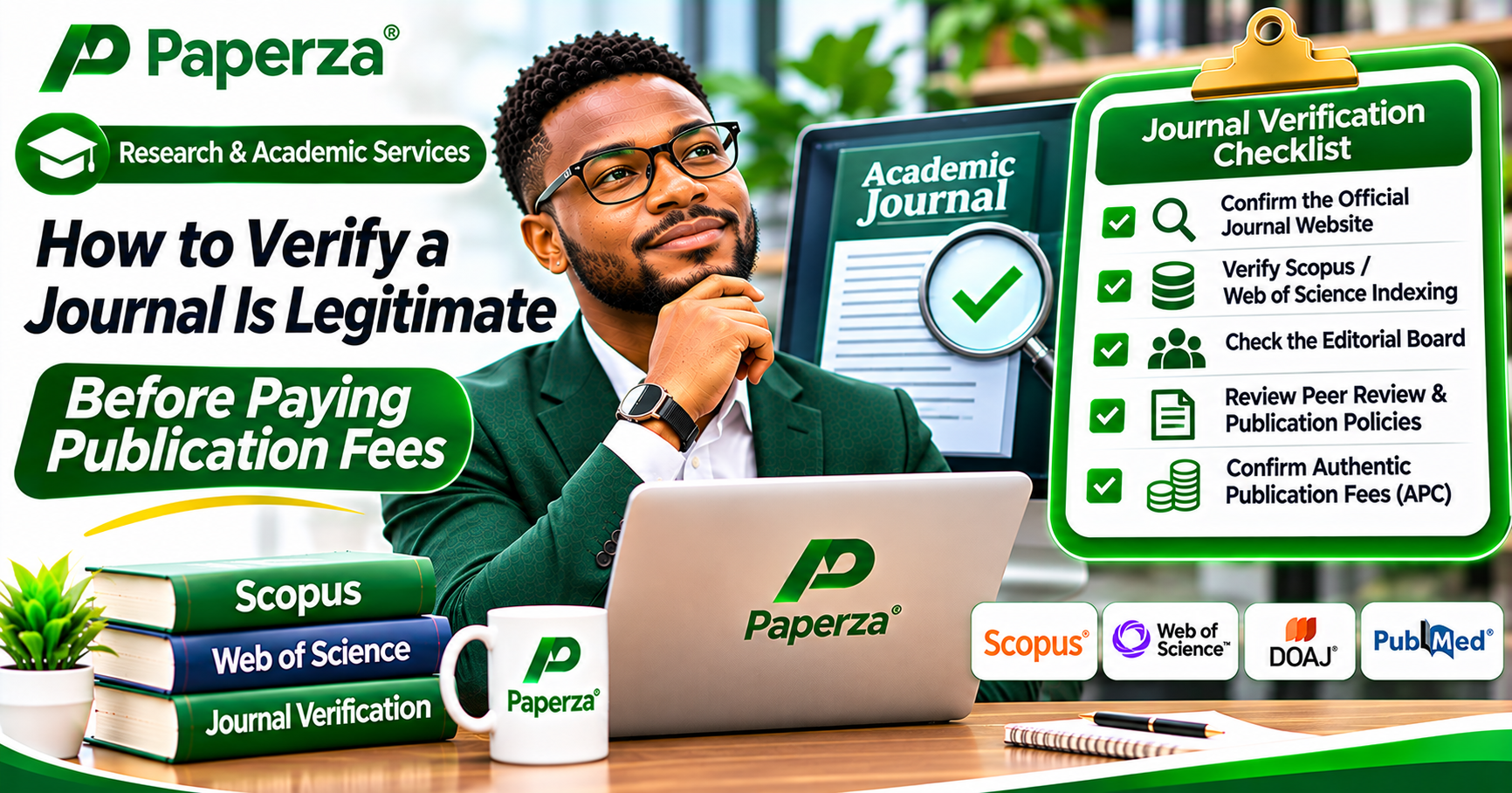
Complete Journal Verification Checklist Before Paying Publication Fees
Journal Identity
- Confirm the exact journal title.
- Verify the print or electronic ISSN.
- Identify the genuine publisher.
- Confirm the official journal website.
- Verify the submission portal.
- Check editorial contact information.
Indexing and Academic Recognition
- Verify Scopus indexing where required.
- Check current Scopus coverage status and years.
- Verify the exact Web of Science collection where required.
- Check applicable journal quartiles and metrics.
- Investigate open-access listings where relevant.
- Confirm institutional publication requirements.
Editorial Quality
- Review the journal's aims and scope.
- Investigate editorial board members.
- Examine the peer review process.
- Read several recently published articles.
- Review publication ethics policies.
- Verify copyright and licensing terms.
- Investigate article preservation arrangements.
Publication Fees and Payment
- Confirm all applicable publication fees.
- Check available institutional agreements and waivers.
- Distinguish freelancer service fees from journal charges.
- Verify the manuscript identification number.
- Confirm the authenticity of acceptance correspondence.
- Verify the official invoice and payment recipient.
- Retain payment receipts and editorial communications.
If you cannot verify important aspects of the journal's identity or payment arrangements, resolve those concerns before proceeding.
What Happens if You Publish in a Predatory Journal?
Publishing in a questionable journal may create several academic and professional difficulties.
Your university may refuse to recognise the publication for promotion or graduation purposes.
The article may not appear in the indexing databases originally advertised.
Your research may become difficult to retrieve if the publisher's website stops operating.
You may also encounter copyright or duplicate-publication issues when attempting to submit the same research to another journal.
For professionals using scholarly achievements as part of immigration, research funding, employment, or professional recognition applications, questionable publication records may receive limited weight or raise credibility concerns.
Researchers should prioritise authentic scholarly achievements rather than accumulating publications solely for numerical targets.
What to Do if You Have Already Paid a Suspicious Journal
If you suspect that you have paid a fraudulent publisher, preserve all correspondence, invoices, acceptance letters, and payment records.
Contact the genuine publisher if its identity appears to have been impersonated.
Notify your university research office, supervisor, academic librarian, or research integrity team where appropriate.
You may also contact your bank or payment provider to discuss available dispute or recovery options.
If the manuscript has already appeared online, obtain guidance about withdrawal, copyright, and duplicate-publication risks before submitting it elsewhere.
Do not assume that an unanswered withdrawal request automatically permits immediate submission to another journal.
How Paperza Can Help Researchers Prepare for Journal Publication
Selecting an appropriate journal requires consideration of research scope, indexing requirements, publication ethics, manuscript quality, and available funding.
Paperza provides access to freelance professionals offering research-related and manuscript preparation services.
Researchers can seek support with journal matching, academic language editing, manuscript formatting, reference organisation, research presentation, and submission preparation.
Scopus Manuscript Editing and Formatting
Explore Scopus Manuscript Editing Services on Paperza for professional proofreading, academic language improvement, and preparation according to journal requirements.
The listing also offers an optional journal matching report.
Research and Academic Support
Browse Research and Academic Services on Paperza to compare relevant freelancers and discuss your existing manuscript and publication objectives.
Before hiring, confirm the proposed journal's official identity, intended service deliverables, applicable fees, and the distinction between editorial assistance and independent publication decisions.
Authors remain responsible for the accuracy, originality, authorship, and ethical integrity of their research.
Frequently Asked Questions
How can I check if a journal is legitimate?
Verify its publisher, official website, ISSN, editorial board, indexing status, peer review procedures, publication ethics policies, and fee structure using independent sources.
Is every Scopus-indexed journal legitimate?
Scopus inclusion is a useful indicator, but researchers should still verify current coverage and assess the journal's publishing practices. Fraudulent websites may also impersonate genuinely indexed journals.
Can a journal be legitimate without Scopus indexing?
Yes. Many legitimate university, regional, specialist, and newly established journals are not indexed in Scopus.
Does Google Scholar indexing guarantee journal quality?
No. Google Scholar discoverability does not independently establish peer review quality or journal legitimacy.
Are journals that charge publication fees predatory?
No. Many reputable open-access journals charge APCs. The concern is deceptive publishing practices, not the existence of a legitimate publication fee.
Can I publish a research article without paying an APC?
Yes. Many journals offer publication without mandatory APCs, although other charges may apply depending on the journal's policies.
How do I check if a journal has been discontinued from Scopus?
Search the journal in the official Scopus Sources database and review its coverage status and coverage years.
Is an ISSN enough to prove journal legitimacy?
No. An ISSN identifies a serial publication but does not certify academic quality, peer review, or indexing.
Can a journal guarantee publication within seven days?
A guarantee of acceptance before meaningful editorial assessment is a warning sign. Legitimate journals may operate efficiently, but editorial decisions should depend on academic evaluation.
Should I pay publication fees before acceptance?
Follow the journal's verified official payment policy. Many open-access journals charge APCs after acceptance, while some legitimate journals have disclosed submission-stage fees.
How can I avoid fake acceptance letters?
Check the manuscript's status through the genuine submission portal and verify correspondence with the journal's independently confirmed editorial office.
Where can I find professional academic publication support?
Researchers can explore Research and Academic Services on Paperza for manuscript preparation and relevant publication assistance.
Conclusion
Verifying the legitimacy of an academic journal before paying publication fees is an essential part of responsible scholarly publishing.
Researchers should independently confirm indexing claims, publisher identity, editorial board credentials, peer review procedures, journal metrics, and payment arrangements.
Scopus indexing, Web of Science coverage, Google Scholar visibility, ISSNs, and DOIs should be understood according to what they actually establish.
None of these indicators, considered in isolation, guarantees that a particular publication offer is trustworthy.
A carefully selected publication can support academic development and contribute meaningfully to scholarly knowledge.
A poorly verified publication may result in financial losses, limited research visibility, and academic credibility concerns.
Before submitting your next research paper, take the time to verify the journal through reliable independent sources.
Need professional assistance preparing your manuscript for a reputable academic journal?
Explore Research and Academic Services on Paperza and find qualified professionals who can assist with legitimate journal selection, manuscript editing, formatting, and submission preparation.
Official Resources and Further Reading
- Think. Check. Submit. — Journal Verification Checklist
- Elsevier — Scopus Content Policy and Selection
- Clarivate — Web of Science Master Journal List
- Directory of Open Access Journals
- Committee on Publication Ethics
- ISSN International Portal
- National Library of Medicine — MEDLINE Frequently Asked Questions
- University of Leeds — How to Evaluate Journals
CONNECT WITH PAPERZA
Follow our official pages for daily publishing guides, expert advice & updates:


I will write and format research papers for Scopus indexed journals
Are you looking for professional research paper support for Scopus-indexed Q1, Q2, Q3, or Q4 journals? I provide high-quality academic research assistance to help researchers and...
View Related Service >NEED PROFESSIONAL ASSISTANCE?
I will write and format research papers for Scopus indexed journals
Are you looking for professional research paper support for Scopus-indexed Q1, Q2, Q3, or Q4 journals? I provide high-quality academic...
OFFICIAL SOCIAL CHANNELS
Stay connected with Paperza across our verified social profiles: