O-1 Visa Expert Letters: How to Present Credible Professional Achievements
By Paperza Editorial Team
|
3 Nov 2026
|
19 min read
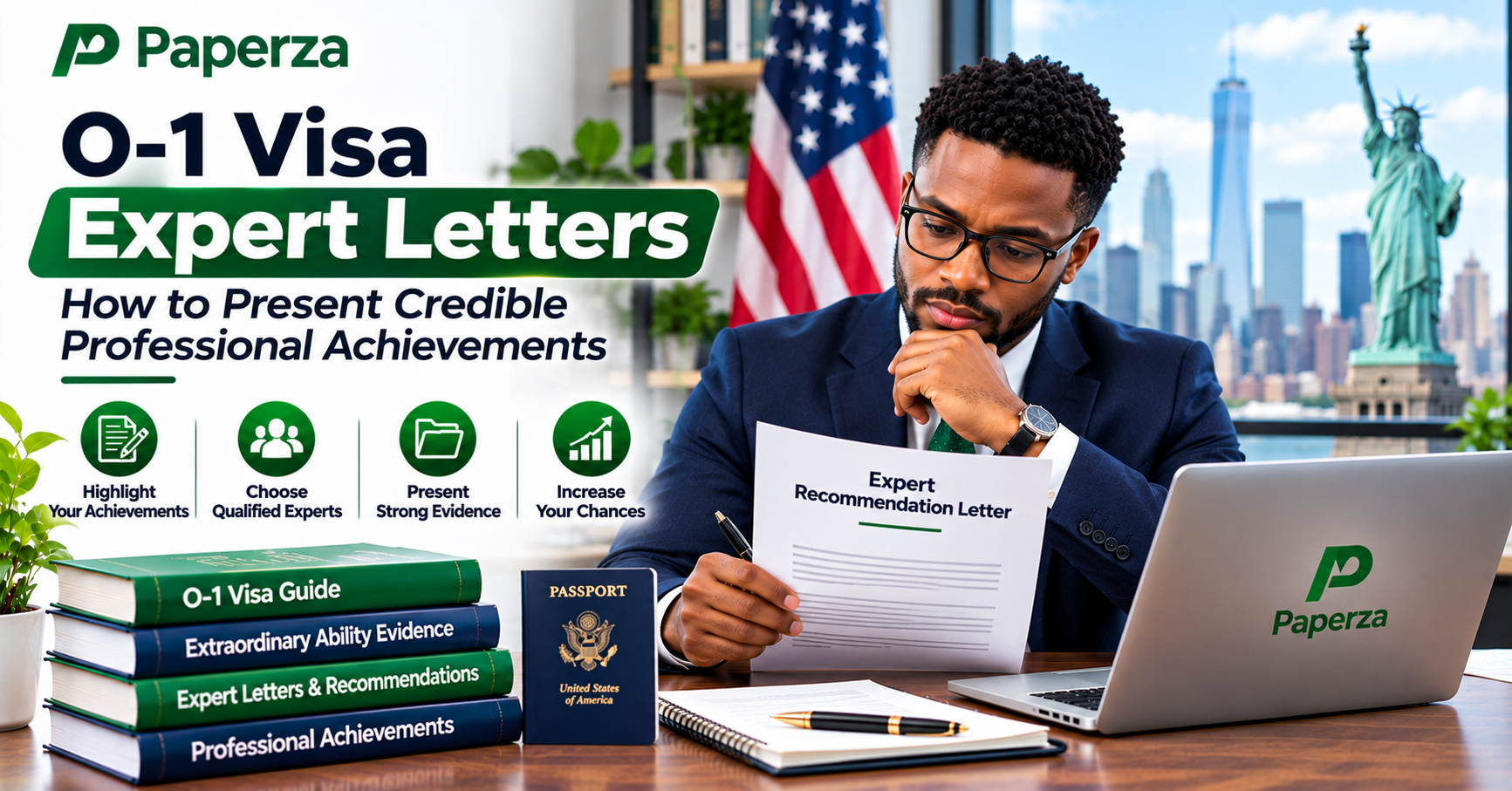
The O-1 visa offers a U.S. temporary employment pathway for individuals with extraordinary ability or achievement in qualifying professional fields.
For scientists, researchers, software engineers, artificial intelligence specialists, entrepreneurs, business executives, and other accomplished professionals, presenting a credible record of professional recognition is essential when preparing an O-1 petition.
One way to explain the significance of professional achievements is through O-1 visa expert letters, sometimes called expert recommendation letters, professional opinion letters, or letters of support.
These letters can help U.S. Citizenship and Immigration Services (USCIS) understand an applicant's original contributions, technical expertise, leadership responsibilities, and professional recognition.
However, a recommendation letter does not establish extraordinary ability simply because it is written by a professor, executive, researcher, or recognized industry expert.
The most useful letters explain specific achievements, describe their significance, and connect those statements to independently verifiable evidence.
This guide explains how to prepare credible O-1 visa expert letters in 2026, select suitable recommenders, document professional impact, organize supporting evidence, and avoid common weaknesses.
If you need assistance organizing your professional achievements or reviewing immigration-related supporting documents, explore professional evidence and documentation support on Paperza.
What Is an O-1 Visa Expert Letter?
An O-1 expert letter is a written statement from a qualified professional who can explain an applicant's achievements, standing, contributions, or expertise in a relevant field.
Depending on the purpose, a letter may discuss:
- Original scientific or technological contributions.
- Recognized research achievements.
- Significant business innovations.
- Professional leadership and critical responsibilities.
- Industry adoption of an applicant's work.
- Independent recognition from professional communities.
- The significance of particular awards, publications, or projects.
Such letters may help explain evidence that would otherwise be difficult for a non-specialist adjudicator to evaluate.
For example, a respected cybersecurity researcher might explain how an applicant's original security framework influenced established technical practices.
An engineering executive might describe the applicant's documented role in developing an important system and explain its technical significance.
The writer should have genuine knowledge of the facts and sufficient qualifications to offer the relevant opinion.
O-1 Expert Recommendation Letters vs Advisory Opinion Letters
One of the most important distinctions in preparing an O-1 petition is understanding the difference between an ordinary expert recommendation and a formal consultation.
These documents are not interchangeable.
Expert Recommendation Letters
Expert recommendation letters generally support the applicant's extraordinary ability evidence.
They may explain specific achievements, research contributions, leadership roles, technical influence, or recognition.
There is no universal requirement that every O-1A applicant submit a particular number of ordinary expert recommendation letters.
Their usefulness depends on the individual petition.
Consultation or Advisory Opinion Letters
O-1 petitions generally require a written consultation or advisory opinion from an appropriate peer group, labor or management organization, or qualifying expert or experts, subject to applicable exceptions.
For O-1A cases, the consultation concerns the beneficiary's qualifications and the nature of the proposed U.S. work.
The requirements depend on the classification and circumstances.
Key Differences
| Feature | Expert recommendation letter | Formal O-1 advisory opinion |
| Main purpose | Explain achievements and professional recognition | Address the required consultation concerning the beneficiary and proposed work |
| Author | Qualified professional with relevant knowledge | Appropriate consulting organization, peer group, or qualifying expert |
| Universally mandatory | No fixed requirement for ordinary recommendations | Generally required unless an exception applies |
| Content | Achievement-specific factual assessment | Consultation content required by the applicable regulations |
| Effect on approval | Supporting evidence | Required procedural evidence where applicable; not binding on USCIS |
A positive advisory opinion does not guarantee petition approval, and a general recommendation letter does not automatically satisfy the consultation requirement.
Applicants should have the appropriate petitioning entity and authorized immigration representative determine which documents are required.
Why Expert Letters Matter in O-1A Petitions
The O-1A classification covers extraordinary ability in science, education, business, and athletics.
Applicants generally need evidence of a qualifying major internationally recognized award or at least three of the eight applicable regulatory evidentiary criteria, including comparable evidence where permitted.
USCIS also evaluates whether the evidence establishes the required extraordinary ability standard.
Expert letters can support this assessment by providing context about achievements that may not be immediately understandable from certificates, research publications, patents, or employment records.
Explaining Original Contributions
An expert may describe what is original about an applicant's research or innovation and why its influence matters.
Establishing Professional Recognition
An expert may explain how an applicant's achievements became recognized within a particular scientific, technical, or business community.
Describing Critical Responsibilities
A knowledgeable executive may provide evidence explaining why an applicant's role was critical or essential to a distinguished organization.
Clarifying Technical Impact
An expert may explain the importance of an engineering system, scientific methodology, software product, or commercial innovation.
A strong expert letter supports real achievements rather than replacing the need to establish them.
Step 1: Identify the Professional Achievements You Want to Document
Before selecting recommenders, determine which accomplishments require explanation.
A letter should have a clear evidentiary purpose.
Potential achievements include original research, patents, technology development, distinguished leadership, recognized awards, or significant professional contributions.
Example: Artificial Intelligence Researcher
An AI researcher may have developed a machine learning methodology that independent researchers subsequently adopted.
An expert letter could explain the technical novelty and documented influence of that methodology.
Example: Software Engineer
A software engineer may have created an important infrastructure automation system.
An expert could explain its original features, implementation, measurable outcomes, and broader significance.
Example: Business Professional
A business executive may have introduced a recognized operational innovation.
A knowledgeable industry professional could explain the applicant's individual role and how the innovation influenced relevant business practices.
Example: Academic Researcher
A researcher may have made an important contribution to an established research problem.
An expert could discuss the specific discovery, relevant publications, independent use, and significance to the field.
The objective is to identify accomplishments that can be substantiated rather than produce a general summary of the applicant's career.
Step 2: Select Credible Expert Recommenders
Choosing a recommender involves more than finding someone with a prestigious title.
The recommender should have appropriate expertise and a factual basis for assessing the applicant's work.
Relevant Professional Expertise
The writer should possess meaningful knowledge of the applicant's field or the particular achievement being discussed.
A professor specializing in artificial intelligence may be appropriate to assess a machine learning contribution.
An experienced technology executive may be well positioned to discuss the operational significance of a specific technical innovation.
Professional Reputation
Evidence of the recommender's qualifications may provide context for the opinion.
Depending on the circumstances, this could include:
- Academic positions.
- Professional experience.
- Relevant publications.
- Technical leadership.
- Recognized industry achievements.
- Professional affiliations.
These credentials should be genuine and verifiable.
Direct Knowledge of Achievements
A recommender who personally observed a project or independently used an applicant's research may provide particularly specific evidence.
Other knowledgeable experts may evaluate published work or documented technical contributions.
The letter should explain how the writer obtained the information used in their assessment.
Step 3: Understand Independent vs Professional-Relationship Letters
Both independent experts and individuals with direct professional relationships may provide useful evidence.
However, their perspectives differ.
Independent Expert Letters
An independent expert may have no employment or personal relationship with the applicant.
For example, a researcher might independently implement a published methodology and provide a letter explaining its usefulness and significance.
This can help document professional influence beyond the applicant's immediate circle.
Letters From Supervisors and Collaborators
A former supervisor, research collaborator, or executive may possess firsthand knowledge of the applicant's responsibilities and achievements.
Such individuals can explain:
- The applicant's actual role.
- Specific technical contributions.
- Important project outcomes.
- Organizational responsibilities.
- Verified performance improvements.
These letters may be especially relevant when documenting critical or essential roles.
Which Is More Important?
There is no universal rule that independent letters always outweigh letters from collaborators.
The usefulness of each letter depends on its credibility, relevance, specificity, and supporting evidence.
A combination of perspectives may help explain different aspects of a petition, but applicants should avoid unnecessary repetition.
Step 4: Establish the Expert's Credentials
The introduction of an expert letter should establish why the author is qualified to assess the applicant's achievements.
A suitable opening may identify the writer's professional position, organization, specialization, and relevant experience.
Example Opening
"I am [Expert's Name], serving as [Professional Position] at [Organization]. My professional work focuses on [Relevant Specialization], and I have experience in [Specific Relevant Area].
I am familiar with [Applicant's Name]'s work through [Truthful Explanation of Relationship or Independent Professional Knowledge]."
The statement should be factual and supported by genuine credentials.
Do not invent titles, organizational affiliations, academic degrees, or professional relationships.
Step 5: Describe Specific Professional Achievements
An expert letter should identify the applicant's actual accomplishments.
Avoid relying on general descriptions such as:
"The applicant is an outstanding engineer and one of the world's best professionals."
Without factual explanation, this wording offers limited insight into the applicant's achievements.
A More Specific Approach
A stronger explanation might identify:
- The problem addressed by the applicant.
- The particular contribution made.
- The applicant's individual responsibilities.
- What distinguished the work from existing approaches.
- The documented results.
- Why those results matter in the relevant field.
Example
"During the development of [Project Name], [Applicant's Name] designed [Specific Technical Component], which addressed [Documented Problem]. The resulting system achieved [Verified Outcome] and was subsequently implemented by [Identified Organization or Group]."
This example is a writing framework.
An actual letter should contain only verified facts known to the recommender.
Step 6: Explain the Significance of Original Contributions
For O-1A applicants relying on original scientific, scholarly, or business-related contributions of major significance, a letter should help establish both originality and importance.
Originality
Explain what the applicant introduced or developed.
This may include a scientific discovery, technical framework, original methodology, business innovation, or other qualifying contribution.
Major Significance
Explain why the contribution matters beyond being new or technically sophisticated.
Potential evidence may include:
- Independent adoption of the innovation.
- Use in subsequent scientific research.
- Documented impact on professional practices.
- Commercial implementation.
- Meaningful influence on technical development.
- Significant recognition by qualified independent professionals.
A patent or published paper may provide evidence of original work, but it does not automatically establish major significance.
Connect the Letter to Supporting Documents
Where appropriate, expert observations should correspond to authentic records such as research papers, technical reports, patent documentation, adoption records, or project evaluations.
This allows the opinion to be examined alongside objective evidence.
For assistance organizing legitimate research accomplishments and supporting documents, explore academic profile and professional evidence support on Paperza.
Step 7: Use Expert Letters to Explain Critical or Essential Roles
O-1A applicants may submit evidence that they have been employed in a critical or essential capacity for organizations or establishments with distinguished reputations.
An expert letter from an appropriate executive or organizational leader may help explain the relevant facts.
What Should the Letter Address?
It should describe:
- The organization's activities and reputation.
- The applicant's position and responsibilities.
- The particular work performed.
- Why the role was critical or essential.
- Measurable or documented outcomes.
- The applicant's individual contribution.
Example
An engineering director might explain how an applicant's responsibility for a major systems migration was essential to maintaining a significant organization's infrastructure.
Supporting documentation might include project reports, organizational records, and verified results.
The letter should not assume that a senior title or employment at a well-known organization automatically satisfies the criterion.
Step 8: Present Research Publications, Citations, and Peer Review Experience Accurately
Academic researchers may use expert opinions to explain the significance of their scholarly achievements.
Research Publications
An expert may discuss a paper's contribution and its relevance to the discipline.
There is no universal minimum number of research publications for O-1A eligibility.
Research Citations
Citations may provide context about scholarly influence.
A letter may explain how independent research groups have used the applicant's findings or methods.
A large citation count alone does not establish extraordinary ability.
Peer Review Experience
Documented judging of other professionals' work may support a separate O-1A evidence criterion.
An expert could explain the technical nature of the activity where relevant.
However, a letter should not claim that the applicant completed reviews that were never performed.
Research Awards
An expert may explain the significance of an award by discussing its professional reputation, selection process, or competitive standards.
All statements should be supportable.
Step 9: Document Achievements for Technology and Business Professionals
Technology professionals may not have the same types of evidence as academic researchers.
For example, a cybersecurity specialist might have substantial technical achievements without publishing scholarly articles.
Relevant evidence may instead involve systems development, technology adoption, recognized innovations, distinguished organizational roles, or important business contributions.
Software Engineers
Expert letters may explain architecture decisions, engineering innovations, independently adopted code, and important technical outcomes.
Artificial Intelligence Professionals
Letters may discuss original algorithms, applied research, recognized technical contributions, or independently implemented models.
Entrepreneurs
Business experts may explain innovations, commercial adoption, distinguished leadership, or significant contributions to a relevant industry.
Business Executives
Appropriate letters may document critical responsibilities, exceptional remuneration, recognized business achievements, or qualifying original contributions.
The evidence should be evaluated under the actual O-1A criteria, including comparable evidence where appropriate.
A professional's seniority or length of employment alone does not establish extraordinary ability.
Step 10: Structure an O-1 Visa Expert Recommendation Letter
A useful letter can be organized into the following sections.
Section 1: Introduction and Expert Qualifications
Identify the recommender, professional role, and relevant expertise.
Section 2: Knowledge of the Applicant
Explain how the expert knows the applicant or became familiar with their work.
Section 3: Specific Achievements
Describe a small number of significant, verifiable accomplishments.
Section 4: Significance of the Contributions
Explain the technical, scientific, commercial, or professional importance of those accomplishments.
Section 5: Supporting Evidence
Connect the assessment to relevant publications, projects, adoption records, or other documents where appropriate.
Section 6: Professional Recognition
Explain any genuine recognition that can be supported by facts known to the expert.
Section 7: Conclusion
Summarize the professional assessment and include the recommender's appropriate contact details and authorization.
This is a suggested structure for a supporting letter, not a mandatory USCIS template.
A formal O-1 consultation or advisory opinion requires a different analysis and must meet its own regulatory requirements.
Sample O-1A Expert Letter Framework
The following example is intended for a genuine expert who has reviewed the underlying evidence and independently agrees with its contents.
Subject: Expert Assessment of [Applicant's Name]'s Professional Contributions
To Whom It May Concern,
I am [Recommender's Full Name], currently serving as [Professional Title] at [Organization].
My professional expertise focuses on [Relevant Field], and my experience includes [Verified Qualifications].
I am familiar with [Applicant's Name]'s professional work through [Actual Relationship or Basis of Knowledge].
One of the applicant's notable contributions is [Specific Verified Achievement]. This work addressed [Defined Problem] through [Brief Technical or Professional Explanation].
The significance of this contribution is demonstrated by [Documented Adoption, Independent Recognition, Research Influence, or Other Relevant Evidence].
In my professional assessment, the achievement is important because [Evidence-Based Explanation of Its Significance].
I have also reviewed [Identified Supporting Materials], which provide additional information concerning the applicant's role and the contribution's results.
Based on my knowledge of the relevant field and the evidence described above, I consider [Applicant's Name]'s work to represent [Carefully Supported Professional Assessment].
Sincerely,
[Recommender's Name]
[Professional Position]
[Organization]
[Professional Contact Details]
[Signature and Date]
How to Use This Framework Responsibly
The expert must write or genuinely review and approve the final assessment.
Do not invent a recommender, impersonate an expert, exaggerate accomplishments, or apply an unauthorized signature.
Avoid generic legal conclusions that are unsupported by professional analysis.
The most valuable content is the expert's credible explanation of actual achievements.
Step 11: Review the Letter Against Supporting Evidence
Before including an expert letter in a petition, verify the factual accuracy of important statements.
Confirm Professional Credentials
Check that the expert's name, position, organization, and relevant experience are correct.
Verify the Relationship
Ensure that the letter accurately explains how the writer knows the applicant or their work.
Check Project Descriptions
Confirm that project names, dates, responsibilities, and outcomes correspond to the documented record.
Review Research Claims
Verify the accuracy of publication details, citation discussions, and descriptions of technical influence.
Check Commercial Achievements
Ensure that claimed financial results, market adoption, revenue figures, or performance improvements have suitable supporting evidence.
Confirm Final Authorization
The identified expert should approve the final text and provide an authentic signature or other acceptable authorization.
Professional editing may improve clarity and formatting, but it should not change the expert's actual views.
Step 12: Avoid Common O-1 Expert Letter Mistakes
Generic Praise
Statements that an applicant is brilliant, hardworking, or exceptional are not substitutes for evidence of recognized achievements.
Identical Letters From Different Recommenders
Letters should reflect the individual expertise, knowledge, and perspective of each genuine author.
Unsupported Claims of Major Significance
Assertions that an invention transformed an entire field should be supported by meaningful evidence.
No Explanation of the Expert's Knowledge
The reader should understand how the recommender is qualified to evaluate the applicant's work.
Confusing Recommendation Letters With Advisory Opinions
An ordinary supporting letter does not automatically satisfy the separate consultation requirement.
Excessive Focus on Credentials
A recommender's impressive background does not substitute for a specific assessment of the applicant's achievements.
Fabricated Evidence
False expert identities, invented professional relationships, altered documents, manipulated metrics, or forged signatures can result in serious immigration consequences.
How Many Expert Letters Are Needed for an O-1 Visa?
There is no universal USCIS rule requiring every O-1A applicant to submit three, five, or ten ordinary expert recommendation letters.
The appropriate number depends on the evidentiary needs of the case.
For example, one well-supported letter from an independent expert who adopted the applicant's technology may explain a significant contribution more effectively than several general letters repeating the same claims.
Other letters may help document different achievements or professional relationships.
However, the formal O-1 consultation requirement must be assessed separately.
Rather than collecting letters to reach an arbitrary target, applicants should focus on relevance, accuracy, and independent corroboration.
O-1 Visa Expert Letter Editing and Documentation Support
Preparing an expert letter often involves several forms of legitimate professional assistance.
Language Editing
Improving grammar, readability, sentence clarity, and professional tone.
Structural Editing
Organizing achievements and supporting explanations logically.
Evidence Organization
Matching factual statements to appropriate supporting documents.
Professional Profile Review
Ensuring CVs, publication records, project histories, and other supporting materials accurately reflect real achievements.
Consistency Checking
Identifying contradictions between letters and other petition materials.
For assistance with professional documentation and related research records, explore immigration profile and evidence organization services on Paperza.
Legal eligibility assessment, petition strategy, and immigration representation should be handled by a qualified U.S. immigration attorney or another properly authorized representative.
Frequently Asked Questions About O-1 Visa Expert Letters
1. Are expert recommendation letters required for an O-1A visa?
There is no fixed requirement for a particular number of ordinary expert recommendation letters. However, a formal consultation or advisory opinion is generally required unless an applicable exception exists.
2. Who can write an O-1 visa expert letter?
A suitably qualified professional with genuine knowledge of the applicant's work or achievements may provide a supporting expert assessment.
3. Are independent expert letters stronger than employer letters?
They can provide different perspectives. Independent experts may explain broader field recognition, while employers or collaborators may provide firsthand evidence of critical responsibilities and project outcomes.
4. How many O-1A recommendation letters should I submit?
The appropriate number depends on the case. Focus on relevant, credible, nonrepetitive letters supported by authentic evidence rather than an arbitrary quantity.
5. Can an expert letter establish original contributions of major significance?
It may help explain the contribution, its originality, and its importance. However, generic praise or unsupported conclusions may carry limited evidentiary value.
6. Can I professionally edit an O-1 recommendation letter?
Yes. Legitimate language, structural, and formatting assistance may improve a genuine letter, provided the expert reviews and authorizes its final contents.
7. Can O-1 expert letters support an EB-1A application?
Some underlying professional evidence may also be relevant to an EB-1A petition, but the classifications have different requirements. Documents should be evaluated for their relevance to the specific immigration category.
8. Does an expert letter guarantee O-1 approval?
No. USCIS considers the complete petition, including the qualifying evidence, petitioning arrangement, required consultation, and applicable immigration requirements.
O-1 Expert Letter Preparation Checklist
Before finalizing a supporting letter, confirm that:
- The expert's identity and credentials are genuine.
- Their professional expertise is relevant.
- The basis of their knowledge is explained.
- Specific achievements are identified.
- The applicant's individual contributions are clear.
- Claims of professional significance are supported.
- Research or technical evidence is accurate.
- Dates, affiliations, and project details are consistent.
- The letter avoids exaggerated statements.
- The author has reviewed the final wording.
- The signature and contact details are authentic.
- The letter serves a clear evidentiary purpose.
- The separate O-1 consultation requirement has been assessed.
Conclusion: Use Credible Expert Letters to Explain Your Achievements
Expert letters can play an important supporting role in O-1 petitions by explaining the significance of professional achievements that may not be immediately apparent from other documents.
For researchers, these letters may discuss important scientific discoveries, research influence, and original methodologies.
For technology professionals, they may explain recognized innovations, engineering contributions, and technical adoption.
For business professionals and entrepreneurs, they may address significant commercial innovations, distinguished leadership, and measurable professional impact.
The most persuasive letters are not necessarily the longest or the most complimentary.
They are letters that identify specific achievements, explain why those achievements matter, and support their conclusions with reliable evidence.
Applicants should also understand that professional recommendation letters and formal O-1 advisory opinions serve different purposes.
A credible petition depends on authentic achievements, accurate supporting records, and compliance with all applicable immigration requirements.
Explore O-1 Professional Evidence Support on Paperza
Paperza connects clients with freelancers providing research, writing, professional profile, and documentation services.
If you need help organizing authentic achievements, improving supporting documents, or preparing materials for professional expert review, explore these listings:
UK and U.S. Immigration Profile Documentation Support
Research Profile and Professional Evidence Organization
Professional Immigration Documentation Preparation Support
Review each listing's actual description and the provider's qualifications before purchasing.
Professional editing and documentation support do not guarantee immigration approval or replace advice from a properly authorized immigration professional.
Present authentic professional achievements clearly and explore relevant documentation services on Paperza.
Official Sources and Further Reading
Disclaimer: This article provides general educational information and does not constitute individualized immigration legal advice. U.S. immigration requirements may change, and the appropriate evidence depends on the facts of each case. Consult official USCIS guidance and a qualified immigration attorney or other properly authorized representative before making case-specific decisions.
I will draft compelling personal statement for eb1a and uk global talent visa
Are you preparing an EB1A or UK Global Talent Visa application and need a compelling, professionally written personal statement? I provide personalized statement writing services...
View Related Service >NEED PROFESSIONAL ASSISTANCE?
I will draft compelling personal statement for eb1a and uk global talent visa
Are you preparing an EB1A or UK Global Talent Visa application and need a compelling, professionally written personal statement? I provide...