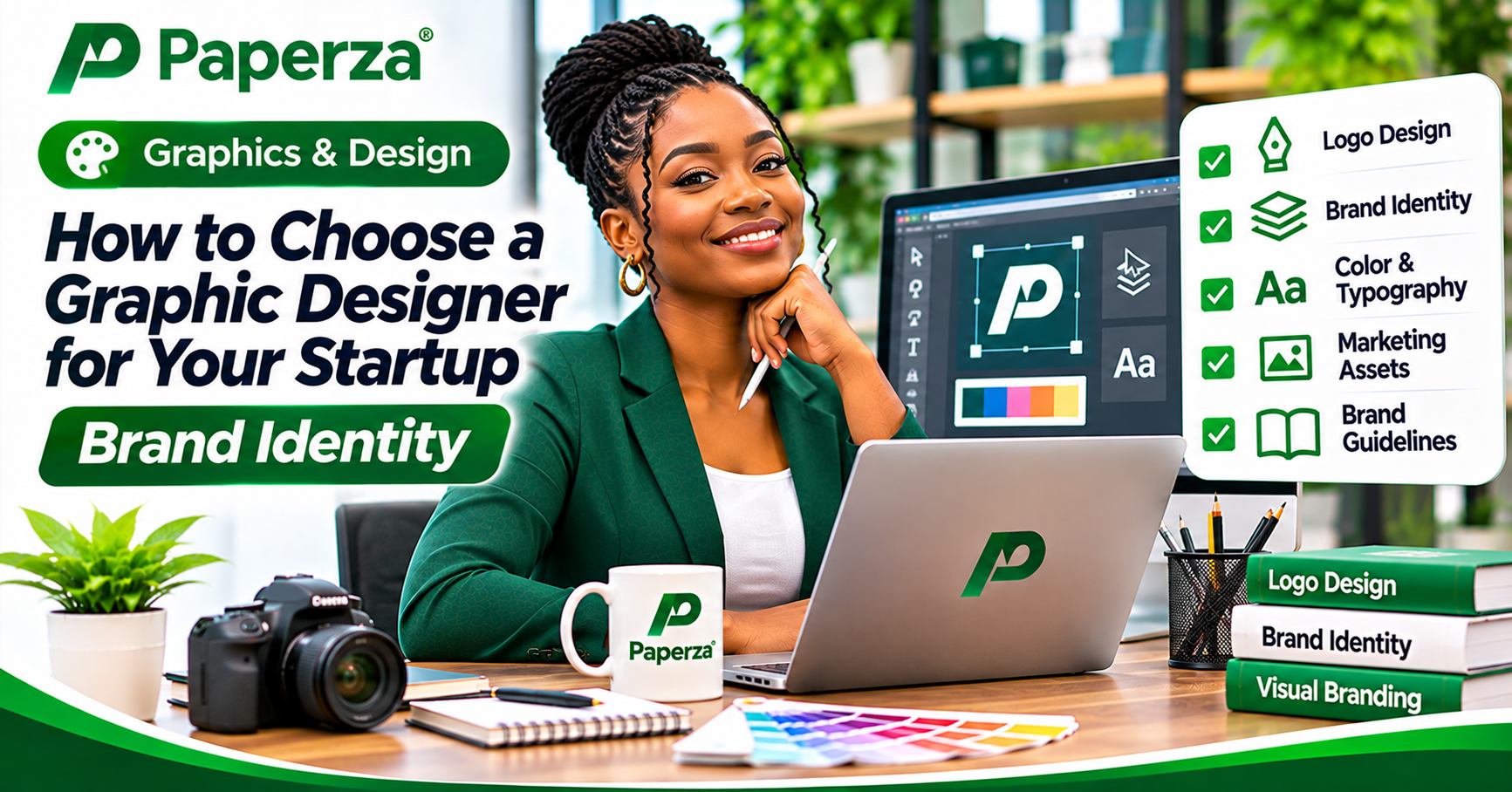
How to Choose a Graphic Designer for Your Startup Brand Identity
By Paperza Editorial Team
|
16 Nov 2026
|
16 min read
How to Choose a Graphic Designer for Your Startup Brand Identity
Building a successful startup requires more than developing an innovative product or offering a valuable service. Your business also needs a recognizable visual identity that communicates professionalism, credibility, and purpose.
From your logo and website to social media graphics and product packaging, your brand identity influences how potential customers perceive your business.
Choosing the right graphic designer can help you establish a consistent visual presence that differentiates your startup from competitors and supports long-term business growth.
This guide explains how to choose a graphic designer for your startup brand identity, what deliverables to expect, and how to find professional graphic design services on Paperza.
What Is Startup Brand Identity?
Brand identity refers to the collection of visual elements that represent a business and communicate its personality, values, and positioning.
A complete visual brand identity may include:
- Company logo and logo variations.
- Primary and secondary brand colors.
- Typography and font combinations.
- Brand imagery and photography style.
- Icons and graphic elements.
- Social media templates.
- Business cards and stationery.
- Product packaging.
- Brand guidelines.
These elements work together to create a consistent and recognizable appearance across different communication channels.
For startups, developing a strong brand identity early can help establish credibility and reduce the need for inconsistent design changes as the business grows.
Why Professional Brand Identity Matters for Startups
Establishes a Professional First Impression
Potential customers often encounter a startup through its website, social media profiles, advertisements, or product packaging.
A professionally designed visual identity can help communicate credibility and attention to detail.
Differentiates Your Business From Competitors
A distinctive visual identity helps customers recognize your business in a competitive marketplace.
Rather than copying popular brands, startups should develop a visual style that reflects their own products, values, and target audience.
Creates Consistency Across Marketing Channels
Consistent colors, typography, imagery, and graphic elements help maintain a recognizable appearance across websites, social media, advertisements, and printed materials.
Supports Customer Recognition
Repeated exposure to a consistent visual identity can help customers remember and recognize a business over time.
Provides a Foundation for Business Growth
A well-developed brand identity provides design standards that can guide future employees, marketing professionals, developers, and external creative teams.
Logo Design vs. Complete Brand Identity Design
Many startup founders assume that creating a logo is equivalent to developing a complete brand identity.
However, a logo represents only one component of a broader visual system.
| Design Element | Logo Design | Complete Brand Identity |
| Primary logo | Included | Included |
| Alternative logo variations | Sometimes included | Usually included |
| Brand color palette | Basic selection | Comprehensive color system |
| Typography | Limited | Defined typography system |
| Social media templates | Usually excluded | May be included |
| Business stationery | Usually excluded | May be included |
| Brand guidelines | Basic or excluded | Usually included |
| Visual consistency | Limited scope | Multiple business channels |
A startup that only needs an initial logo may benefit from a smaller design package.
However, businesses preparing for a professional launch may find a complete brand identity package more suitable.
1. Define Your Startup's Brand Strategy
Before hiring a graphic designer, clarify what your business represents.
A designer needs to understand your business objectives before developing an appropriate visual identity.
Consider the following questions:
- What products or services does your startup offer?
- Who is your target audience?
- What problems does your business solve?
- What makes your business different from competitors?
- What values should your brand communicate?
- How do you want customers to perceive your company?
For example, a financial technology startup may want to communicate security, reliability, and innovation.
A children's clothing brand may prefer a playful, warm, and approachable visual identity.
A luxury fashion business may require a sophisticated and minimalist design direction.
Clear brand positioning helps the designer create visual elements that serve your business objectives.
2. Identify Your Preferred Design Style
Graphic designers often specialize in different visual styles.
Understanding your preferences can help you identify professionals whose creative approach aligns with your startup.
Common brand identity styles include:
Minimalist: Clean layouts, simple typography, and restrained visual elements.
Modern corporate: Professional colors, structured layouts, and contemporary typography.
Luxury: Refined typography, elegant compositions, and sophisticated visual details.
Playful: Bright colors, expressive graphics, and approachable imagery.
Technology-focused: Contemporary visual systems designed around digital products and innovation.
Organic and natural: Earth-inspired colors, natural textures, and softer visual elements.
Your preferred style should reflect your audience and business positioning rather than simply following current design trends.
3. Review the Graphic Designer's Portfolio
A designer's portfolio is one of the most important resources for evaluating their capabilities.
Look for previous projects that demonstrate:
- Strong visual composition.
- Consistent brand identity systems.
- Professional typography.
- Effective color combinations.
- Original design concepts.
- Attention to detail.
- Adaptability across different applications.
- Relevant experience with startups or businesses.
Do not evaluate a portfolio solely based on attractive logo mockups.
Review how the designer applies a brand identity across websites, packaging, stationery, social media graphics, and other practical applications.
A strong portfolio demonstrates the ability to develop a coherent visual system rather than isolated graphics.
You can explore professional graphic designers on Paperza and compare portfolios based on your startup's requirements.
4. Look for Experience With Brand Identity Projects
Not every graphic designer specializes in brand identity development.
Some designers focus primarily on social media graphics, illustrations, presentation design, or promotional materials.
A brand identity designer should understand how individual design elements work together to represent a business consistently.
Relevant experience may include:
- Startup branding.
- Corporate identity development.
- Logo systems.
- Brand guidelines.
- Product packaging.
- Digital brand applications.
- Business rebranding.
A designer with relevant industry experience may understand your requirements more quickly. However, a strong design process and relevant portfolio can be equally valuable.
5. Evaluate the Designer's Creative Process
A professional brand identity project should follow a structured process.
Discovery
The designer gathers information about your business, target audience, competitors, objectives, and visual preferences.
Research
The designer evaluates relevant market positioning, existing visual identities, and potential opportunities for differentiation.
Concept Development
Initial visual concepts are developed based on the agreed creative direction.
Design Refinement
The selected concept is refined using constructive client feedback.
Brand System Development
The approved direction is extended into logo variations, color palettes, typography, and other agreed brand elements.
Final Delivery
The designer provides the completed assets, relevant source files, and brand guidelines according to the project agreement.
A clear creative process helps reduce misunderstandings and unnecessary revisions.
6. Confirm What the Brand Identity Package Includes
Before hiring a graphic designer, request a detailed description of the expected deliverables.
A comprehensive startup brand identity package may include the following:
| Deliverable | Purpose |
| Primary logo | Main visual representation of the business |
| Secondary logo | Alternative layout for different applications |
| Brand icon | Simplified symbol for apps and profile images |
| Color palette | Consistent brand colors |
| Typography system | Approved fonts and usage rules |
| Social media templates | Consistent digital marketing graphics |
| Business card design | Professional networking materials |
| Letterhead | Branded business correspondence |
| Brand patterns | Supporting visual elements |
| Brand guidelines | Instructions for consistent brand usage |
| Editable source files | Future design modifications |
Not every startup requires all these deliverables immediately.
Choose a package that supports your launch requirements and anticipated growth.
7. Request Professional Logo Variations
A single logo layout may not work effectively across every business application.
A professional logo system can include:
- Primary horizontal logo.
- Vertical or stacked logo.
- Standalone brand symbol.
- Black-and-white logo.
- Reversed logo for dark backgrounds.
- Simplified logo for small digital applications.
For example, a horizontal logo may work well on a website header, while a standalone symbol may be more suitable for a mobile application icon or social media profile.
Confirm that the designer will provide appropriate variations for your intended uses.
8. Understand the Importance of Brand Colors
Brand colors influence the visual personality of a business and help maintain consistency.
Different colors can communicate different impressions depending on cultural context, industry, and design execution.
| Color | Common Brand Associations |
| Green | Growth, sustainability, freshness |
| Blue | Reliability, professionalism, stability |
| Black | Sophistication, authority, elegance |
| Red | Energy, urgency, excitement |
| Purple | Creativity, imagination, luxury |
| Orange | Enthusiasm, friendliness, innovation |
| White | Simplicity, clarity, minimalism |
These associations are not universal rules.
Your designer should select colors based on your business positioning, audience, accessibility requirements, and practical applications.
A professional color palette should include relevant HEX, RGB, and CMYK values where applicable.
9. Choose a Consistent Typography System
Typography plays an important role in communicating your startup's personality.
A brand identity designer should recommend fonts that are readable, visually consistent, and appropriate for your business.
A typography system may define:
- Primary heading font.
- Secondary heading font.
- Body text font.
- Font weights.
- Text hierarchy.
- Recommended spacing.
- Usage across digital and printed materials.
Ensure that the selected fonts are properly licensed for your intended commercial applications.
Some fonts are freely available for commercial use, while others require separate licensing.
10. Ensure the Brand Identity Works Across Digital Platforms
Modern startups need visual identities that function effectively across multiple digital environments.
Your designer should consider how the brand will appear on:
- Business websites.
- Mobile applications.
- Instagram and Facebook.
- LinkedIn.
- YouTube.
- Email newsletters.
- Digital advertisements.
- Online marketplaces.
- Presentation slides.
A visually attractive logo may become difficult to recognize when displayed as a small profile picture or mobile application icon.
Testing brand elements at different sizes and on different backgrounds helps ensure practical usability.
11. Set a Realistic Brand Identity Design Budget
Graphic design costs vary depending on the designer's experience, project complexity, research requirements, and deliverables.
The following figures are illustrative budgeting examples in US dollars, rather than verified marketplace rates.
| Brand Identity Service | Illustrative Budget |
| Basic logo design | $50–$200 |
| Professional logo package | $200–$600 |
| Startup visual identity package | $300–$1,000 |
| Comprehensive brand identity system | $1,000–$3,000 |
| Advanced branding and strategy | $3,000–$10,000+ |
A basic package may provide a logo and limited visual assets.
A comprehensive package may include research, multiple concepts, typography, brand guidelines, social media templates, and additional business materials.
Actual quotations will depend on the designer and agreed project scope.
Startups can explore Graphics & Design services on Paperza to compare relevant services and request quotations.
12. Understand Design File Formats
Receiving the correct file formats is important for maintaining control over your brand assets.
| File Format | Common Use |
| SVG | Scalable logos and website graphics |
| AI | Editable Adobe Illustrator artwork |
| EPS | Vector artwork and professional printing |
| Brand guidelines and print-ready documents | |
| PNG | Transparent logos and digital graphics |
| JPG | Standard images and promotional materials |
| PSD | Editable Photoshop designs |
For logos, request scalable vector files rather than relying exclusively on JPG or PNG images.
Vector artwork can be resized without losing its original visual quality.
Confirm which editable source files are included in your package before placing an order.
13. Confirm Ownership and Commercial Usage Rights
Your startup's brand identity is an important business asset.
Before hiring a designer, clarify the ownership and licensing arrangements for the completed work.
Discuss:
- Ownership of the final approved logo.
- Commercial usage rights.
- Editable source file ownership.
- Font licensing.
- Stock image and illustration licensing.
- Restrictions on third-party design assets.
- Whether the designer can display the work in their portfolio.
Ask the designer to disclose any stock assets, templates, or AI-generated components used in the project.
If you intend to register your logo as a trademark, consider obtaining professional trademark advice and conducting appropriate clearance searches.
A graphic design project does not automatically establish trademark availability or registration rights.
14. Discuss Revisions and Project Timelines
Brand identity projects often require feedback and refinement.
Before starting, agree on the number of initial concepts, included revision rounds, delivery milestones, and expected completion date.
A straightforward logo project may take several working days, while a comprehensive brand identity project may require several weeks.
The timeline depends on the complexity of the project, the designer's availability, and how quickly the client provides feedback.
Provide consolidated and specific feedback rather than sending conflicting instructions throughout the project.
15. Request a Professional Brand Guidelines Document
Brand guidelines explain how your visual identity should be applied consistently.
A useful brand guidelines document may include:
Logo usage: Approved logo variations, minimum sizes, clear space, and prohibited modifications.
Color palette: Primary and secondary colors with relevant color codes.
Typography: Approved fonts, weights, and text hierarchy.
Imagery: Photography style and visual direction.
Graphic elements: Patterns, icons, illustrations, and supporting design assets.
Digital applications: Examples of the brand across websites and social media.
Print applications: Examples of stationery, packaging, and promotional materials.
Brand guidelines become particularly valuable when your startup begins working with multiple designers, marketing professionals, and development teams.
Example: Brand Identity for a Technology Startup
Consider a hypothetical startup developing a software platform for small businesses.
The company wants to communicate innovation, simplicity, and reliability.
A potential brand identity package could include:
| Brand Component | Proposed Direction |
| Logo | Clean, distinctive wordmark and symbol |
| Primary color | Emerald green |
| Secondary colors | White and dark charcoal |
| Typography | Modern, readable sans-serif fonts |
| Website graphics | Minimal and professional |
| Social media templates | Consistent educational and promotional layouts |
| Mobile application icon | Simplified brand symbol |
| Brand guidelines | Complete digital identity usage instructions |
This example demonstrates how a consistent visual system can support multiple business applications.
The final design should be developed around the startup's specific market positioning and customer requirements.
Startup Brand Identity Project Brief Template
Before contacting a graphic designer, prepare a project brief that explains your requirements.
Business name: Your startup's registered or proposed brand name.
Industry: Technology, healthcare, education, fashion, finance, or another relevant sector.
Business description: A short explanation of your products or services.
Target audience: Your intended customers and their characteristics.
Brand personality: Professional, innovative, elegant, approachable, playful, or another appropriate direction.
Preferred colors: Existing color preferences or colors to avoid.
Design style: Examples of visual identities you admire.
Required deliverables: Logo, brand colors, typography, social media templates, stationery, and brand guidelines.
File formats: SVG, PNG, PDF, and agreed editable source files.
Budget: Your available investment for the project.
Timeline: Your preferred launch date and project milestones.
A detailed brief helps designers understand your expectations and provide more accurate proposals.
Questions to Ask Before Hiring a Graphic Designer
Before selecting a freelancer, ask questions that establish their experience and working process.
- Can you share examples of complete brand identity projects?
- How do you research a startup's target audience and competitors?
- What deliverables are included in your package?
- How many initial concepts and revisions are provided?
- Will I receive editable vector source files?
- Are commercial usage rights included?
- Do you provide brand guidelines?
- What is your expected project timeline?
A professional designer should communicate clearly and explain their approach before development begins.
Common Mistakes Startups Make When Hiring Graphic Designers
Choosing Based Only on Price
A low-cost design package may not include the research, originality, file formats, or usage rights your startup requires.
Copying Competitor Branding
Imitating established brands can weaken differentiation and create potential intellectual property concerns.
Providing Unclear Instructions
Without a clear project brief, the designer may struggle to understand your business objectives.
Following Trends Without Considering Brand Strategy
Design trends change. Your visual identity should remain relevant to your business and customers.
Requesting Too Many Unrelated Design Concepts
An excessive number of unrelated concepts can make it difficult to establish a clear creative direction.
Ignoring Mobile and Digital Applications
Your brand identity should remain recognizable across different screen sizes and platforms.
Failing to Obtain Source Files
Without appropriate editable files, future design modifications may become unnecessarily difficult.
Neglecting Brand Guidelines
Inconsistent use of colors, typography, and logos can weaken your visual identity as your business grows.
Where to Hire a Graphic Designer for Your Startup
Finding the right graphic designer becomes easier when you can compare relevant services, portfolios, and project deliverables.
Paperza provides a freelance marketplace where businesses can explore creative and professional design services.
Through Paperza's Graphics & Design marketplace, startups can discover services relevant to:
- Logo design.
- Brand identity development.
- Social media graphics.
- Presentation design.
- Infographics.
- Book cover design.
- Other visual communication requirements.
Review available portfolios, communicate your business objectives, and confirm the complete project scope before hiring.
Choose a designer who understands your startup's positioning and can translate your business objectives into a consistent visual identity.
Frequently Asked Questions
How much does startup brand identity design cost?
The cost depends on the designer's experience, project complexity, and required deliverables. A basic logo package generally costs less than a comprehensive brand identity system.
What is the difference between a logo and a brand identity?
A logo is an individual visual symbol representing a business. Brand identity includes the broader system of colors, typography, imagery, graphic elements, and design guidelines.
How long does it take to develop a startup brand identity?
A basic logo project may take several days, while a comprehensive brand identity project may require several weeks. The timeline should be agreed with the designer.
Do startups need brand guidelines?
Brand guidelines are highly useful for maintaining consistency across websites, social media, advertisements, packaging, and other business materials.
Should I hire a freelancer or a branding agency?
Freelancers may offer greater flexibility and lower overhead costs, while agencies may provide broader strategic and creative resources. The best choice depends on your budget and project requirements.
What files should I receive from my graphic designer?
Request appropriate vector files, transparent PNG images, relevant PDF documents, and agreed editable source files. Confirm commercial usage rights and third-party licensing requirements.
Where can I hire a professional brand identity designer?
You can explore Graphics & Design services on Paperza to discover freelance designers and compare relevant creative services.
Conclusion
Choosing the right graphic designer is an important investment in your startup's visual identity.
A strong brand identity goes beyond an attractive logo. It creates a consistent visual system that communicates your business values, supports customer recognition, and provides a foundation for future growth.
Before hiring a designer, define your brand strategy, review relevant portfolios, establish a realistic budget, and confirm the expected deliverables.
Whether you are launching a technology startup, an e-commerce business, a professional services company, or a consumer brand, professional graphic design can help establish a distinctive and credible visual presence.
Ready to build a professional identity for your startup?
Explore Graphics & Design Services on Paperza and find creative professionals who can help bring your brand vision to life.
CONNECT WITH PAPERZA
Follow our official pages for daily publishing guides, expert advice & updates:


I will do grant writing, grant proposals, grant research, and grant applicati
Are you looking for funding opportunities or professional grant writing support? I provide grant writing, grant proposal development, grant research, and application assistance...
View Related Service >NEED PROFESSIONAL ASSISTANCE?
I will do grant writing, grant proposals, grant research, and grant applicati
Are you looking for funding opportunities or professional grant writing support? I provide grant writing, grant proposal development, grant...
OFFICIAL SOCIAL CHANNELS
Stay connected with Paperza across our verified social profiles: