How to Build a High-Converting Landing Page: Design, Copy and Testing
By Paperza Editorial Team
|
19 Nov 2026
|
22 min read
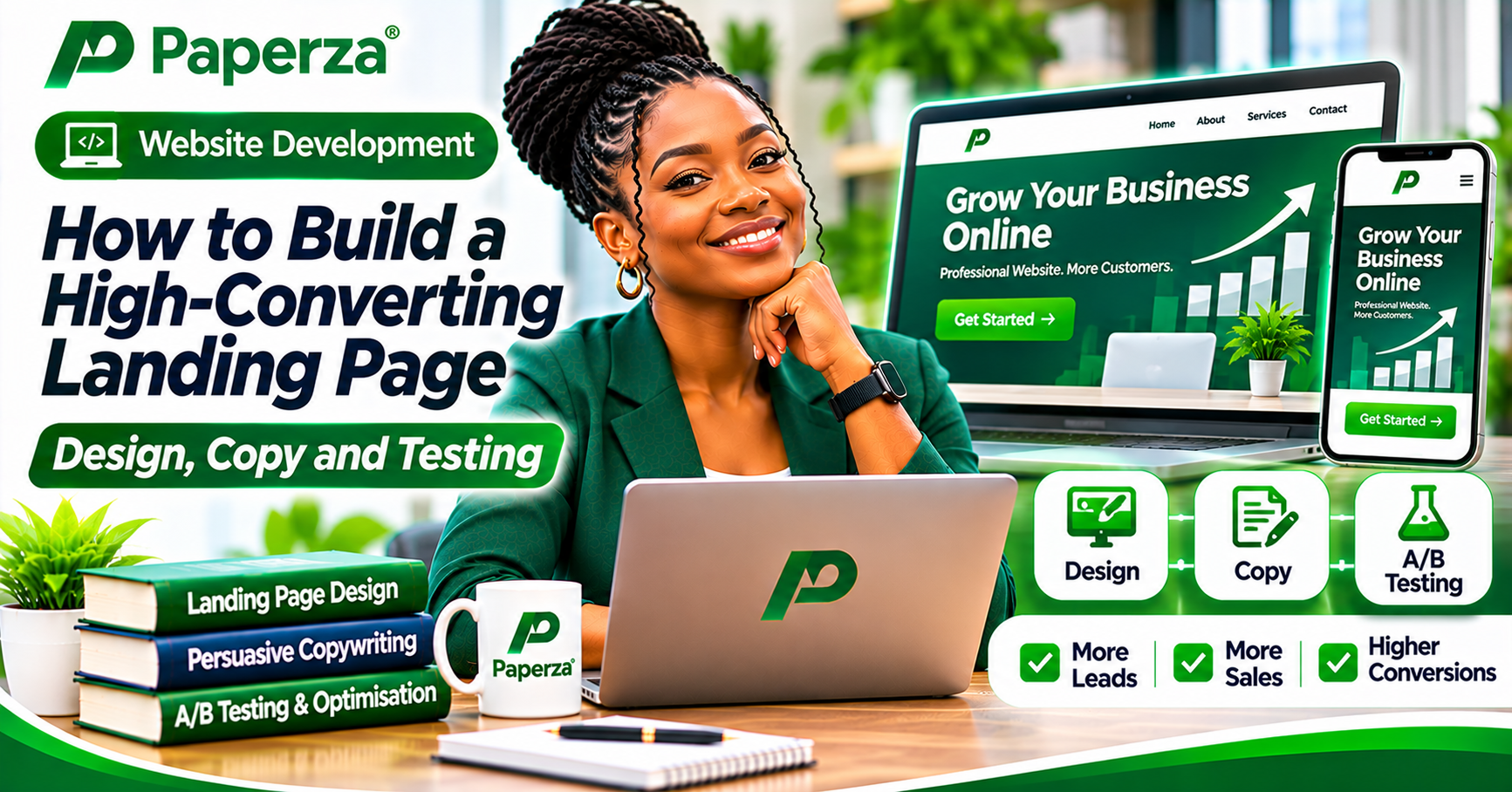
A professionally designed website can attract visitors, but attracting traffic is only one part of building a successful online business. The real challenge is converting those visitors into paying customers, qualified leads, subscribers, or registered users.
A high-converting landing page helps businesses achieve this objective by presenting a compelling offer, communicating clear benefits, establishing trust, and guiding visitors towards a specific action.
Whether you are launching a startup, promoting a digital product, advertising professional services, or running an e-commerce campaign, an effective landing page can improve the results of your marketing investment.
This guide explains how to build a high-converting landing page through strategic design, persuasive copywriting, performance optimisation, and continuous testing.
Businesses looking for professional development support can explore Website Development Services on Paperza.
What Is a Landing Page?
A landing page is a dedicated web page designed to encourage visitors to complete a specific action.
Unlike a general website homepage, which may introduce several products, services, and company information, a landing page typically focuses on one primary marketing objective.
Common landing page objectives include:
- Generating qualified sales leads.
- Encouraging product purchases.
- Collecting email subscriptions.
- Promoting software registrations.
- Booking consultations.
- Increasing mobile application downloads.
- Registering participants for events.
- Encouraging free trial subscriptions.
For example, a software company running Google Ads for its project management platform may direct visitors to a dedicated landing page that explains the software's benefits and encourages users to start a free trial.
What Makes a Landing Page High-Converting?
A high-converting landing page effectively communicates value and reduces the obstacles that prevent visitors from taking action.
Its effectiveness depends on several interconnected elements.
| Landing Page Element | Primary Purpose |
| Headline | Communicates the main value proposition |
| Supporting copy | Explains benefits and addresses concerns |
| Visual design | Establishes credibility and guides attention |
| Call to action | Encourages the desired visitor behaviour |
| Social proof | Builds confidence through genuine customer experiences |
| Page speed | Reduces unnecessary waiting |
| Mobile responsiveness | Supports visitors across different devices |
| Analytics | Measures visitor behaviour and conversions |
| Testing | Identifies opportunities for improvement |
A visually attractive landing page is not necessarily a high-converting page. Design must support the business objective rather than simply demonstrate creativity.
Landing Page vs. Homepage: What Is the Difference?
Although both are website pages, they serve different purposes.
| Feature | Landing Page | Homepage |
| Primary objective | One specific conversion goal | General business introduction |
| Navigation | Usually limited and focused | Broader website navigation |
| Content | Specific offer or campaign | Multiple products and services |
| Target audience | Defined visitor segment | General website visitors |
| Calls to action | One primary action | Several possible actions |
| Marketing application | Advertising and targeted campaigns | Overall brand presence |
Businesses often achieve better campaign relevance by creating dedicated landing pages instead of directing every advertisement to their homepage.
1. Define Your Landing Page Conversion Goal
Before designing your landing page, determine exactly what you want visitors to accomplish.
A landing page promoting a software platform may focus on free trial registrations, while a consulting business may prioritise consultation bookings.
An e-commerce business may focus on product purchases.
Examples of clear conversion goals include:
- Start a free trial.
- Request a quotation.
- Create an account.
- Purchase a product.
- Book a consultation.
- Download a resource.
- Register for a webinar.
Avoid combining several unrelated conversion goals on the same page.
A focused objective makes it easier to develop relevant messaging, design appropriate calls to action, and measure performance.
2. Understand Your Target Audience
An effective landing page should address the needs and expectations of its intended audience.
Before writing copy or designing the layout, identify:
- Who your potential customers are.
- What problems they are experiencing.
- What solutions they are searching for.
- What concerns may prevent them from purchasing.
- What benefits they consider most valuable.
- What information they need before making a decision.
For example, a small business searching for an affordable website developer may prioritise transparent pricing, professional portfolios, delivery timelines, and reliable communication.
A landing page targeting enterprise customers may instead emphasise technical expertise, scalability, security, and ongoing support.
Understanding these differences helps businesses create more relevant experiences.
3. Create a Strong Value Proposition
A value proposition explains why visitors should choose your product or service.
It should communicate the primary benefit, intended audience, and distinguishing characteristics of the offer.
Consider the following example.
Weak value proposition:
We provide professional digital solutions.
Stronger value proposition:
Launch a fast, mobile-friendly business website designed to turn visitors into customers.
The second example communicates a specific service and explains its potential business value.
An effective value proposition should be clear, relevant, credible, and easy to understand.
Avoid exaggerated claims or promises that your business cannot substantiate.
4. Write a Compelling Landing Page Headline
The headline is often the first message visitors notice when arriving on a landing page.
A strong headline should immediately communicate what the business offers and why it matters.
Examples of Effective Landing Page Headlines
For website development:
Build a Professional Website That Helps Your Business Grow.
For software products:
Manage Your Entire Business From One Simple Dashboard.
For digital marketing services:
Reach More Customers With Targeted Digital Marketing Campaigns.
For freelance marketplaces:
Find Skilled Freelancers for Your Next Business Project.
For online education:
Learn Practical Digital Skills at Your Own Pace.
The headline should match the expectations created by the advertisement, search result, or social media content that brought the visitor to the page.
5. Use Supporting Copy That Focuses on Benefits
Many businesses make the mistake of describing technical features without explaining why those features matter to customers.
Features describe what a product or service includes. Benefits explain how those features help the customer.
| Feature | Customer Benefit |
| Mobile-responsive website | Customers can browse comfortably on their phones |
| Automated email notifications | Reduce repetitive communication tasks |
| Secure payment integration | Customers can complete transactions with greater confidence |
| Search engine optimisation | Improve opportunities for organic discovery |
| Real-time reporting dashboard | Monitor business performance more easily |
| Custom website design | Present a consistent and professional brand identity |
Effective landing page copy should explain how the offer addresses the visitor's problem.
Use straightforward language, short paragraphs, descriptive headings, and specific examples.
6. Design a Clear Hero Section
The hero section is the main introductory area at the top of a landing page.
It should communicate the offer quickly and encourage visitors to explore or take action.
A well-designed hero section typically includes:
- A clear headline.
- A concise supporting description.
- A primary call-to-action button.
- A relevant product image or visual demonstration.
- An appropriate credibility indicator.
For example, a website development landing page could feature the following structure:
Headline: Build a Website That Works for Your Business.
Supporting text: Hire experienced freelance developers to create responsive, professional websites tailored to your business goals.
Call to action: Find a Website Developer.
Visual: A professional website displayed across desktop and mobile devices.
The hero section should avoid unnecessary animations, excessive text, and distracting visual elements.
7. Create a Strong Call to Action
A call to action, commonly called a CTA, tells visitors what they should do next.
Effective calls to action are specific, visible, and aligned with the landing page's primary objective.
Examples include:
- Get a Free Quote.
- Start Your Free Trial.
- Browse Website Developers.
- Book a Consultation.
- Create Your Account.
- Download the Guide.
- Shop Now.
- Request a Demo.
Generic phrases such as Click Here or Submit may provide less context about what happens next.
The CTA should use a visually distinctive design while remaining consistent with the business's branding.
For longer landing pages, repeating the same primary CTA at relevant points can help visitors take action when they are ready.
8. Build Trust Through Social Proof
Visitors may hesitate to purchase from a business they have never encountered before.
Social proof helps address this uncertainty by demonstrating genuine customer experiences and professional credibility.
Useful trust-building elements include:
- Verified customer reviews.
- Authentic testimonials.
- Completed project examples.
- Relevant case studies.
- Professional qualifications.
- Recognised business partnerships.
- Genuine client logos used with permission.
- Transparent refund and cancellation policies.
- Clear business contact information.
For example, a freelance website developer could display screenshots of completed projects alongside authentic client feedback.
Businesses should never use fabricated testimonials, misleading customer statistics, or unauthorised company logos.
Trust signals are most effective when they are credible and relevant to the customer's decision.
9. Display Your Product or Service Clearly
Visitors should understand what they will receive before committing to a purchase or enquiry.
For physical products, use accurate product photographs, demonstrations, and relevant specifications.
For software products, provide genuine interface screenshots, feature demonstrations, or short explanatory videos.
For professional services, explain deliverables, timelines, project requirements, and the service process.
A website development service landing page could explain whether the package includes responsive design, content management, payment integration, hosting configuration, revisions, and technical support.
Clear service descriptions reduce uncertainty and help customers make informed decisions.
10. Simplify Your Landing Page Forms
Long and complicated forms can create unnecessary friction.
Businesses should request only the information needed to complete the immediate conversion objective.
For example, a basic consultation enquiry form may require:
- Full name.
- Email address.
- Project description.
- Optional budget information.
Additional information can be collected later when necessary.
Forms should provide clear field labels, helpful validation messages, and confirmation after successful submission.
Where appropriate, explain how submitted information will be used and provide access to your privacy policy.
11. Make Your Landing Page Mobile-Friendly
Many customers discover businesses through mobile devices.
A landing page that performs well on desktop computers but poorly on smartphones may lose valuable conversion opportunities.
Mobile optimisation should include:
- Responsive layouts.
- Readable text.
- Appropriately sized buttons.
- Simple forms.
- Compressed images.
- Clear navigation.
- Stable page layouts.
- Accessible contact and payment options.
Test the page on actual smartphones rather than relying exclusively on desktop previews.
Google's advertising guidance also recommends mobile-friendly landing pages that closely match the content and objectives of the advertisements directing visitors to them.
12. Improve Landing Page Loading Speed
Page performance can influence how easily visitors interact with a website.
Slow-loading pages, delayed buttons, and unstable layouts may interrupt the customer journey.
Developers can improve performance by:
- Compressing and resizing images.
- Using modern image formats such as WebP.
- Reducing unnecessary JavaScript.
- Optimising font loading.
- Implementing appropriate caching.
- Using reliable hosting infrastructure.
- Removing unnecessary third-party scripts.
- Prioritising important above-the-fold content.
Google's Core Web Vitals provide useful performance targets.
| Metric | Recommended Good Performance |
| Largest Contentful Paint (LCP) | 2.5 seconds or less |
| Interaction to Next Paint (INP) | 200 milliseconds or less |
| Cumulative Layout Shift (CLS) | 0.1 or less |
These targets are evaluated at the 75th percentile of page visits, with mobile and desktop experiences assessed separately.
Businesses can use Google PageSpeed Insights to investigate website performance.
For professional implementation, explore Website Development Services on Paperza.
13. Use a Clean and Professional Visual Design
Landing page design should guide visitors towards important information.
Effective design does not require excessive animations, complex backgrounds, or numerous decorative elements.
Instead, focus on visual hierarchy, readability, consistent branding, and appropriate spacing.
Important design considerations include:
Typography
Use readable fonts and consistent heading sizes. Ensure visitors can distinguish headlines, supporting text, and calls to action.
Colour
Choose a consistent colour palette that reflects your brand and provides sufficient contrast.
White Space
Allow appropriate spacing between sections so visitors can understand information without feeling overwhelmed.
Visual Hierarchy
Give important messages and primary actions greater visual prominence.
Accessibility
Use descriptive image alternatives, keyboard-accessible controls, readable contrast, and properly labelled forms.
A clean design helps visitors concentrate on the offer rather than unnecessary visual distractions.
14. Address Customer Objections
Potential customers often have questions before making a purchase.
A landing page should anticipate these concerns and provide clear answers.
Common objections include:
- How much does the service cost?
- What is included in the package?
- How long will delivery take?
- Can I request revisions?
- Is my payment secure?
- What happens if I am dissatisfied?
- Can I contact customer support?
- Will the product work for my business?
Addressing relevant questions can reduce uncertainty and help visitors progress towards a decision.
A concise frequently asked questions section is particularly useful for services involving technical requirements or significant financial commitments.
15. Match Your Landing Page With Your Advertising Campaign
A landing page should fulfil the expectations established by the advertisement that brought visitors to it.
For example, if an advertisement promotes affordable Shopify store development, visitors should arrive on a page specifically explaining Shopify development services.
Directing them to a generic homepage covering unrelated services may create confusion.
Maintain consistency across:
- Advertising headlines.
- Product or service descriptions.
- Promotional offers.
- Pricing information.
- Visual branding.
- Calls to action.
- Target audience messaging.
This consistency helps visitors understand that they have arrived at the correct destination.
The Ideal High-Converting Landing Page Structure
Although landing page structures vary, the following layout provides a practical starting point.
| Section | Recommended Content |
| Hero section | Headline, value proposition and primary CTA |
| Problem statement | Customer challenges and needs |
| Solution overview | How the product or service addresses the problem |
| Key benefits | Specific customer advantages |
| Product demonstration | Screenshots, photographs or examples |
| Social proof | Authentic reviews and case studies |
| How it works | Simple explanation of the customer journey |
| Pricing or offer | Relevant costs and package information |
| FAQs | Answers to common objections |
| Final CTA | Clear invitation to take the desired action |
| Footer | Contact information and relevant legal policies |
Not every landing page needs every section.
A simple newsletter registration page may require only a headline, short description, and email form.
A complex software or professional services landing page may need additional information to support customer decisions.
Example: Landing Page for a Freelance Website Development Service
Consider a hypothetical freelance website development business targeting startups and small companies.
Its landing page could use the following copy.
Headline
Build a Professional Website That Helps Your Business Grow.
Supporting Description
Get a responsive, modern website tailored to your brand, customers, and business objectives.
Primary Call to Action
Get a Website Quote.
Key Benefits
- Professional and mobile-friendly design.
- Fast-loading website pages.
- Search-friendly website structure.
- Custom features for your business.
- Clear project communication.
How It Works
Share your requirements, agree on the project scope, review the website design, and receive the completed website according to the agreed deliverables.
Trust Section
Display authentic client reviews, completed website examples, and genuine professional credentials.
Final Call to Action
Ready to launch your business website? Request a quotation today.
This structure provides a clear offer, explains the customer journey, and addresses common concerns.
How to Calculate Your Landing Page Conversion Rate
Conversion rate measures the percentage of visitors who complete the desired action.
The basic formula is:
Conversion Rate = (Number of Conversions ÷ Number of Visitors) × 100
For example, suppose a landing page receives 2,000 visitors in one month and generates 100 purchases.
Conversion Rate = (100 ÷ 2,000) × 100
The landing page conversion rate is 5%.
Businesses should define whether their measurement uses unique users, sessions, or another consistent denominator.
They should also distinguish between different conversion actions, such as registrations, enquiries, and completed purchases.
What Is a Good Landing Page Conversion Rate?
There is no universal conversion rate that applies to every business.
Performance varies according to industry, traffic quality, product pricing, customer awareness, competition, and the complexity of the requested action.
A free newsletter registration may convert differently from a high-value consulting service or enterprise software purchase.
Instead of focusing exclusively on industry averages, businesses should measure their own baseline and work towards meaningful improvements.
The following hypothetical example demonstrates the potential effect of improving conversion rates.
| Monthly Visitors | Conversion Rate | Monthly Conversions |
| 5,000 | 1% | 50 |
| 5,000 | 2% | 100 |
| 5,000 | 3% | 150 |
| 5,000 | 5% | 250 |
| 5,000 | 8% | 400 |
These figures are mathematical illustrations rather than expected performance benchmarks.
Improving conversion rates can help businesses generate more results from existing traffic without necessarily increasing advertising expenditure.
How to Track Visitor Behaviour on a Landing Page
Businesses should implement analytics before launching a major advertising campaign.
Tracking only page visits may not explain why customers fail to complete purchases or registrations.
A useful analytics implementation can monitor the following events.
| Tracking Event | What It Reveals |
| Page view | Number of landing page visits |
| Traffic source | Where visitors discovered the business |
| Device category | Whether visitors use mobile or desktop devices |
| Scroll depth | How far visitors explore the page |
| CTA click | Interest in the primary offer |
| Form start | Initial intention to submit information |
| Form submission | Completed enquiry or registration |
| Checkout start | Purchase intention |
| Payment failure | Potential payment processing problems |
| Purchase completion | Successful customer conversion |
For example, a business may discover that visitors frequently click its purchase button but fail to complete checkout.
This could indicate unexpected charges, technical problems, limited payment options, or insufficient customer confidence.
Analytics can help identify where visitors abandon the process, although additional investigation may be necessary to establish why.
Understanding the Landing Page Conversion Funnel
A conversion funnel represents the stages visitors pass through before completing a desired action.
For an online service marketplace, the funnel may include:
Landing page visit → Service search → Service details viewed → Account registration → Checkout started → Payment completed.
Consider the following hypothetical results.
| Funnel Stage | Number of Users |
| Landing page visitors | 10,000 |
| Service searches | 4,000 |
| Service details viewed | 2,500 |
| Account registrations | 800 |
| Checkout starts | 300 |
| Completed payments | 120 |
The overall visitor-to-purchase conversion rate is 1.2%.
The checkout completion rate is 40%.
These measurements help businesses distinguish between problems occurring during service discovery, registration, checkout, and payment processing.
A business should not automatically assume that low sales are caused by poor landing page design when the actual issue may occur later in the customer journey.
How to Conduct A/B Testing on a Landing Page
A/B testing involves comparing two versions of a landing page or specific page element to determine which performs better against a predefined objective.
For example, a business could compare two headlines.
Version A: Hire Professional Website Developers.
Version B: Launch Your Business Website With Experienced Freelance Developers.
Visitors are randomly assigned to the two versions, and the business measures the resulting conversion rates.
Common elements to test include:
- Headlines.
- CTA button wording.
- Hero section images.
- Pricing presentation.
- Form length.
- Customer testimonials.
- Page structure.
- Product descriptions.
- Promotional offers.
Define the primary success metric before beginning the experiment.
Avoid ending tests prematurely simply because one version initially appears to perform better.
Example of Landing Page A/B Testing
Consider a hypothetical business testing two versions of a lead generation page.
| Metric | Version A | Version B |
| Visitors | 2,000 | 2,000 |
| Qualified leads | 80 | 110 |
| Conversion rate | 4% | 5.5% |
Version B generated a higher observed conversion rate.
The absolute improvement is 1.5 percentage points, while the relative improvement is 37.5%.
However, businesses should evaluate statistical uncertainty, sample size, experiment duration, and lead quality before concluding that one version consistently performs better.
Best Tools for Landing Page Development and Optimisation
Businesses can use different tools depending on their technical requirements.
| Tool | Primary Application |
| WordPress | Website and landing page development |
| Webflow | Visual website design and development |
| Framer | Responsive landing page creation |
| Shopify | E-commerce landing pages |
| Unbounce | Campaign-focused landing pages |
| Google Analytics | Visitor behaviour and conversion tracking |
| Google Tag Manager | Analytics tag management |
| Microsoft Clarity | Heatmaps and session recordings |
| Google PageSpeed Insights | Website performance analysis |
| Figma | Interface design and prototyping |
The appropriate tools depend on your budget, business model, technical infrastructure, and ongoing maintenance requirements.
Businesses using analytics and session-recording tools should implement appropriate privacy safeguards and consent mechanisms where required.
Sensitive information, passwords, and payment details should not be captured through behavioural tracking.
Landing Page SEO Best Practices
Although many landing pages are created for paid advertising campaigns, they can also support organic search visibility when designed appropriately.
Important SEO considerations include:
- Selecting a relevant primary keyword.
- Writing a descriptive page title.
- Creating an informative meta description.
- Using logical heading structures.
- Providing useful and original content.
- Optimising images and page performance.
- Maintaining mobile responsiveness.
- Including relevant internal links.
- Avoiding duplicate or thin content.
Not every advertising landing page needs to be indexed by search engines.
Businesses should determine whether the page is intended for organic discovery, paid advertising, or both.
How Much Does It Cost to Build a Landing Page?
Landing page development costs vary depending on design complexity, copywriting, integrations, analytics requirements, and freelancer experience.
The following figures are illustrative project budgeting ranges in US dollars.
| Landing Page Service | Illustrative Budget |
| Basic template-based landing page | $75–$250 |
| Professional custom landing page | $250–$800 |
| Landing page with copywriting | $400–$1,200 |
| E-commerce landing page | $500–$1,500 |
| Advanced SaaS landing page | $800–$3,000+ |
| Landing page with custom integrations | $1,000–$5,000+ |
These figures are not fixed market prices or verified Paperza service rates.
Additional expenses may include domain registration, hosting, software subscriptions, premium design assets, analytics tools, and ongoing optimisation.
Businesses can compare available professionals through Paperza's Website Development category.
Common Landing Page Mistakes to Avoid
Using Too Many Calls to Action
Multiple unrelated actions can distract visitors from the primary conversion objective.
Writing Generic Headlines
Visitors should immediately understand what the business offers and why it is relevant.
Hiding Important Pricing Information
Unexpected costs can create frustration and reduce customer confidence.
Ignoring Mobile Users
A poorly optimised mobile experience may prevent customers from completing important actions.
Using Excessive Pop-Ups
Unnecessary interruptions can make it difficult for visitors to understand the offer.
Displaying Fake Reviews
Fabricated testimonials and misleading claims can damage credibility.
Neglecting Checkout Testing
A strong landing page cannot compensate for a broken registration form or payment system.
Failing to Implement Analytics
Without reliable tracking, businesses may struggle to identify conversion problems.
Testing Too Many Changes Simultaneously
Changing numerous elements at once can make it difficult to understand which changes influenced performance.
Prioritising Appearance Over Functionality
A visually impressive page must still provide a clear and reliable customer journey.
How to Hire a Landing Page Developer
A professional landing page developer can help businesses create responsive, functional, and conversion-focused web pages.
Before hiring a freelancer, evaluate their experience in:
- Responsive website development.
- Landing page design.
- User experience and interface design.
- Website performance optimisation.
- Form and payment integration.
- Analytics implementation.
- Search engine optimisation.
- Accessibility.
- Technical testing and maintenance.
Review previous projects and discuss your specific conversion objectives before agreeing on the project scope.
A developer should understand not only how the landing page should look but also what it needs to accomplish.
Explore freelance website developers on Paperza to find professionals for your project.
Landing Page Development Project Brief
Before hiring a freelancer, prepare a detailed project brief.
Business name: Provide your company or brand name.
Business description: Explain your products, services, and target customers.
Landing page objective: Identify the primary conversion goal.
Traffic sources: Specify Google Ads, social media, organic search, email marketing, or other channels.
Target audience: Describe the customers you want to attract.
Design requirements: Provide brand colours, logo, typography, and preferred design style.
Required sections: Identify the hero section, benefits, pricing, testimonials, FAQs, and other content.
Technical requirements: Specify the preferred platform, hosting, forms, payment systems, and integrations.
Analytics requirements: Identify the conversion events and reporting tools required.
Deliverables: Request a responsive landing page, testing, documentation, and agreed technical support.
Budget and timeline: Specify the available investment and expected completion date.
A clear project brief helps freelancers understand your expectations and provide more accurate quotations.
High-Converting Landing Page Launch Checklist
Before publishing your landing page, confirm that:
- The headline clearly communicates the offer.
- The primary call to action is visible and functional.
- Product and service descriptions are accurate.
- Pricing information is transparent.
- Testimonials and trust indicators are authentic.
- The page works on mobile and desktop devices.
- Images and scripts are appropriately optimised.
- Contact forms submit successfully.
- Payment and checkout processes work correctly.
- Analytics and conversion tracking are configured.
- Privacy and legal information is accessible.
- Important accessibility requirements have been addressed.
- The page matches its advertising campaign.
- A process exists for monitoring and improving performance.
Completing these checks can help identify problems before visitors encounter them.
Frequently Asked Questions
What is a high-converting landing page?
A high-converting landing page is a dedicated web page that effectively encourages visitors to complete a defined action, such as purchasing a product, submitting an enquiry, or creating an account.
What is the most important element of a landing page?
A clear and relevant value proposition is fundamental. However, conversion performance also depends on design, trust, traffic quality, page speed, and the customer journey.
How long should a landing page be?
The appropriate length depends on the offer and customer decision process. Simple offers may require short pages, while expensive or complex services may require more detailed explanations.
Can I build a landing page without coding?
Yes. Platforms such as WordPress, Webflow, Framer, and Unbounce provide visual development tools. Custom functionality may require professional development.
How can I improve my landing page conversion rate?
Review visitor behaviour, improve messaging, simplify forms, optimise page performance, address customer concerns, and test meaningful design or copy changes.
Do landing pages need SEO?
Landing pages intended for organic search should follow relevant SEO practices. Pages created exclusively for paid advertising may have different indexing requirements.
How long does it take to build a professional landing page?
A straightforward landing page may take several days, while custom development involving advanced integrations and testing may require several weeks.
Where can I hire a professional landing page developer?
Businesses can explore Website Development Services on Paperza to find freelance professionals for custom landing page design and development.
Conclusion
Building a high-converting landing page requires more than attractive visual design.
Businesses must combine clear messaging, persuasive copywriting, professional design, reliable technical functionality, authentic trust signals, and continuous performance measurement.
The most effective landing pages understand their target audience, communicate a compelling offer, and provide a straightforward path towards the desired action.
By tracking visitor behaviour and testing improvements, businesses can identify conversion barriers and make informed decisions about their digital marketing strategies.
Whether you are launching a startup, promoting professional services, selling products, or developing a software platform, investing in a well-designed landing page can help you make better use of your existing website traffic.
Ready to build a professional landing page for your business?
Explore Website Development Services on Paperza and find freelance developers who can help transform your business requirements into a responsive, functional, and conversion-focused website.
Additional resources:
CONNECT WITH PAPERZA
Follow our official pages for daily publishing guides, expert advice & updates:


I will do grant writing, grant proposals, grant research, and grant applicati
Are you looking for funding opportunities or professional grant writing support? I provide grant writing, grant proposal development, grant research, and application assistance...
View Related Service >NEED PROFESSIONAL ASSISTANCE?
I will do grant writing, grant proposals, grant research, and grant applicati
Are you looking for funding opportunities or professional grant writing support? I provide grant writing, grant proposal development, grant...
OFFICIAL SOCIAL CHANNELS
Stay connected with Paperza across our verified social profiles: