How Much Does It Cost to Build a Mobile App in 2026?
By Paperza Editorial Team
|
22 Nov 2026
|
20 min read
Building a mobile application is one of the ways businesses can improve customer experiences, automate operations, and introduce new digital products.
From e-commerce applications and food delivery platforms to booking systems, fintech products, and freelance marketplaces, mobile apps have become important tools for businesses of different sizes.
However, before hiring a developer, most business owners want to answer one question:
How much does it cost to build a mobile app in 2026?
The answer depends on what you want the application to do.
A simple app displaying business information costs significantly less than a marketplace supporting customer accounts, payments, messaging, notifications, and multiple user roles.
The development approach also matters. Businesses can choose native Android or iOS development, cross-platform frameworks such as Flutter and React Native, or no-code tools such as FlutterFlow and Adalo.
According to Clutch's 2026 mobile app development pricing guide, many app development projects reviewed on its platform fall between $10,000 and $49,999. More complex applications can require considerably larger investments.
This guide explains mobile app development costs in 2026, the factors affecting pricing, the differences between development methods, and how to hire a suitable freelancer without overspending.
Businesses looking for professional support can explore Mobile App Development Services on Paperza.
How Much Does Mobile App Development Cost in 2026?
Mobile app development costs vary considerably depending on the project's complexity, features, development team, and technology.
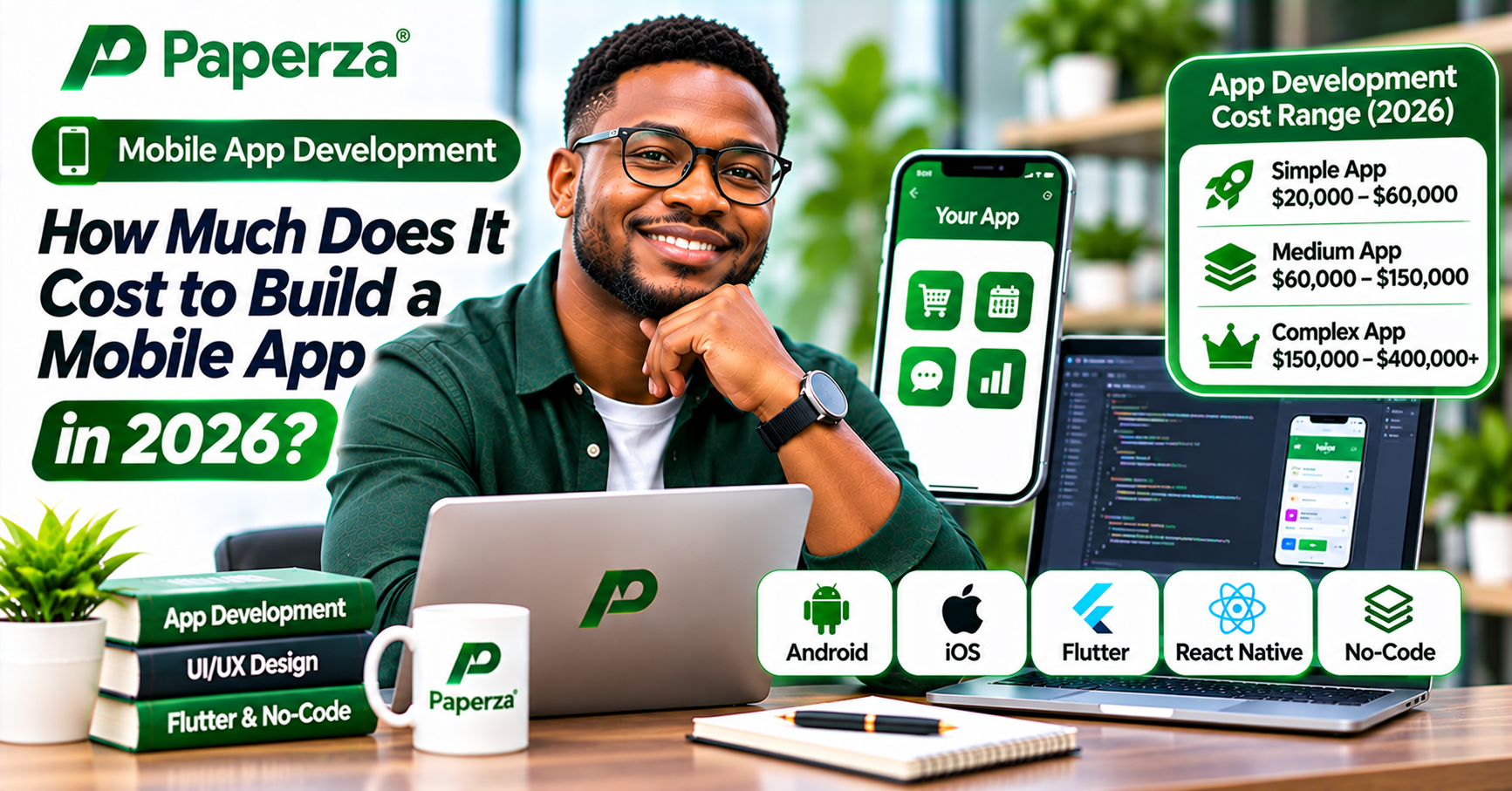
For planning purposes, the following table provides broad industry estimates for professionally developed applications.
| App Complexity | Estimated Development Cost | Typical Features |
| Simple mobile app | $20,000–$60,000 | Basic screens, content, simple functionality |
| Medium-complexity app | $60,000–$150,000 | User accounts, payments, integrations and administration |
| Complex mobile app | $150,000–$400,000+ | Real-time services, advanced workflows, extensive integrations |
| Enterprise application | $400,000+ | Large-scale systems, advanced security and complex infrastructure |
These ranges reflect published 2026 industry estimates, not fixed market prices or quotations from Paperza freelancers.
Smaller prototypes, individual app screens, bug fixes, and limited no-code projects may cost substantially less.
For example, Paperza currently features a FlutterFlow, Bubble and Adalo development service starting at $50 for a basic screen or limited bug-fixing task.
That $50 package is not the price of a complete production-ready mobile application.
The distinction between a small freelance deliverable and a complete app is essential when comparing development prices.
What Determines the Cost of Building a Mobile App?
Several factors influence the amount a business will spend on app development.
1. App Complexity
Simple applications generally require fewer screens, limited data processing, and straightforward navigation.
More advanced applications may require multiple user roles, payment processing, real-time messaging, complex databases, and extensive testing.
Each additional requirement increases development effort.
2. Number of Features
An app containing only registration, profiles, and basic content is less demanding than one supporting bookings, payments, live tracking, and customer support.
3. Development Platform
Building for Android, iOS, or both can affect the development process and total cost.
4. UI/UX Design
Custom illustrations, advanced animations, accessibility requirements, and complex navigation systems can increase design expenses.
5. Backend Infrastructure
Applications that store user information, process transactions, or synchronise data may require servers, databases, APIs, and administrative systems.
6. Developer Experience
Freelance developers, specialist agencies, and large development companies may charge different rates.
7. Security and Compliance
Financial, healthcare, and other sensitive applications may require additional security reviews, regulatory assessments, and testing.
8. Maintenance
Development costs do not end when an application launches. Updates, infrastructure, bug fixes, and ongoing support must also be considered.
Simple vs. Medium vs. Complex Mobile Apps
Understanding your application's complexity is one of the first steps towards establishing a realistic budget.
Simple Mobile Applications
A simple application may include a home screen, basic navigation, informational pages, and a contact form.
Examples include a company information app, basic event guide, or simple product catalogue.
Some applications in this category can be developed with no-code tools or limited freelance packages.
However, a professionally engineered, fully tested, custom-built app can still cost tens of thousands of dollars.
Medium-Complexity Applications
A medium-complexity app may include user registration, customer profiles, booking functionality, payment integration, push notifications, and an admin dashboard.
Examples include appointment-booking apps, subscription platforms, and small e-commerce applications.
These projects generally require more backend development, integration work, and quality assurance.
Complex Mobile Applications
Complex apps may support multiple user roles, live chat, location tracking, payment splitting, recommendation systems, real-time synchronisation, and large-scale data processing.
Examples include ride-hailing services, multi-vendor marketplaces, advanced fintech applications, and large delivery platforms.
These applications often require ongoing engineering and operational support beyond the initial launch.
How Much Does It Cost to Build an Android App?
Android app development costs depend primarily on features and complexity rather than the operating system alone.
A developer may use Kotlin or Java to build a native Android application.
Native Android development can be useful when the project requires close integration with Android-specific capabilities or a platform-specific user experience.
However, businesses targeting both Android and iOS may need to consider the cost of maintaining separate applications.
For a startup serving primarily Android users, an Android-first launch may be a practical way to test the product before expanding.
The final budget should include development, testing, publishing, and maintenance.
How Much Does It Cost to Build an iOS App?
Native iOS applications are commonly developed using Swift and Apple's development tools.
Like Android applications, iOS app costs depend on features, design, integrations, and technical complexity.
An iOS application requiring only basic functionality may be relatively straightforward, while an app involving subscriptions, financial transactions, and complex backend systems can be expensive.
Businesses should also consider Apple's developer membership requirements and App Store review process.
For many startups, the decision to build an iOS app first should depend on the intended customer base rather than assumptions about which platform is more prestigious.
Flutter vs. React Native vs. Native Development
Choosing the right development technology can influence both initial costs and long-term maintenance.
| Development Approach | Main Advantage | Potential Consideration |
| Flutter | Cross-platform development from a shared codebase | Some features may require platform-specific implementation |
| React Native | Cross-platform development using React-based technologies | Native modules and platform-specific work may still be necessary |
| Native Android | Direct access to Android platform capabilities | Separate iOS development may be needed |
| Native iOS | Direct access to Apple's platform capabilities | Separate Android development may be needed |
| FlutterFlow | Visual application development with Flutter-related tooling | Advanced features may require custom code or integrations |
| Adalo | Visual no-code app building | Platform capabilities and scaling needs must be assessed |
Cross-platform development can reduce duplicated work when the same application is required on Android and iOS.
However, using Flutter or React Native does not automatically make a project inexpensive.
The number of features, backend requirements, and quality expectations remain major cost drivers.
Can You Build a Mobile App Without Coding?
Yes. No-code and low-code development platforms allow users and freelancers to create applications through visual interfaces and configurable workflows.
Popular options include FlutterFlow, Adalo, and other app-building platforms.
These tools can be particularly useful for prototypes, minimum viable products, internal business applications, and certain customer-facing services.
Advantages of No-Code Development
No-code development may reduce the amount of custom programming required.
It can also make it easier to create prototypes, test business ideas, and update certain application components.
Limitations of No-Code Development
Complex integrations, specialised functionality, advanced performance requirements, and unusual workflows may require custom development.
Businesses should also examine platform subscriptions, export capabilities, hosting requirements, and long-term maintenance.
For a limited project, consider hiring a FlutterFlow or Adalo freelancer on Paperza.
How Much Does FlutterFlow App Development Cost?
FlutterFlow development costs depend on the number of screens, database requirements, integrations, and workflows.
Paperza currently lists the following packages for one no-code development service.
| Package | Listed Price | Included Scope |
| Basic | $50 | One basic screen or up to two minor bug fixes |
| Standard | $150 | Up to three screens and three core features |
| Premium | $350 | Up to five MVP screens, with specified integrations |
These are limited freelance service packages, not prices for complete applications of arbitrary complexity.
A production-ready app with authentication, payment processing, backend systems, extensive testing, and app store deployment may require a larger custom quotation.
The listed packages can be useful for buyers who want to start with a prototype, improve an existing app, or develop a small part of a larger project.
View FlutterFlow, Bubble and Adalo App Development on Paperza.
How Much Does Mobile App UI/UX Design Cost?
Before development begins, many projects require interface design.
UI refers to the visual elements of the application, while UX focuses on how users navigate and interact with the product.
A professional design process may include wireframes, user flows, visual screens, reusable components, and interactive prototypes.
Paperza features a mobile app UI/UX design service in Figma starting at $25 for one screen.
Another mobile app and website UI/UX design service starts at $50 for a basic design package.
These prices relate to limited design deliverables rather than complete application development.
For a full app, the design budget depends on the number of screens, user journeys, interaction complexity, and revision requirements.
Mobile App Development Cost by App Type
Different app categories require different features and infrastructure.
The following examples explain why some applications cost more than others.
| App Type | Common Requirements | Typical Complexity |
| Business information app | Company information, contact forms and content | Low |
| Booking app | Accounts, availability, reservations and notifications | Medium |
| E-commerce app | Product catalogue, checkout, orders and payments | Medium |
| Educational app | Lessons, progress tracking, accounts and subscriptions | Medium |
| Food delivery app | Customers, vendors, drivers and live order tracking | High |
| Marketplace app | Buyer/seller roles, payments, messaging and administration | High |
| Fintech app | Financial integrations, identity checks, security and transaction records | High |
| Social networking app | Profiles, messaging, feeds, moderation and notifications | High |
The same category can contain both relatively simple and extremely complex products.
For example, a basic online store app may use an existing e-commerce backend, while a multi-vendor marketplace requires additional seller management, order processing, commission calculations, and dispute handling.
How Much Does It Cost to Build an App Like Uber?
A ride-hailing application involves more than a customer booking screen.
It may require separate customer and driver interfaces, location services, route calculations, fare estimation, payments, trip tracking, notifications, and an administrative dashboard.
These features create significant technical and operational complexity.
A limited prototype demonstrating ride requests and driver matching is different from a production-ready transportation platform.
Businesses should request a custom estimate based on the exact features and expected scale.
How Much Does It Cost to Build an App Like Amazon?
An e-commerce app may require product listings, search, shopping carts, checkout, customer accounts, and order tracking.
A marketplace similar in business model to Amazon introduces additional requirements such as seller onboarding, inventory management, commissions, refunds, customer support, and potentially logistics integrations.
A startup does not need to reproduce every feature of an established marketplace.
A focused MVP can help validate demand before investing in a larger platform.
How Much Does It Cost to Build a Fintech App?
Fintech applications can be particularly demanding because they may handle sensitive customer information and financial transactions.
Depending on the product, development may involve payment integrations, identity verification, transaction histories, fraud controls, account security, and compliance requirements.
Security and regulatory obligations should be assessed before development.
A basic interface prototype should never be confused with a fully operational financial application.
For high-risk financial functionality, qualified technical and regulatory professionals should review the proposed architecture.
What Is an MVP, and Why Does It Matter?
MVP stands for minimum viable product.
An MVP is an initial product containing the essential functionality needed to test a business idea with real users.
Rather than building every planned feature immediately, a business starts with the most important user journey.
For example, a service-booking MVP might include customer registration, service listings, booking requests, and a basic management interface.
Advanced loyalty programmes, recommendation systems, and extensive automation can be considered later.
Benefits of Starting With an MVP
An MVP can help reduce initial development scope, validate customer demand, identify usability problems, and gather feedback.
However, an MVP should still meet appropriate standards for security, functionality, and reliability.
Removing unnecessary features should not mean neglecting essential safeguards.
Example: Mobile App Development Budget
Consider a hypothetical startup developing a cross-platform booking application.
The business requires customer registration, service listings, appointment booking, notifications, and an administrative interface.
A preliminary budget might look like this:
| Development Activity | Illustrative Budget |
| Requirements and planning | $2,000 |
| UI/UX design | $3,000 |
| Mobile app development | $12,000 |
| Backend and integrations | $7,000 |
| Testing and bug fixes | $3,000 |
| Deployment preparation | $1,000 |
| Contingency | $2,000 |
| Total | $30,000 |
This is a hypothetical planning example, not a market quotation or a published Paperza package.
A freelancer using existing tools and a narrowly defined scope may propose a different budget.
The purpose of the breakdown is to show that app development involves more than writing code.
How Much Do Mobile App Developers Charge Per Hour?
Clutch's 2026 pricing guide reports that app development companies commonly list hourly rates around $25–$49.
Rates vary according to location, experience, project type, and service provider.
For example, at a hypothetical rate of $40 per hour:
| Estimated Development Hours | Labour Cost |
| 100 hours | $4,000 |
| 250 hours | $10,000 |
| 500 hours | $20,000 |
| 1,000 hours | $40,000 |
| 2,000 hours | $80,000 |
These calculations illustrate the relationship between development effort and cost.
They do not include every expense associated with launching and operating an application.
A low hourly rate does not necessarily produce the lowest total project cost. Experience, productivity, testing quality, and communication also matter.
Freelancer vs. Agency vs. In-House Development
Businesses have several options when choosing who will build an application.
| Hiring Option | Advantages | Considerations |
| Freelance developer | Flexible engagement and potentially lower overhead | May have limited capacity for large projects |
| Development agency | Access to designers, developers and testers | Often higher project costs |
| In-house team | Direct control and ongoing availability | Recruitment and employment expenses |
| No-code specialist | Suitable for selected prototypes and smaller apps | Platform and technical limitations |
For startups, a freelancer may be suitable for a clearly defined MVP.
For larger applications, a team may be necessary to handle mobile development, backend engineering, design, quality assurance, and security.
Businesses can compare Mobile App Development Freelancers on Paperza before deciding on an engagement model.
What Additional Costs Should You Expect?
The initial development quotation may not include every expense.
App Store Fees
Apple currently lists its Developer Program at $99 per membership year.
Google Play lists a $25 one-time registration fee for a Play Console developer account.
Additional verification and publication requirements may apply.
Hosting and Databases
Applications that store information online may require cloud hosting, managed databases, and data storage.
Third-Party APIs
Maps, messaging, email delivery, identity verification, and other services may have usage-based charges.
Payment Processing
Apps that accept payments may incur transaction fees, and certain digital goods or subscriptions may be subject to platform-specific billing rules.
Maintenance
Ongoing work may include security updates, bug fixes, compatibility testing, and new features.
Marketing
Launching an app does not automatically attract users. Businesses may need to budget for advertising, content marketing, and customer acquisition.
How Much Does Mobile App Maintenance Cost?
Maintenance expenses depend on the application's complexity and how frequently it needs updates.
Some industry planning guides use approximately 15%–20% of the original development cost per year as an illustrative maintenance allowance.
For example:
| Initial Development Cost | Illustrative Annual Maintenance Budget |
| $10,000 | $1,500–$2,000 |
| $30,000 | $4,500–$6,000 |
| $50,000 | $7,500–$10,000 |
| $100,000 | $15,000–$20,000 |
These figures are budgeting assumptions rather than mandatory expenses.
Actual costs may be lower or higher depending on infrastructure, service-level commitments, security requirements, and product changes.
Maintenance should be discussed before signing a development agreement.
How Long Does It Take to Build a Mobile App?
Development timelines vary according to project complexity and team capacity.
| Project Type | Illustrative Timeline |
| Basic prototype | Several days to several weeks |
| Simple custom mobile app | 2–4 months |
| Medium-complexity app | 4–8 months |
| Complex mobile platform | 9–15 months or longer |
A small freelance package covering a few screens may have a much shorter delivery time.
For example, Paperza's verified FlutterFlow and Adalo service lists delivery periods of three to seven days across its packages, but those packages cover limited features rather than complete large-scale applications.
When discussing timelines, distinguish between a clickable prototype, a functional MVP, a production release, and subsequent maintenance.
How to Reduce Mobile App Development Costs
Businesses can control expenses without compromising essential quality.
Start With Essential Features
Prioritise the functionality required to deliver the application's main value.
Use a Cross-Platform Framework When Appropriate
Flutter or React Native may reduce duplicated development effort when supporting Android and iOS.
Consider No-Code Tools
No-code development can be useful for suitable prototypes and straightforward applications.
Prepare Clear Requirements
A detailed project brief helps developers estimate work accurately and reduces misunderstandings.
Design Before Developing
Wireframes and prototypes can identify usability issues before expensive development begins.
Use Established Services
Appropriate existing authentication, payment, analytics, and backend services may reduce custom engineering.
Avoid Unnecessary Integrations
Each external service introduces additional implementation and maintenance requirements.
Launch in Stages
Release essential functionality first, then expand based on real customer feedback.
Agree on Milestones
Milestone-based deliverables can make progress easier to review and help control project scope.
How to Hire a Mobile App Developer
Finding the right developer involves more than comparing prices.
Step 1: Define Your App Idea
Describe the problem the application solves and who will use it.
Step 2: List the Essential Features
Identify the main screens, user roles, integrations, and workflows.
Step 3: Choose the Development Approach
Discuss whether native, cross-platform, or no-code development is appropriate.
Step 4: Review Previous Projects
Ask for relevant portfolio examples and explanations of the developer's role.
Step 5: Confirm Technical Expertise
Evaluate experience with the intended framework, databases, APIs, testing, and security.
Step 6: Request a Detailed Quotation
A useful quotation should identify the scope, deliverables, timeline, revisions, and exclusions.
Step 7: Clarify Ownership
Agree in writing on ownership and access to source code, design files, hosting accounts, and app store accounts.
Step 8: Establish Testing Requirements
The application should be tested on relevant devices and operating system versions.
Step 9: Discuss Maintenance
Determine who will address defects and support future updates.
Step 10: Use Clear Payment Milestones
Link payments to agreed deliverables and acceptance criteria.
Questions to Ask Before Hiring an App Developer
Before placing an order, consider asking:
- Have you developed applications similar to my project?
- Can you share examples of your previous work?
- Do you recommend Flutter, React Native, native development, or no-code?
- What features are included in your quotation?
- Will I receive the editable source code and design files?
- Who will own the app store and hosting accounts?
- How will you test the application?
- Does the price include deployment assistance?
- How many revisions are included?
- What maintenance and post-launch support do you offer?
Clear answers can help prevent disagreements after development begins.
Example Mobile App Project Brief
Project title: Cross-Platform Mobile App Development for a Service Booking Business
Project overview: We need an Android and iOS application that allows customers to browse services, register accounts, and request appointments.
Target users: Customers and business administrators.
Required features: User registration, service listings, booking management, notifications, and a basic admin dashboard.
Preferred technology: Flutter or React Native, subject to developer recommendations.
Design requirements: Modern, accessible UI with clear navigation and consistent branding.
Integrations: Authentication, notifications, and a payment service if required.
Deliverables: Functional application, agreed source files, backend configuration, testing, and deployment documentation.
Timeline: To be agreed after scope review.
Budget: Please provide a detailed quotation separating development, third-party costs, and maintenance.
A project brief like this can help freelancers provide more meaningful proposals.
Common Mistakes That Increase App Development Costs
Starting Without Clear Requirements
Unclear expectations can cause repeated changes and additional development work.
Building Too Many Features Initially
An oversized first release can consume resources before customer demand has been validated.
Choosing Developers Based Only on Price
An inexpensive quotation may exclude important requirements such as testing, deployment, or backend functionality.
Ignoring UI/UX Design
Poor navigation and confusing screens can reduce usability and require costly redesigns.
Underestimating Backend Development
Authentication, data storage, payments, and integrations often require substantial work.
Failing to Test Properly
Insufficient testing can lead to defects, crashes, and negative user experiences.
Ignoring Security
Applications handling personal information or payments require appropriate safeguards.
Forgetting Maintenance Costs
A mobile app is an ongoing software product rather than a one-time design asset.
Not Securing Source Code Ownership
Businesses should confirm the agreed intellectual property and handover terms before development begins.
Assuming App Store Approval Is Guaranteed
Apple and Google independently review applications according to their applicable policies.
Where to Hire Mobile App Developers on Paperza
Paperza connects businesses with freelance professionals offering mobile app development, no-code application development, and UI/UX design.
Depending on your project, you can explore the following services.
No-Code and FlutterFlow App Development: Hire a freelancer for Bubble, Adalo, and FlutterFlow applications.
Mobile App UI/UX Design: Hire a Figma designer for mobile app screens and prototypes.
Mobile App and Website Interface Design: Explore professional UI/UX design services.
For larger projects, browse the Mobile App Development category on Paperza and discuss your requirements with suitable freelancers.
Compare the scope, portfolio, delivery time, and package terms before ordering.
Frequently Asked Questions
How much does it cost to build a mobile app in 2026?
Costs vary widely. Clutch reports that many reviewed projects fall between $10,000 and $49,999, while complex custom applications may cost substantially more. Small freelance tasks and prototypes can be less expensive.
Can I build a mobile app for $500?
A $500 budget may be sufficient for selected design tasks, prototypes, bug fixes, or narrowly scoped no-code work. It should not be assumed sufficient for a complete custom production application.
Is Flutter cheaper than native app development?
Flutter may reduce duplicated work when developing for Android and iOS, but the actual savings depend on the application's requirements and any platform-specific functionality.
How much does FlutterFlow development cost?
Paperza currently lists limited FlutterFlow, Bubble, and Adalo development packages from $50 to $350. Larger applications require a scope-based quotation.
How much does it cost to publish an app?
Google Play lists a $25 one-time developer registration fee, while Apple's Developer Program lists a $99 annual membership. Other development, compliance, hosting, and operational costs may apply.
How long does it take to develop a mobile app?
A small prototype may take days or weeks, while a professionally developed custom application can require several months. Complex platforms may take a year or longer.
Should I hire a freelancer or an agency?
Freelancers may be suitable for smaller, clearly defined projects. Agencies or multidisciplinary teams may be more appropriate for large applications requiring extensive design, backend development, testing, and security work.
Can one app work on both Android and iOS?
Yes. Cross-platform frameworks such as Flutter and React Native support developing applications for both platforms, although platform-specific implementation and testing may still be necessary.
Where can I hire a mobile app developer?
You can explore Mobile App Development Services on Paperza to find freelancers offering development, no-code solutions, and related design services.
Conclusion
The cost of building a mobile app in 2026 depends on the complexity of the product, the development approach, and the expertise required.
Simple applications and prototypes can be relatively affordable, particularly when using suitable no-code tools or limited freelance services.
More advanced applications involving payments, real-time communication, multiple user roles, and extensive backend systems require larger budgets.
For most startups, the most practical approach is to define the essential features, prepare a clear project brief, and request quotations based on realistic deliverables.
Starting with a focused MVP can help businesses test demand before investing in additional functionality.
Ready to build your mobile application?
Explore Mobile App Development Freelancers on Paperza and find professionals who can help turn your app idea into a functional digital product.
Sources and Further Reading
CONNECT WITH PAPERZA
Follow our official pages for daily publishing guides, expert advice & updates:


I will do grant writing, grant proposals, grant research, and grant applicati
Are you looking for funding opportunities or professional grant writing support? I provide grant writing, grant proposal development, grant research, and application assistance...
View Related Service >NEED PROFESSIONAL ASSISTANCE?
I will do grant writing, grant proposals, grant research, and grant applicati
Are you looking for funding opportunities or professional grant writing support? I provide grant writing, grant proposal development, grant...
OFFICIAL SOCIAL CHANNELS
Stay connected with Paperza across our verified social profiles: