Hire a Social Media Manager or Run Ads Yourself? Costs and Trade-Offs
By Paperza Editorial Team
|
21 Nov 2026
|
19 min read
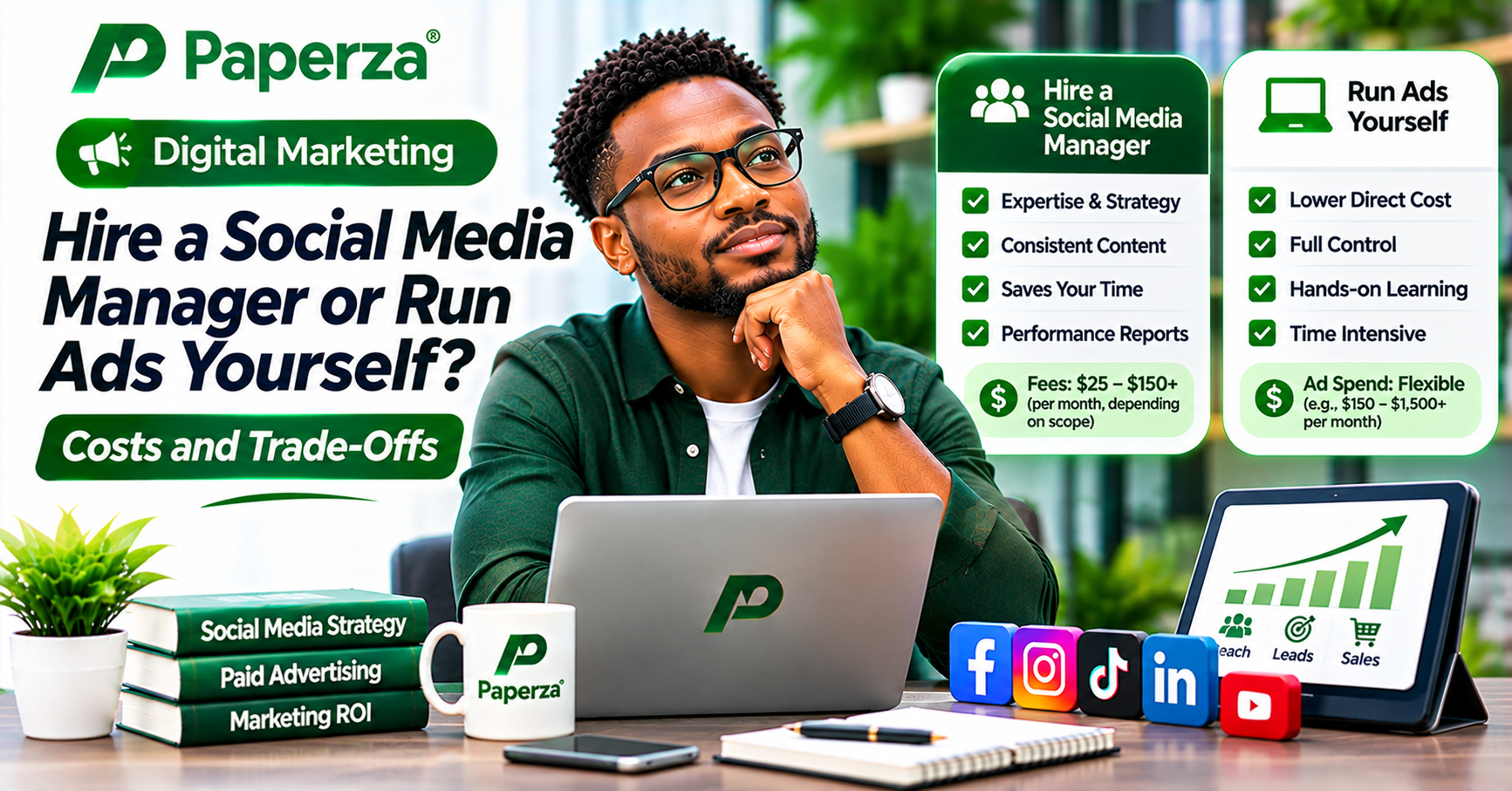
Social media marketing has become an important growth channel for startups, small businesses, online stores, and professional service providers. Platforms such as Facebook, Instagram, TikTok, LinkedIn, and YouTube allow businesses to connect with potential customers, promote their services, and build brand awareness.
However, many business owners face an important decision: Should you hire a social media manager or manage your advertising campaigns yourself?
Managing social media independently can reduce outsourcing expenses, but it requires time, marketing knowledge, and consistent effort. Hiring a professional can provide expertise and operational support, although it introduces additional costs.
There is also an important distinction between social media management and paid advertising. A social media manager may focus on organic content, while an advertising specialist manages paid campaigns.
This guide compares the costs, advantages, disadvantages, and practical considerations of managing social media yourself versus hiring a professional.
Businesses looking for marketing support can explore Digital Marketing Services on Paperza.
What Does a Social Media Manager Do?
A social media manager helps businesses maintain and develop their presence across social media platforms.
Depending on the agreed service package, responsibilities may include:
- Developing a social media content strategy.
- Creating monthly content calendars.
- Writing captions and promotional messages.
- Designing social media graphics.
- Scheduling and publishing posts.
- Monitoring comments and customer interactions.
- Researching relevant content topics.
- Analysing audience engagement.
- Preparing performance reports.
- Maintaining consistent brand messaging.
Some social media managers also offer paid advertising services, but this should not be assumed.
For example, a freelancer may manage Instagram and Facebook content without creating or optimising paid advertising campaigns.
Before hiring, confirm whether the service includes organic management, paid advertising, or both.
Businesses can compare available social media management services on Paperza.
What Does Running Social Media Ads Yourself Involve?
Running advertisements yourself means taking responsibility for planning, launching, monitoring, and optimising your paid campaigns.
This may involve using Meta Ads Manager for Facebook and Instagram, TikTok Ads Manager, LinkedIn Campaign Manager, or another advertising platform.
Typical responsibilities include:
- Identifying your target customers.
- Choosing campaign objectives.
- Preparing advertising graphics or videos.
- Writing advertisement copy.
- Configuring audience targeting.
- Setting advertising budgets.
- Creating and launching campaigns.
- Monitoring advertising performance.
- Testing different advertisements.
- Improving campaigns based on results.
Running advertisements yourself does not necessarily mean avoiding professional services entirely. You may still hire freelancers for graphics, video editing, or landing page development while managing campaign settings independently.
Social Media Management vs. Paid Advertising
Organic social media management and paid advertising serve different purposes.
| Feature | Organic Social Media Management | Paid Social Media Advertising |
| Main objective | Build an ongoing brand presence | Reach selected audiences through paid promotion |
| Typical activities | Content creation, scheduling and engagement | Campaign setup, targeting and optimisation |
| Distribution | Primarily organic | Paid advertising placements |
| Main costs | Content production and management | Advertising spend and management fees |
| Results | Often develop gradually | Campaigns can generate exposure after launch |
| Measurement | Reach, engagement and audience growth | Leads, conversions, acquisition costs and sales |
| Long-term value | Brand familiarity and community relationships | Scalable campaigns when economics are favourable |
Many businesses benefit from combining both approaches.
Organic content can help establish credibility, while paid advertising can introduce the business to potential customers who have not previously encountered the brand.
Option 1: Managing Social Media and Ads Yourself
Managing social media independently may be attractive to business owners with limited budgets or a strong understanding of their customers.
Advantages of DIY Social Media Marketing
Lower outsourcing expenses
You avoid paying a recurring management fee, although you still pay advertising costs and any necessary software subscriptions.
Direct control
You decide what to publish, how much to spend, and when to modify campaigns.
Better understanding of customers
Managing your own marketing can help you learn which messages, products, and offers attract attention.
Faster internal decisions
You can adjust campaigns without waiting for a freelancer or agency to respond.
Useful marketing experience
Learning campaign fundamentals can help you evaluate future marketing professionals more effectively.
Disadvantages of DIY Social Media Marketing
Significant time commitment
Content planning, creative production, campaign management, and performance analysis can consume several hours each week.
Learning curve
Advertising platforms include targeting options, bidding strategies, conversion tracking, and technical settings that require practice.
Risk of inefficient spending
Poor targeting, weak advertisements, or incorrect tracking can result in advertising expenditure without meaningful business results.
Inconsistent content production
Business owners may struggle to maintain a regular publishing schedule alongside their other responsibilities.
Limited optimisation expertise
Without sufficient experience, it can be difficult to identify why a campaign is underperforming.
DIY marketing is most practical when the business owner has enough time to learn, test, and monitor campaigns.
Option 2: Hiring a Social Media Manager
Hiring a professional allows a business owner to delegate some or all of the work involved in maintaining a social media presence.
Advantages of Hiring a Social Media Manager
Professional content planning
An experienced manager can develop content around business objectives, customer interests, and relevant campaigns.
Consistent publishing
A structured content calendar helps maintain a regular presence across selected platforms.
Better use of business owner time
Delegating routine marketing tasks allows the owner to focus on operations, customer relationships, and product development.
Creative support
Some packages include graphic design, caption writing, content ideas, and video coordination.
Performance reporting
A professional can help interpret engagement trends and recommend improvements.
Brand consistency
A dedicated manager can help maintain consistent messaging, tone, and visual identity.
Disadvantages of Hiring a Social Media Manager
Additional service costs
Professional management introduces an expense beyond advertising budgets and other marketing costs.
Variable service quality
Not every freelancer has experience with your industry, target audience, or preferred platforms.
Communication requirements
You may need to provide product information, approve content, and respond to questions.
Limited control over daily execution
Delegation requires clearly defined responsibilities and appropriate account permissions.
No guaranteed results
Even an experienced manager cannot guarantee followers, enquiries, or sales.
Hiring works best when the service scope, performance expectations, and reporting arrangements are clearly established.
How Much Does a Social Media Manager Cost?
Social media management prices depend on the number of platforms, publishing frequency, content requirements, community engagement, and reporting responsibilities.
Paperza currently features social media management services with different package structures.
| Paperza Service | Listed Starting Price | Example Scope |
| Social media content and engagement management | $25 | Five captions and five scheduled posts |
| Social media marketing and account management | $35 | Starter content planning, graphics and scheduling |
| Business social media content management | $50 | Basic account management and content creation |
These are starting service prices, not universal monthly rates. Package delivery periods and included services differ.
For example, a social media management service starting at $25 offers content planning, captions, and scheduling, with expanded packages available.
Another social media management service starting at $35 includes branded content creation and scheduling in its starter package.
Businesses should compare the exact deliverables before selecting a package.
Important: Organic social media management fees generally do not include paid advertising budgets unless explicitly stated.
How Much Does It Cost to Run Ads Yourself?
When managing advertisements yourself, your main direct expense is the amount paid to the advertising platform.
You may also incur expenses for graphics, video production, landing pages, tracking software, and other tools.
For planning purposes, consider the following hypothetical monthly advertising budgets.
| Daily Advertising Budget | Approximate 30-Day Spend |
| $5 | $150 |
| $10 | $300 |
| $20 | $600 |
| $30 | $900 |
| $50 | $1,500 |
These are simple budgeting calculations, not minimum spending requirements or estimates of campaign performance.
Actual platform billing depends on campaign settings, delivery, applicable taxes, and platform-specific budgeting rules.
A $300 advertising budget does not guarantee a particular number of clicks, leads, or purchases.
Hiring a Manager vs. Running Ads Yourself: Cost Comparison
Consider a hypothetical small business with a $500 monthly marketing budget.
Scenario A: DIY Advertising
| Expense | Monthly Cost |
| Paid advertising | $400 |
| Creative tools and assets | $50 |
| Other marketing software | $50 |
| Total direct expenditure | $500 |
The business owner manages the campaigns independently.
This example excludes the financial value of the owner's time.
Scenario B: Hiring a Freelancer
| Expense | Monthly Cost |
| Paid advertising | $300 |
| Freelance management | $150 |
| Creative assets or tools | $50 |
| Total direct expenditure | $500 |
In this example, the business allocates less money to advertising distribution but receives professional management support.
The $150 management fee is an illustrative planning assumption, not a quotation for a specific Paperza advertising package.
Neither scenario is automatically more profitable.
A professionally managed campaign may perform better if the specialist improves targeting, creative quality, and conversion tracking. However, results depend on the business, offer, competition, and campaign execution.
The Hidden Cost of Managing Social Media Yourself
One expense businesses frequently overlook is the value of the owner's time.
Suppose a business owner spends ten hours each week creating content, managing campaigns, and reviewing performance.
If the owner's time is valued at $20 per hour, the estimated monthly time cost over four weeks would be:
10 hours × 4 weeks × $20 = $800
This does not mean the business necessarily pays an additional $800 in cash.
It represents an opportunity-cost estimate: time that could potentially be spent on sales, customer service, product development, or other business activities.
When deciding whether to outsource, consider both direct expenses and the potential value of time saved.
When Should You Run Social Media Ads Yourself?
DIY advertising may be suitable when:
- Your business is newly established.
- You have a limited marketing budget.
- You are testing your first product or service.
- You have time to learn advertising fundamentals.
- Your campaigns are relatively simple.
- You understand your target audience.
- You can monitor results consistently.
For example, a small online store testing a new product may begin with a limited advertising budget and one or two carefully prepared advertisements.
The owner can use the initial campaign to learn about customer interest, advertising costs, and website performance.
However, a small budget does not remove the need for proper tracking and realistic expectations.
When Should You Hire a Social Media Manager?
Professional support may be more appropriate when:
- You manage several social media accounts.
- Your business requires frequent content.
- You struggle to maintain consistent publishing.
- You need professional graphics and copywriting.
- You receive many customer enquiries.
- You want structured performance reporting.
- Your business is expanding into new markets.
- Marketing tasks are taking too much time away from operations.
For example, a consulting company managing LinkedIn, Facebook, and Instagram may benefit from hiring a freelancer to plan and schedule content while its internal team handles customer enquiries.
The decision should depend on the work required rather than follower count alone.
When Should You Hire a Paid Ads Specialist Instead?
A social media manager is not always the right professional for a paid advertising problem.
If your primary objective is improving advertising performance, you may need a specialist experienced in campaign setup, audience targeting, conversion tracking, and optimisation.
A paid advertising specialist may help with:
- Advertising account configuration.
- Campaign structure.
- Audience and keyword research.
- Advertising creative strategy.
- Conversion tracking.
- Campaign testing.
- Budget allocation.
- Performance reporting.
For example, Paperza offers a Google Ads campaign setup and management service with a listed starter package of $50.
The advertising budget is paid separately to Google, and the service package determines the management activities included.
For Facebook and Instagram advertising, businesses can also browse Facebook & Instagram Ads services on Paperza.
Facebook Ads vs. Instagram Ads vs. Google Ads
Different advertising platforms serve different customer discovery behaviours.
| Platform | Common Business Applications |
| Facebook Ads | Local services, community-oriented businesses and product promotions |
| Instagram Ads | Visual brands, fashion, beauty, lifestyle and e-commerce |
| TikTok Ads | Short-form creative campaigns and product discovery |
| LinkedIn Ads | B2B services, professional audiences and business lead generation |
| Google Search Ads | Reaching people actively searching for products or services |
| YouTube Ads | Video-based product demonstrations and brand awareness |
These are common use cases rather than strict platform limitations.
A business should choose advertising platforms based on where its target customers are active and how they discover relevant products or services.
For example, a B2B technology consultant may prioritise LinkedIn and Google Search, while a fashion retailer may focus on Instagram and TikTok.
Organic Social Media vs. Paid Ads: Which Produces Better Results?
Organic social media and paid advertising support different stages of business growth.
Organic marketing can help businesses establish credibility, develop relationships, educate customers, and maintain a consistent brand presence.
Paid advertising can help businesses reach additional audiences and test specific offers.
A business with strong advertising but an inactive or unprofessional social media profile may struggle to establish customer confidence.
Similarly, a business publishing useful content regularly may still need paid promotion to reach new audiences more quickly.
A balanced approach may involve publishing consistent organic content while using paid campaigns for selected products, promotions, or customer acquisition objectives.
What Metrics Should You Track?
Whether you manage advertising yourself or hire a professional, performance should be evaluated using measurable business outcomes.
| Metric | What It Measures |
| Reach | Number of people exposed to content |
| Engagement rate | Audience interaction relative to a defined audience measure |
| Click-through rate | Percentage of impressions resulting in clicks |
| Cost per click | Advertising expenditure per click |
| Cost per lead | Advertising expenditure per recorded lead |
| Conversion rate | Percentage of relevant visitors completing an action |
| Customer acquisition cost | Cost of acquiring a new customer |
| Return on ad spend | Attributed revenue divided by advertising expenditure |
| Revenue | Sales generated during the reporting period |
A campaign generating thousands of impressions may still be ineffective if it fails to attract relevant customers.
Similarly, high engagement does not necessarily translate into profitable sales.
Choose performance indicators that correspond to the actual marketing objective.
How to Calculate Return on Ad Spend
Return on ad spend, or ROAS, measures the revenue attributed to advertising relative to advertising expenditure.
ROAS = Attributed Advertising Revenue ÷ Advertising Spend
For example:
| Measurement | Amount |
| Advertising spend | $500 |
| Revenue attributed to advertising | $2,000 |
| ROAS | 4.0× |
The campaign generated four dollars in attributed revenue for every dollar spent on advertising.
However, ROAS does not account for all business costs.
To evaluate profitability, businesses should also consider product costs, fulfilment expenses, management fees, payment processing, and other operating expenses.
How to Evaluate a Social Media Manager Before Hiring
Hiring a freelancer should involve more than comparing prices.
Review Relevant Experience
Look for experience with businesses, products, or audiences similar to yours.
Examine Previous Work
Request genuine examples of content calendars, social media graphics, campaigns, or performance reports.
Understand the Service Scope
Confirm how many posts, graphics, videos, and platforms are included.
Ask About Paid Advertising
Determine whether the freelancer manages organic content, paid campaigns, or both.
Clarify Reporting
Agree on which performance indicators will be tracked and how frequently reports will be delivered.
Discuss Content Approval
Establish whether you will review captions and graphics before publication.
Confirm Account Ownership
Your business should retain appropriate administrative control of its social media and advertising accounts.
Use official account access and permission features wherever possible rather than sharing passwords.
Avoid Unrealistic Guarantees
Be cautious of freelancers promising guaranteed sales, viral content, or a specific number of followers.
Questions to Ask Before Hiring a Social Media Manager
Before placing an order, consider asking:
- Which social media platforms do you manage?
- How many posts and graphics are included?
- Do you create short-form videos?
- Is paid advertising management included?
- Does the fee include advertising spend?
- Will you provide a content calendar?
- Can I approve content before publication?
- How will campaign performance be measured?
- What happens if I need revisions?
- Will I retain ownership and administrative access to my accounts?
Clear answers help prevent misunderstandings and ensure that the service matches your business requirements.
The Hybrid Approach: Manage Strategy and Outsource Execution
Businesses do not necessarily need to choose between managing everything internally and outsourcing all marketing activities.
A hybrid approach allows the business owner to retain strategic control while delegating specialised or repetitive tasks.
For example:
| Activity | Responsibility |
| Business objectives | Business owner |
| Product information | Business owner |
| Marketing strategy | Business owner and freelancer |
| Content calendar | Freelancer |
| Graphic design | Freelancer |
| Post scheduling | Freelancer |
| Advertising budget approval | Business owner |
| Campaign setup | Ads specialist |
| Performance reporting | Freelancer or specialist |
| Final business decisions | Business owner |
This approach can help businesses control costs while benefiting from professional support.
It is particularly useful for startups that need consistent marketing but cannot justify a full-time marketing employee.
Example: A Small Business Marketing Strategy
Consider a hypothetical startup offering website development services.
The business wants to build credibility, attract enquiries, and generate sales.
A practical marketing approach could involve:
Organic content: Publish educational posts about website design, business websites, online stores, and digital marketing.
Professional management: Hire a freelancer to prepare graphics, captions, and a publishing calendar.
Paid advertising: Run a limited campaign targeting potential customers searching for website development services.
Landing page: Direct advertising traffic to a clear service page with examples, pricing information, and an enquiry form.
Measurement: Track qualified enquiries, consultation bookings, advertising costs, and completed purchases.
The business can review the results and adjust its marketing investment based on actual performance.
For businesses developing video advertisements, Paperza's guide to AI Video Ads vs. Traditional Video Production explains additional creative production considerations.
Common Mistakes Businesses Make With Social Media Marketing
Hiring Based on Price Alone
A low-priced package may be appropriate for a small project but may not include the content volume or campaign management required.
Confusing Posting With Advertising
Publishing organic posts is different from creating and optimising paid campaigns.
Expecting Immediate Sales
Marketing results depend on the offer, audience, competition, creative quality, and customer journey.
Running Ads Without Conversion Tracking
Without reliable measurement, businesses may struggle to understand which campaigns generate meaningful results.
Changing Campaigns Too Frequently
Constantly modifying campaigns can make performance evaluation difficult.
Ignoring Landing Page Quality
Even effective advertisements may produce poor results if the website is slow, confusing, or difficult to use.
Paying for Artificial Engagement
Purchased followers, fake likes, and manipulated engagement metrics do not establish genuine customer demand.
Failing to Define Deliverables
A vague agreement can create disagreements about the number of posts, revisions, platforms, and reporting responsibilities.
Giving Away Account Ownership
Businesses should retain control of their advertising accounts, pages, billing arrangements, and customer data.
How to Start With a Small Marketing Budget
Businesses with limited resources should prioritise clarity and measurable results.
First, define one primary marketing objective, such as generating qualified enquiries.
Next, identify the platform most relevant to your customers.
Prepare a clear offer and a functional landing page.
Start with a manageable advertising budget and track results before increasing expenditure.
If content production becomes difficult to maintain, consider outsourcing specific tasks such as graphic design, caption writing, or scheduling.
Avoid committing to expensive long-term contracts before understanding the services and results your business needs.
Where to Hire Social Media Managers and Advertising Specialists
Paperza connects businesses with freelance professionals offering social media management, digital marketing, and advertising support.
Depending on your requirements, you can explore:
Social media content management: Hire a freelancer for content, engagement and growth.
Business social media management: Explore content creation and account management services.
Google Ads management: Hire a freelancer for campaign setup and optimisation.
Additional marketing services: Browse Digital Marketing on Paperza.
Before hiring, review the service description, available packages, delivery timelines, and additional charges.
Frequently Asked Questions
Is it better to hire a social media manager or manage social media yourself?
It depends on your budget, available time, marketing experience, and business objectives. DIY management may suit simple campaigns, while professional support can be valuable when content production or advertising becomes more complex.
How much does a social media manager cost?
Costs vary according to the service scope. Paperza currently features introductory social media management packages starting from $25, $35, and $50, with different deliverables and delivery periods.
Does a social media manager run Facebook and Instagram ads?
Some do, but many focus on organic content creation, scheduling, and engagement. Confirm whether paid advertising is included before hiring.
Can I run Facebook and Instagram ads without a manager?
Yes. Businesses can manage their own campaigns using Meta's advertising tools, provided they understand the relevant account settings, targeting, budgets, and platform policies.
Is the advertising budget included in a freelancer's fee?
Usually not unless the service explicitly states otherwise. Advertising spend and professional management fees should be treated as separate expenses.
Can hiring a social media manager guarantee more sales?
No. Professional management can support marketing activities, but results depend on multiple factors, including the offer, competition, audience, website, and campaign execution.
What should a small business outsource first?
Many businesses begin by outsourcing time-consuming tasks such as graphic design, content creation, and scheduling. Paid advertising management may become a priority when campaigns require specialised expertise.
Where can I hire a social media manager?
You can explore Digital Marketing Services on Paperza and compare freelancers based on their services, portfolios, pricing, and project requirements.
Conclusion
Choosing between hiring a social media manager and running advertisements yourself requires a clear understanding of your business goals, budget, and available resources.
Managing marketing independently provides direct control and may reduce outsourcing expenses, but it requires time, technical knowledge, and consistent monitoring.
Hiring a professional can help improve content consistency, reduce administrative workload, and provide access to specialised skills.
For many small businesses, a hybrid approach offers a practical balance: retain control over business strategy and advertising budgets while outsourcing selected marketing activities.
The most important consideration is not whether you manage everything yourself or hire a freelancer. It is whether your marketing investment supports measurable business objectives.
Ready to strengthen your business's social media presence?
Explore Digital Marketing Services on Paperza and find freelance professionals who can help with content creation, social media management, and advertising campaigns.
Additional resources:
CONNECT WITH PAPERZA
Follow our official pages for daily publishing guides, expert advice & updates:


I will do grant writing, grant proposals, grant research, and grant applicati
Are you looking for funding opportunities or professional grant writing support? I provide grant writing, grant proposal development, grant research, and application assistance...
View Related Service >NEED PROFESSIONAL ASSISTANCE?
I will do grant writing, grant proposals, grant research, and grant applicati
Are you looking for funding opportunities or professional grant writing support? I provide grant writing, grant proposal development, grant...
OFFICIAL SOCIAL CHANNELS
Stay connected with Paperza across our verified social profiles: