How to Prepare an Investor Pitch Deck That Explains Your Business Clearly
By Paperza Editorial Team
|
29 Nov 2026
|
38 min read
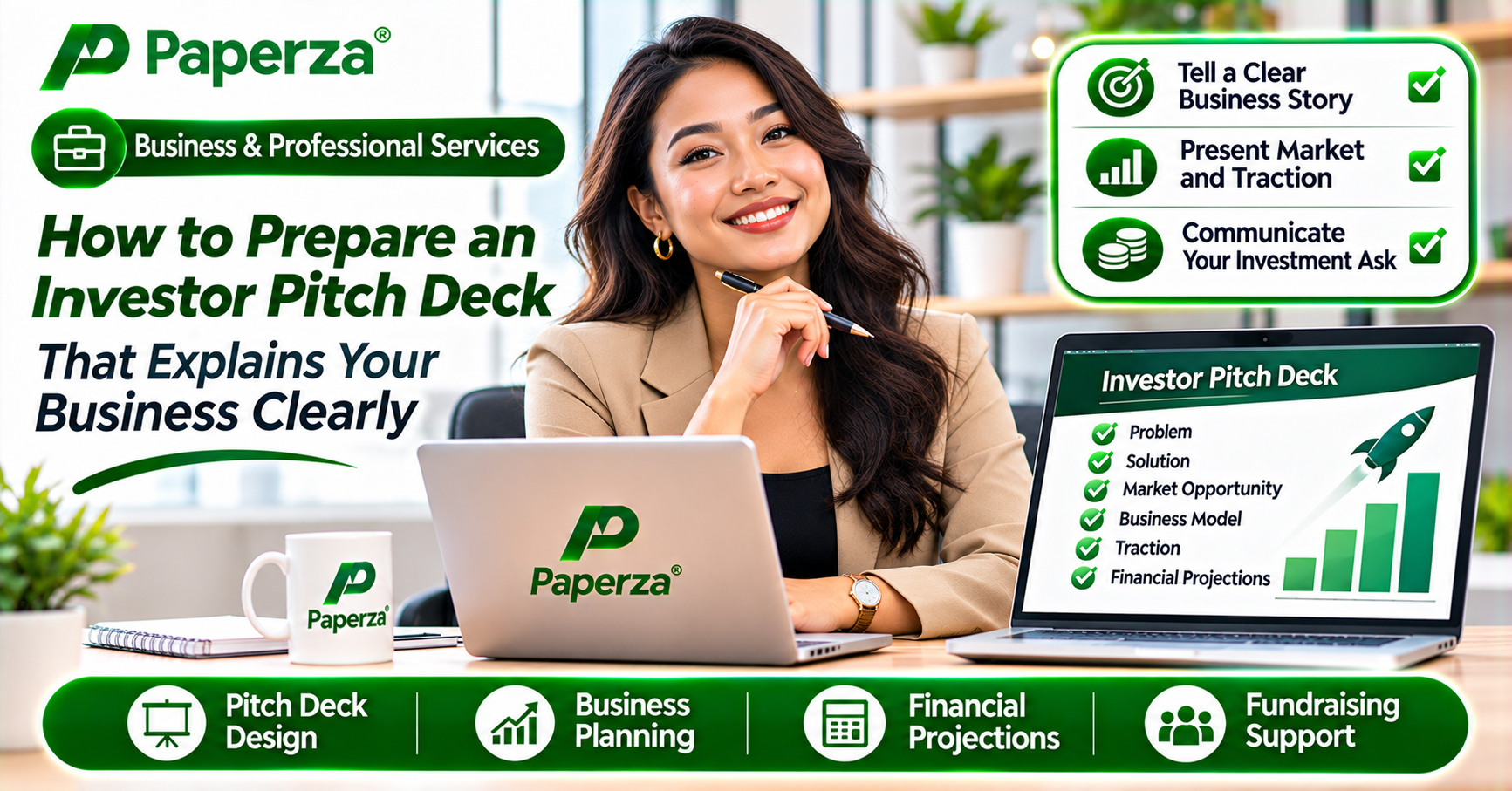
A great business idea does not automatically attract investors. Founders must communicate what their business does, the problem it solves, how it generates revenue, the size of its market opportunity, and why investment could help it grow.
An investor pitch deck provides a structured way to communicate this information.
Unfortunately, many entrepreneurs spend considerable time designing attractive presentations while overlooking the underlying business narrative. Their slides contain complicated explanations, unsupported financial projections, excessive text, and market statistics that do not clearly relate to their business.
An effective investor pitch deck should make a complex business easy to understand without oversimplifying its commercial potential.
Whether you are launching a technology startup, building an online marketplace, developing a software product, or expanding an established business, a well-prepared pitch deck can support more productive conversations with angel investors, venture capital firms, and potential business partners.
This guide explains how to structure an investor presentation, communicate business traction, calculate market opportunities, present financial projections, and prepare a compelling investment request.
Entrepreneurs can also hire professional investor pitch deck designers on Paperza for assistance preparing visually engaging fundraising presentations.
What Is an Investor Pitch Deck?
An investor pitch deck is a concise business presentation designed to communicate a company's investment opportunity to prospective investors.
It introduces the business, explains its commercial potential, presents available evidence of customer demand, and identifies how additional capital could support future growth.
A pitch deck is not intended to answer every possible question about a company. Instead, it should provide enough relevant information to encourage meaningful investment discussions and further evaluation.
A professional investor presentation typically addresses the following questions:
- What does the company do?
- What customer problem does it solve?
- Who are its target customers?
- How does the business generate revenue?
- What evidence demonstrates customer demand?
- How large is the commercial opportunity?
- What differentiates the company from its competitors?
- Who is responsible for building the business?
- How much investment is required?
- What will the investment help the company achieve?
Investors should understand the fundamental business proposition without requiring a lengthy explanation from the founder.
1. Investor Pitch Deck vs Business Plan
Entrepreneurs frequently confuse investor pitch decks with traditional business plans.
Although both documents explain a company's operations and commercial objectives, their purposes differ.
| Comparison Area | Investor Pitch Deck | Business Plan |
| Main purpose | Introduce an investment opportunity | Explain the complete business strategy |
| Typical format | Presentation slides | Detailed written document |
| Typical length | Approximately 10–15 core slides | Often 15–50 pages |
| Content | Selected business highlights | Detailed operational and financial information |
| Audience | Investors and strategic partners | Investors, lenders and internal stakeholders |
| Visual presentation | Highly important | Usually secondary to detailed information |
| Financial information | Summary projections and key metrics | Detailed financial models and assumptions |
A pitch deck should communicate the most important aspects of the business. A business plan provides the detail required for deeper assessment.
Founders preparing both documents can hire an Investor-Ready Business Plan Specialist on Paperza.
2. What Makes an Investor Pitch Deck Effective?
An effective presentation combines clarity, credibility, relevance, and an understandable business narrative.
Investors frequently evaluate unfamiliar companies. They should not have to interpret complicated technical explanations before understanding the underlying opportunity.
Clarity
Explain the business using straightforward language.
Credibility
Support important claims with reliable documentation and clearly defined metrics.
Relevance
Include information that helps investors evaluate the company rather than unnecessary operational details.
Consistency
Ensure that market estimates, financial projections, traction figures, and fundraising objectives support the same business strategy.
Visual Communication
Use charts, diagrams, product screenshots, and readable typography to explain information efficiently.
A polished design should strengthen the investment narrative rather than distract from it.
3. How Many Slides Should an Investor Pitch Deck Have?
A practical starting point for many early-stage startups is approximately 10–15 core slides, with additional supporting materials available in an appendix.
There is no universally required slide count.
A hardware company, healthcare startup, or deep-technology venture may require additional slides explaining regulatory requirements, technical validation, intellectual property, or manufacturing operations.
A simpler software business may communicate its investment opportunity using fewer slides.
The appropriate presentation length depends on the company's development stage, business complexity, and investor audience.
4. Recommended Investor Pitch Deck Structure
The following structure provides a practical framework that founders can adapt.
| Slide | Content |
| 1 | Company introduction |
| 2 | Customer problem |
| 3 | Proposed solution |
| 4 | Product demonstration |
| 5 | Target customers and market opportunity |
| 6 | Business model |
| 7 | Traction and validation |
| 8 | Customer acquisition strategy |
| 9 | Competitive positioning |
| 10 | Founding team |
| 11 | Financial projections |
| 12 | Development roadmap |
| 13 | Investment request |
| 14 | Use of funds |
| 15 | Closing statement and contact information |
Founders can combine related sections or add supporting slides according to the needs of their business.
The objective is to maintain a coherent story from the opening introduction to the investment request.
5. Slide One: Introduce Your Company Clearly
The opening slide should immediately communicate the company's identity and purpose.
Include the company name, logo, concise business description, and relevant presentation information.
Examples of Clear Business Descriptions
Freelance marketplace: An online marketplace connecting businesses with independent professionals for digital and specialised services.
Financial technology startup: A financial management platform helping small businesses automate invoicing and expense tracking.
Healthcare technology company: A digital platform helping healthcare providers coordinate patient appointments and records.
Artificial intelligence startup: An AI-powered solution helping customer support teams automate routine enquiries.
Avoid vague phrases that do not explain the actual business.
For example, describing a company as a revolutionary technology ecosystem transforming the future of innovation provides limited information about its customers, products, or commercial activities.
Investors should quickly understand what the company offers and who benefits from it.
6. Slide Two: Explain the Customer Problem
Successful businesses generally address identifiable customer needs.
The problem slide should explain the practical challenge that motivates customers to purchase the company's product or service.
Important Questions to Address
- Who experiences the problem?
- How frequently does it occur?
- What financial or operational consequences does it create?
- How do customers currently address it?
- Why are existing solutions insufficient for the target customer?
Example Problem Statement
Small businesses often struggle to find reliable freelance professionals for specialised projects. Existing hiring processes may require extensive searching, inconsistent communication, and complicated project coordination.
This creates delays and increases the time business owners spend managing external service providers.
A strong problem statement should be supported by customer interviews, survey findings, observed purchasing behaviour, industry research, or other credible evidence.
Do not exaggerate the size or severity of a problem merely to make the business appear more valuable.
7. Slide Three: Present Your Solution
The solution slide explains how the business addresses the customer problem.
It should directly relate to the challenges described in the preceding slide.
Example Solution Statement
Our platform allows businesses to discover relevant freelance professionals, compare service packages, communicate project requirements, place orders, and manage project delivery through a single digital marketplace.
This explanation describes the product's practical functionality rather than relying exclusively on promotional language.
Focus on Customer Benefits
| Product Feature | Potential Customer Benefit |
| Search and filtering | Find relevant professionals more efficiently |
| Service packages | Understand pricing and deliverables before ordering |
| Integrated messaging | Simplify project communication |
| Order management | Track project progress |
| Customer feedback | Evaluate previous service experiences |
| Digital payments | Simplify transaction processing |
The solution slide should explain why customers would consider adopting the product.
8. Slide Four: Show Your Product
Product demonstrations can help investors understand how a business operates.
Depending on the company's development stage, this slide may include website screenshots, mobile application interfaces, product photographs, prototypes, or workflow diagrams.
For a software business, a simplified customer journey may be more informative than several screenshots containing small, unreadable interface elements.
Example Marketplace Customer Journey
Discover a service → Compare freelancers → Discuss project requirements → Place an order → Receive the completed deliverable.
Example SaaS Customer Journey
Create an account → Connect business data → Configure the workflow → Automate routine activities → Monitor performance.
Clearly distinguish functional products from prototypes, concept designs, and planned features.
Do not present a nonfunctional prototype as a fully operational product.
9. Slide Five: Explain Your Target Customers
A business cannot effectively serve every possible customer from the beginning.
Investors want to understand which customers are most likely to adopt the product and how the company intends to reach them.
Example Customer Segmentation
| Customer Segment | Main Requirement |
| Small business owners | Affordable professional services |
| Startup founders | Product development and business support |
| Marketing agencies | Flexible outsourced project capacity |
| Independent professionals | Access to business tools and specialist assistance |
| Established companies | Reliable external service providers |
A startup may eventually serve multiple customer segments, but its initial marketing strategy should identify a clearly defined priority audience.
Explain why the first customer segment is attractive, how purchasing decisions are made, and what evidence supports willingness to pay.
10. Understanding TAM, SAM and SOM
Market sizing helps investors evaluate the potential commercial scale of a business.
Three commonly used concepts are TAM, SAM, and SOM.
Total Addressable Market (TAM)
TAM represents the theoretical market opportunity if the company could serve the entire relevant market.
Serviceable Available Market (SAM)
SAM represents the portion of that market the company can realistically serve with its product, geographic coverage, and operating model.
Serviceable Obtainable Market (SOM)
SOM represents the portion of the serviceable market the company could reasonably capture over a defined period.
Illustrative Market Sizing Example
| Market Level | Example Annual Spending |
| Total Addressable Market | $10 billion |
| Serviceable Available Market | $500 million |
| Serviceable Obtainable Market | $5 million |
These figures are hypothetical and are not estimates of any particular industry.
A founder should explain the sources, assumptions, geographic boundaries, and customer definitions behind the actual numbers used.
11. Top-Down vs Bottom-Up Market Sizing
There are two common approaches to calculating market opportunities.
Top-Down Market Sizing
This approach starts with a broad industry estimate and narrows it according to relevant customer segments, locations, or product categories.
For example, a founder may identify industry-wide software spending and calculate the portion attributable to small businesses within the company's service area.
The main limitation is that large industry figures may poorly represent the company's actual opportunity.
Bottom-Up Market Sizing
This approach estimates potential demand using customer counts, realistic purchasing behaviour, and expected prices.
Example Bottom-Up Calculation
| Assumption | Value |
| Addressable businesses | 100,000 |
| Estimated annual spending per business | $500 |
| Total annual spending opportunity | $50 million |
| Illustrative attainable market share | 2% |
| Potential annual transaction value | $1 million |
If the company operates a marketplace with a 20% effective commission, the $1 million transaction value could correspond to approximately $200,000 in platform revenue before applicable adjustments.
Market sizing should distinguish customer spending from the company's own potential revenue.
12. Slide Six: Explain Your Business Model
A business model describes how a company creates commercial value and generates revenue.
Investors should understand who pays, what they pay for, how frequently they pay, and the main costs associated with delivering the product.
Common Startup Business Models
| Business Model | Revenue Source |
| Subscription | Monthly or annual customer payments |
| Marketplace | Commission or fees on transactions |
| E-commerce | Product sales |
| Advertising | Payments from advertisers |
| Licensing | Fees for access to intellectual property or software |
| Usage-based pricing | Charges based on service consumption |
| Professional services | Project or consulting fees |
| Freemium | Paid upgrades from a free offering |
A company may combine several revenue streams, but the presentation should clearly identify its primary commercial model.
Avoid listing speculative revenue opportunities as established income sources.
13. How to Explain a Marketplace Business Model
Marketplace founders should distinguish gross transaction value from the revenue retained by the platform.
Gross Merchandise Value, commonly known as GMV, represents the value of transactions conducted through a marketplace according to its defined calculation methodology.
Marketplace revenue may include commissions, transaction fees, memberships, promoted listings, or other charges.
Illustrative Marketplace Revenue Example
| Financial Item | Amount |
| Completed orders | 1,000 |
| Average order value | $100 |
| Gross transaction value | $100,000 |
| Seller commission rate | 20% |
| Seller commissions | $20,000 |
| Additional buyer fee | 5% |
| Buyer fees | $5,000 |
| Gross platform fee income | $25,000 |
This example assumes both percentages are calculated from the same order value, all applicable fees are collected, and the transactions are completed without refunds.
Payment processing expenses, chargebacks, taxes, operating costs, and relevant accounting treatment may affect reported revenue and profitability.
The marketplace should not present the entire $100,000 transaction value as its own revenue merely because payments passed through its platform.
14. How to Explain a Subscription Business Model
Subscription businesses should communicate customer numbers, pricing, retention, and recurring revenue.
Illustrative Subscription Revenue Example
| Business Metric | Amount |
| Active paying customers | 500 |
| Monthly subscription price | $30 |
| Monthly Recurring Revenue | $15,000 |
| Annualised Recurring Revenue | $180,000 |
Annualised recurring revenue represents an annualised run rate based on the stated recurring revenue.
It does not necessarily mean the company has already earned $180,000 or that future revenue is guaranteed.
Churn, discounts, customer upgrades, cancellations, and future acquisition can affect actual results.
15. Slide Seven: Present Business Traction
Traction refers to evidence that a company is making measurable progress toward commercial adoption.
Strong traction demonstrates more than interest in an idea. It may show customers using the product, paying for services, returning for additional purchases, or entering meaningful commercial relationships.
Common Startup Traction Metrics
| Metric | What It Demonstrates |
| Paying customers | Evidence of willingness to pay |
| Completed transactions | Actual commercial activity |
| Monthly revenue | Current income generation |
| Recurring revenue | Repeatable subscription income |
| Customer retention | Continued customer adoption |
| Repeat purchase rate | Ongoing purchasing behaviour |
| Active users | Product engagement |
| Conversion rate | Effectiveness of the purchasing journey |
| Signed contracts | Confirmed commercial commitments |
| Product adoption | Usage within the target market |
Choose metrics that are meaningful for the company's business model.
For a marketplace, completed orders and repeat buyers may be more informative than total seller registrations alone.
16. How to Present Early-Stage Startup Traction
Early-stage founders may not yet have significant revenue.
Nevertheless, they can present credible evidence of progress.
Examples include customer discovery interviews, functional product development, pilot programmes, confirmed partnerships, early customer orders, relevant waitlist registrations, and documented product usage.
Hypothetical Early-Stage Traction Slide
First 90 Days of Operations
| Business Metric | Result |
| Registered users | 850 |
| Paying customers | 75 |
| Completed orders | 120 |
| Completed transaction value | $18,000 |
| Gross platform fee income | $4,500 |
| Repeat customers | 24 |
These illustrative figures represent fictional business performance.
Actual presentations should use verified metrics covering clearly identified reporting periods.
If the company has pending orders, distinguish them from completed transactions.
If customers registered but did not pay, do not classify them as paying customers.
17. How to Calculate Business Growth
Growth figures are valuable when presented accurately.
The percentage growth formula is:
Growth Rate = ((Current Period Value − Previous Period Value) / Previous Period Value) × 100
Example Revenue Growth
| Month | Revenue |
| January | $1,000 |
| February | $1,500 |
| March | $2,400 |
Revenue increased by 50% from January to February and 60% from February to March.
From January to March, total growth was 140%.
Investors should also see the absolute revenue figures because percentage growth can appear unusually impressive when the starting value is small.
A company growing from $10 to $100 has achieved 900% growth, but its commercial scale remains limited.
18. What Should a Pre-Revenue Startup Present?
Not every startup raises investment after generating revenue.
A pre-revenue company can still explain its progress using relevant evidence.
Potential Pre-Revenue Validation
- Completed prototype.
- Functional minimum viable product.
- Customer discovery interviews.
- Pilot programme participation.
- Product testing results.
- Letters of intent.
- Documented customer interest.
- Intellectual property development.
- Relevant founder experience.
- Technical feasibility assessment.
Clearly distinguish binding commercial agreements from nonbinding expressions of interest.
Similarly, a waitlist does not establish that every registered person will become a paying customer.
19. Slide Eight: Explain Your Go-to-Market Strategy
A go-to-market strategy explains how the business intends to acquire customers and deliver its offering successfully.
Investors want to understand how the company will turn its market opportunity into actual commercial activity.
Common Customer Acquisition Channels
| Channel | Potential Application |
| Search engine optimisation | Attract customers searching for relevant solutions |
| Google Ads | Reach potential customers with purchasing intent |
| Social media marketing | Build awareness and generate enquiries |
| Content marketing | Educate customers and demonstrate expertise |
| Email marketing | Nurture prospects and encourage repeat purchases |
| Influencer marketing | Introduce the product to relevant audiences |
| Direct sales | Acquire high-value business customers |
| Strategic partnerships | Access established customer networks |
| Referral programmes | Encourage existing customers to introduce new ones |
Avoid claiming that the company will dominate every marketing channel simultaneously.
A stronger strategy identifies priority channels, initial experiments, performance targets, and the resources required.
20. Understanding Customer Acquisition Cost
Customer Acquisition Cost, or CAC, estimates the expenditure required to acquire a customer.
Example Calculation
| Marketing and Sales Metric | Value |
| Advertising expenditure | $1,500 |
| Attributable sales and marketing expenses | $500 |
| New paying customers acquired | 100 |
| Customer Acquisition Cost | $20 |
The company spent $2,000 to acquire 100 paying customers.
Its illustrative CAC is $20.
An accurate calculation should include relevant acquisition costs and use a measurement period that reflects the customer purchasing cycle.
Do not calculate paying-customer CAC using website visitors or account registrations unless that metric is explicitly described differently.
21. Understanding Customer Lifetime Value
Customer Lifetime Value, commonly known as LTV, estimates the economic value a customer may generate over the course of their relationship with the company.
Simplified Subscription Example
| Metric | Value |
| Monthly customer revenue | $40 |
| Estimated gross margin | 75% |
| Expected customer lifetime | 20 months |
| Estimated gross-profit LTV | $600 |
If customer acquisition costs $100, the illustrative LTV-to-CAC ratio is 6:1.
However, early-stage lifetime estimates can be highly uncertain, particularly when the business has limited historical retention data.
Founders should explain the underlying assumptions and avoid presenting estimated lifetime value as a verified historical result.
22. Explain Your Unit Economics
Unit economics helps investors understand whether an individual customer, transaction, or product sale contributes positively toward covering operating expenses.
Example Marketplace Order Economics
| Item | Amount |
| Average order value | $100 |
| Platform fee income | $25 |
| Payment processing costs | $4 |
| Variable customer support costs | $3 |
| Other variable costs | $2 |
| Contribution per order before acquisition costs | $16 |
If acquiring a new customer costs $20, the company may lose money on the first order.
Repeat purchases could improve the economics if additional acquisition costs remain low.
This example illustrates why increasing transaction volume alone does not necessarily establish business profitability.
23. Slide Nine: Explain Your Competitive Advantage
Investors need to understand why customers would choose the proposed business instead of existing alternatives.
A competitor may be another company, an internal business process, a traditional service provider, or a customer's decision not to purchase anything.
Example Competitive Comparison
| Factor | Our Business | General Marketplace | Traditional Agency |
| Specialised service focus | Primary focus | Varies | Varies |
| Standardised service packages | Available | Often available | Varies |
| Custom project requirements | Available | Often available | Available |
| Self-service onboarding | Available | Often available | Less common |
| Dedicated account management | Planned | Varies | Often available |
This table is illustrative. Real competitor comparisons must be based on verified product information.
Avoid marking every competitor as inferior simply to make the company appear more attractive.
Potential Competitive Advantages
Sustainable advantages may arise from technology, proprietary data, intellectual property, trusted partnerships, strong customer relationships, operational efficiency, distribution capabilities, network effects, or specialised domain expertise.
Explain how the advantage works and why competitors may find it difficult to replicate.
24. Slide Ten: Introduce Your Founding Team
Investors assess both the business opportunity and the people responsible for executing it.
A team slide should communicate relevant experience, complementary skills, and clearly defined responsibilities.
Example Founding Team Structure
| Role | Main Responsibility |
| Chief Executive Officer | Strategy, fundraising and commercial growth |
| Chief Technology Officer | Product architecture and engineering |
| Operations Lead | Customer operations and service delivery |
| Marketing Lead | Customer acquisition and brand development |
| Financial Lead | Financial planning and reporting |
Early-stage businesses do not necessarily need individuals filling every executive role.
Do not present contractors, advisors, or anticipated future hires as full-time executives unless that accurately reflects their roles.
Highlight achievements and professional experience that relate directly to the company's objectives.
25. How to Write an Effective Founder Biography
A founder biography should explain why that person is qualified to build the company.
Weak Founder Biography
An ambitious entrepreneur passionate about technology, innovation, leadership, and transforming the global business ecosystem.
Stronger Founder Biography
A founder with five years of experience in digital services and customer operations, responsible for developing the marketplace strategy, establishing service provider relationships, and managing early commercial activities.
The stronger description provides relevant experience and specific responsibilities.
Where available, include verified previous achievements, industry experience, or successful projects.
Avoid invented qualifications or exaggerated professional titles.
26. Slide Eleven: Present Financial Projections
Financial projections help investors evaluate how the company expects to develop commercially.
Early-stage projections are estimates, not established future outcomes.
They should be driven by identifiable business assumptions.
Example Three-Year Marketplace Financial Projection
| Financial Metric | Year 1 | Year 2 | Year 3 |
| Completed orders | 3,000 | 12,000 | 35,000 |
| Average order value | $100 | $110 | $120 |
| Gross transaction value | $300,000 | $1,320,000 | $4,200,000 |
| Effective platform fee rate | 25% | 25% | 25% |
| Gross platform fee income | $75,000 | $330,000 | $1,050,000 |
| Variable operating costs | $15,000 | $66,000 | $210,000 |
| Contribution after variable costs | $60,000 | $264,000 | $840,000 |
| Fixed operating expenses | $110,000 | $230,000 | $500,000 |
| Illustrative operating result | −$50,000 | $34,000 | $340,000 |
These figures are hypothetical and exclude certain potential items, including financing costs, taxes, and depreciation.
Actual financial models should reflect the company's accounting policies, payment costs, customer acquisition expenses, staffing requirements, operational risks, and revenue recognition practices.
27. Make Financial Projections Defensible
A projection should explain how a company expects to achieve its numbers.
For example, projecting $1 million in revenue provides limited information without identifying the customer acquisition, pricing, retention, and operating assumptions.
Example Revenue Forecast Assumptions
| Forecast Driver | Example Assumption |
| Monthly website visitors | 50,000 |
| Visitor-to-order conversion | 2% |
| Monthly completed orders | 1,000 |
| Average order value | $100 |
| Monthly transaction value | $100,000 |
| Platform fee rate | 25% |
| Monthly gross fee income | $25,000 |
If the conversion rate falls from 2% to 1%, monthly gross fee income falls to $12,500, assuming other factors remain unchanged.
This illustrates the importance of testing the assumptions behind financial forecasts.
28. Use Conservative, Base and Optimistic Scenarios
Scenario analysis allows founders to show how different business conditions could affect financial performance.
Illustrative Revenue Scenarios
| Scenario | Monthly Orders | Average Order | Annual Gross Fee Income |
| Conservative | 250 | $80 | $60,000 |
| Base | 500 | $100 | $150,000 |
| Optimistic | 1,000 | $120 | $360,000 |
These calculations assume a 25% platform fee rate and the stated monthly order volume remains constant for 12 months.
Real forecasts should incorporate growth patterns, cancellations, seasonal changes, and different operating assumptions.
Scenario analysis helps investors understand both potential upside and business risk.
Founders requiring detailed projections can explore Business Planning and Financial Modelling Services on Paperza.
29. Understand Burn Rate and Cash Runway
Investors often want to know how long the company can operate before requiring additional capital.
Burn Rate
Net cash burn refers to the amount of cash a company uses over a period after accounting for relevant cash inflows.
Cash Runway
A simplified estimate of cash runway divides available cash by the average monthly net cash burn.
Example Calculation
| Financial Metric | Amount |
| Available cash | $120,000 |
| Monthly cash outflows | $18,000 |
| Monthly cash inflows | $8,000 |
| Monthly net cash burn | $10,000 |
| Estimated runway | 12 months |
This assumes relatively stable cash inflows and outflows.
Future hiring, marketing investment, delayed customer payments, and unexpected expenses may change the actual runway.
A detailed monthly cash-flow forecast is generally more useful than relying exclusively on a single average.
30. Slide Twelve: Present Your Business Roadmap
The roadmap explains how the company intends to develop after securing investment.
It should connect planned activities to measurable milestones.
Example Startup Roadmap
| Period | Development Priority | Illustrative Milestone |
| Months 1–3 | Improve the core product | Release improved customer onboarding |
| Months 4–6 | Test acquisition channels | Establish reliable conversion tracking |
| Months 7–9 | Expand commercial activities | Increase monthly completed transactions |
| Months 10–12 | Improve operating efficiency | Reduce delivery and support bottlenecks |
| Year 2 | Expand successful strategies | Enter additional customer segments |
The roadmap should prioritise activities that contribute to commercial progress rather than feature development alone.
Investors should understand how the proposed investment helps the company reach its next meaningful stage.
31. Slide Thirteen: Present Your Investment Request
The investment request should explain how much funding the company is seeking and what that funding is intended to accomplish.
Example Investment Request
We are seeking $100,000 in investment to strengthen product infrastructure, expand customer acquisition, improve operational efficiency, and support the company's next stage of commercial development.
The investment is intended to support approximately 12 months of planned operations and help the business reach defined customer growth and revenue milestones.
This example provides a funding amount, operational purpose, and intended timeframe.
The appropriate funding request should be based on a realistic cash-flow forecast rather than an arbitrary amount.
32. How to Calculate Startup Valuation When Offering Equity
When a founder offers a specified percentage of post-investment ownership in exchange for capital, the implied valuation can be calculated.
Example Equity Investment
A startup seeks $100,000 in exchange for 10% ownership through a new share issuance.
| Valuation Component | Amount |
| Investment amount | $100,000 |
| Investor's post-investment ownership | 10% |
| Implied post-money valuation | $1,000,000 |
| Implied pre-money valuation | $900,000 |
The simplified calculations are:
Post-Money Valuation = Investment Amount / Investor Ownership Percentage
Pre-Money Valuation = Post-Money Valuation − New Investment
These calculations assume a straightforward primary equity investment without convertible instruments, additional dilution, option-pool adjustments, or secondary share purchases.
An implied valuation is a proposed transaction term, not independent proof of the company's fair market value.
Founders should obtain appropriate legal and financial advice when negotiating investment agreements.
33. Understand Different Startup Funding Instruments
Not every startup investment involves an immediately negotiated equity percentage.
Common Investment Structures
| Funding Instrument | General Description |
| Priced equity round | Investment in exchange for shares at an agreed valuation |
| SAFE | Contract providing potential future equity according to agreed terms |
| Convertible note | Debt instrument that may convert into equity |
| Business loan | Borrowed capital generally requiring repayment |
| Grant | Funding subject to the grant programme's conditions |
| Revenue-based financing | Funding repaid according to specified revenue arrangements |
These structures have different implications for ownership, repayment, investor rights, and future fundraising.
The pitch deck should accurately describe the proposed investment structure when it has been determined.
34. Slide Fourteen: Explain the Use of Funds
The use-of-funds slide communicates how the requested capital will be allocated.
Investors should understand why those expenditures are necessary and what outcomes they are expected to support.
Example $100,000 Funding Allocation
| Allocation | Percentage | Amount |
| Product development and engineering | 35% | $35,000 |
| Marketing and customer acquisition | 30% | $30,000 |
| Operations and customer support | 15% | $15,000 |
| Infrastructure and software | 10% | $10,000 |
| Legal and administrative expenses | 5% | $5,000 |
| Contingency reserve | 5% | $5,000 |
| Total | 100% | $100,000 |
A simple chart can make the allocation easier to understand.
However, the categories should reflect a detailed operating budget prepared separately.
35. Connect Investment Spending to Business Milestones
Investors generally want to know what the investment will achieve, not merely how it will be spent.
Example Funding-to-Milestone Framework
| Investment Area | Intended Outcome |
| Product development | Improve onboarding and core platform functionality |
| Marketing | Validate repeatable customer acquisition channels |
| Customer support | Improve service delivery and issue resolution |
| Infrastructure | Support operational reliability and additional usage |
| Business development | Establish relevant commercial relationships |
| Financial planning | Maintain visibility into costs and runway |
The company should define appropriate indicators for measuring each outcome.
For example, marketing investment might be assessed using paying-customer acquisition cost, conversion rate, and repeat purchase behaviour rather than social media impressions alone.
36. Slide Fifteen: Create a Strong Closing Statement
The final slide should reinforce the business opportunity and make the next step clear.
Include the company name, a concise investment proposition, founder contact information, and the company website.
Example Closing Statement
We are building an accessible digital solution that helps businesses overcome a clearly identified operational challenge. With a functional product, documented early demand, and a focused growth strategy, we are seeking investment to expand adoption and build a sustainable business.
The closing statement should reflect the company's actual development stage.
If the product is still being developed or customer demand has not yet been validated, adjust the statement accordingly.
37. How to Design a Professional Investor Pitch Deck
Presentation design plays an important role in communicating business information.
A professional pitch deck should be easy to read, visually consistent, and suitable for both live presentations and independent review.
Recommended Design Principles
| Design Element | Recommended Approach |
| Slide aspect ratio | Typically 16:9 unless instructed otherwise |
| Typography | Consistent and readable fonts |
| Colours | A restrained, brand-aligned palette |
| Slide titles | Clear and informative statements |
| Charts | Labelled, accurate and easy to interpret |
| Images | Relevant, high-quality visuals |
| Product screenshots | Large enough to understand |
| Spacing | Sufficient whitespace around content |
| Animations | Minimal and purposeful |
| Footnotes | Identify data sources and assumptions |
Avoid filling every available area with text or decorative elements.
One well-designed chart may communicate more information than several dense paragraphs.
38. Use Charts Instead of Complicated Financial Tables
Financial slides should make important trends easy to understand.
Different chart types serve different purposes.
| Information | Recommended Visual |
| Monthly revenue growth | Line chart |
| Revenue across products | Bar chart |
| Funding allocation | Bar chart or doughnut chart |
| Customer conversion stages | Funnel diagram |
| Market segmentation | Nested or grouped visual |
| Development milestones | Timeline |
| Customer acquisition costs | Bar or line chart |
Charts should include meaningful titles, defined units, accurate scales, and appropriate reporting periods.
Avoid misleading axis ranges or visual effects that exaggerate performance.
39. How to Tell a Compelling Founder Story
An investor presentation should guide the audience through a logical business narrative.
Example Narrative Flow
The problem: Customers experience an identifiable and commercially important challenge.
The insight: Existing solutions do not adequately address a particular customer segment or requirement.
The solution: The company has developed a product or service that addresses the identified gap.
The validation: Early customer behaviour and other evidence demonstrate meaningful progress.
The opportunity: The business can potentially reach a larger market through a practical growth strategy.
The investment: Additional capital will support clearly defined commercial milestones.
This structure connects each part of the presentation to the next.
Avoid relying on emotional storytelling without evidence supporting the underlying business opportunity.
40. Investor Pitch Decks for Different Business Types
Different businesses require different investment narratives.
Software as a Service
A SaaS pitch deck should emphasise recurring revenue, product usage, retention, customer acquisition costs, and software scalability.
Online Marketplace
A marketplace presentation should explain both sides of the platform, transaction activity, customer retention, seller participation, platform economics, and marketplace liquidity.
E-commerce Business
An e-commerce pitch deck should highlight customer demand, product margins, acquisition costs, inventory management, fulfilment, and repeat purchase behaviour.
Artificial Intelligence Startup
An AI startup should explain its specific technical application, customer benefits, data access, validation results, computing costs, and competitive differentiation.
Healthcare Startup
Healthcare presentations may require additional information concerning clinical evidence, regulatory pathways, privacy, safety, reimbursement, and institutional adoption.
Professional Services Business
A service-based company should demonstrate demand, project profitability, repeat customers, delivery capacity, and opportunities to scale beyond individual founder involvement.
41. Hypothetical Investor Pitch Deck Example
Consider a fictional startup called FlowBridge, a digital platform helping small businesses automate administrative workflows.
| Presentation Section | Example Content |
| Company introduction | Workflow automation software for small businesses |
| Problem | Businesses spend excessive time on repetitive administrative tasks |
| Solution | Accessible automation tools and reusable workflows |
| Target customers | Small professional service companies |
| Revenue model | Monthly software subscription |
| Traction | 150 paying customers |
| Monthly subscription price | $25 |
| Monthly recurring revenue | $3,750 |
| Growth strategy | Search marketing, agency partnerships and referrals |
| Funding request | $150,000 |
| Investment purpose | Product development and customer acquisition |
| Next milestone | Establish measurable retention and acquisition performance |
These details are fictional and demonstrate how a company could communicate a coherent investment opportunity.
The actual deck should include supporting evidence, financial assumptions, risks, and relevant business documentation.
42. What Investors May Ask After Reviewing Your Pitch Deck
A founder should be prepared to discuss information beyond the slides.
Common questions include:
- Why is this the right time to launch or expand the business?
- What evidence demonstrates that customers will pay?
- How does the company acquire customers?
- What is the cost of acquiring a paying customer?
- How frequently do customers return?
- What differentiates the business from its competitors?
- What prevents competitors from replicating the offering?
- How were financial projections calculated?
- What are the greatest operational risks?
- Why is the founding team suited to this opportunity?
- How much capital has already been invested?
- What ownership structure currently exists?
- How long will the requested capital support operations?
- What milestones should be achieved before the next funding round?
- What potential exit opportunities exist, if relevant?
Prepare evidence-based responses rather than memorising generic investment terminology.
43. Prepare Supporting Due Diligence Documents
An initial pitch deck may lead to more detailed business evaluation.
Depending on the company and investment stage, investors may request supporting documents.
| Document | Purpose |
| Company registration records | Verify the legal entity |
| Capitalisation table | Understand existing ownership |
| Financial statements | Assess historical performance |
| Financial model | Review forecast assumptions |
| Bank or payment records | Validate relevant financial activity |
| Customer contracts | Assess commercial relationships |
| Product documentation | Understand technology and operations |
| Intellectual property records | Verify relevant ownership rights |
| Employment agreements | Assess team arrangements |
| Privacy and compliance policies | Evaluate regulatory and operational risks |
Prepare accurate records and share sensitive information through appropriate access controls.
Avoid including unnecessary confidential documents in the initial publicly distributed pitch deck.
44. Understand Your Capitalisation Table
A capitalisation table, commonly known as a cap table, records company ownership.
Founders should understand how new investment affects existing shareholders.
Simplified Ownership Example
| Shareholder | Before Investment | After Investment |
| Founder A | 70% | 63% |
| Founder B | 30% | 27% |
| New investor | 0% | 10% |
| Total | 100% | 100% |
This example assumes newly issued shares give the investor 10% post-investment ownership and dilute existing shareholders proportionally.
Existing option pools, convertible instruments, investor agreements, and additional share issuances can change the actual outcome.
Founders should obtain professional advice before finalising ownership arrangements.
45. How Much Does Professional Pitch Deck Design Cost?
The cost of preparing an investor pitch deck depends on the number of slides, business complexity, available content, research requirements, and design expectations.
Illustrative Pitch Deck Preparation Budgets
| Service | Example Budget |
| Basic redesign of existing slides | $15–$75 |
| Standard startup presentation design | $50–$200 |
| Custom investor deck design | $150–$500 |
| Pitch deck writing and storytelling | $150–$600 |
| Financial modelling and market research | $100–$1,000+ |
| Comprehensive fundraising presentation preparation | $500–$3,000+ |
These are illustrative budgeting ranges rather than independently measured market averages.
A basic design package may not include business research, financial modelling, content writing, or investment strategy.
Confirm the specific deliverables before hiring a freelancer.
46. Professional Investor Pitch Deck Services on Paperza
Paperza provides access to freelance presentation designers, business consultants, and business plan writers.
Investor Pitch Deck and Startup Funding Presentation
Hire an Investor Pitch Deck Designer on Paperza.
The service is listed from $35 and supports investor presentations covering business introductions, customer problems, proposed solutions, market opportunities, revenue models, competitive analysis, and growth strategies.
Confirm the number of slides, content writing requirements, and editable file formats before ordering.
Professional Pitch Deck Redesign
Hire a Startup Pitch Deck Redesign Specialist.
The introductory package starts at $15 for four slides, with a listed one-day delivery period.
This service focuses on improving existing presentations, visual consistency, slide structure, financial charts, and investor-oriented layouts.
Copywriting and financial modelling are excluded unless separately agreed.
Investor-Ready Business Plan and Financial Planning
Hire a Professional Business Plan Writer.
Business plan packages start at $30, with additional options for pitch deck design and financial modelling.
The listing includes a $75 add-on for a 10-slide investor pitch deck and a $45 add-on for a break-even and cash-flow spreadsheet.
Listed prices exclude any applicable platform charges and optional services.
47. Should You Hire a Pitch Deck Designer or Business Consultant?
The appropriate freelancer depends on the type of support required.
| Project Requirement | Suitable Specialist |
| Improve an existing deck's appearance | Presentation designer |
| Develop a coherent investment narrative | Pitch deck writer or business consultant |
| Calculate revenue projections | Financial modelling specialist |
| Estimate market opportunities | Market research specialist |
| Prepare a detailed business plan | Business plan consultant |
| Negotiate investment terms | Qualified legal and financial professionals |
A presentation designer can improve visual communication, but this does not necessarily mean they are qualified to prepare financial forecasts or advise on investment agreements.
For comprehensive projects, founders may require more than one specialist.
48. Questions to Ask a Pitch Deck Freelancer Before Hiring
Before placing an order, ask the following questions:
- Have you prepared investor presentations for similar businesses?
- Does the service include content writing or only visual design?
- Can you work with our existing brand guidelines?
- Will you verify financial calculations?
- Is market research included?
- How many slides will be delivered?
- Will the presentation include editable source files?
- Can you provide presentation-ready PDF files?
- How many revisions are included?
- How will confidential business information be protected?
- Are additional financial models available?
- What is the expected delivery timeline?
A clear agreement helps prevent misunderstandings about project scope and final deliverables.
49. Sample Investor Pitch Deck Project Brief
Entrepreneurs can adapt the following brief when engaging a freelance presentation designer.
Project Title: Professional Investor Pitch Deck for Startup Fundraising
Business Name: [Company name]
Industry: [Business sector]
Business Description: [Explain the company's product or service.]
Target Audience: Angel investors, venture capital firms, or strategic investment partners.
Funding Stage: [Pre-seed, seed, Series A, or other applicable stage.]
Requested Presentation: Approximately 12–15 core slides.
Required Content: Company overview, customer problem, solution, product, target market, business model, traction, competitive positioning, growth strategy, founding team, financial projections, investment request, and use of funds.
Design Requirements: Professional corporate appearance, consistent brand colours, readable typography, clear charts, appropriate whitespace, and minimal unnecessary decoration.
Available Materials: Company logo, existing business plan, product screenshots, financial records, customer metrics, and founder biographies.
Deliverables: Editable presentation file and presentation-ready PDF.
Accuracy Requirements: All financial figures and business claims must be based on approved information. Unverified estimates should be clearly identified.
Confidentiality: Company information must not be distributed to unauthorised parties.
Deadline and Budget: To be agreed with the freelancer.
This project brief can be customised according to the company's fundraising strategy and presentation needs.
50. Common Investor Pitch Deck Mistakes
Too Much Text
Slides should communicate important information efficiently rather than reproduce lengthy business plan sections.
Unclear Business Description
Investors should understand what the company does early in the presentation.
Unsupported Market Statistics
Large industry estimates are not meaningful unless connected to the company's actual market opportunity.
Confusing Revenue With Transaction Volume
Marketplace founders should clearly distinguish GMV, gross fee income, and recognised revenue.
Unrealistic Financial Projections
Forecasts require reasonable customer acquisition, pricing, retention, and cost assumptions.
Presenting Registrations as Paying Customers
Clearly define users, customers, subscribers, and completed transactions.
Claiming There Are No Competitors
Every business operates within a landscape of alternative products, services, and customer behaviours.
Unclear Investment Request
State the amount of capital required and its intended purpose.
Excessive Visual Effects
Decorative animations, complicated backgrounds, and unnecessary graphics may reduce readability.
Incorrect or Outdated Financial Figures
Check that every number is consistent across slides and supporting documents.
Overstating Partnerships
Distinguish confirmed commercial agreements from discussions and anticipated relationships.
Failing to Explain Business Risks
A credible business presentation acknowledges uncertainties and demonstrates awareness of significant operational challenges.
51. Investor Pitch Deck Review Checklist
Business Narrative
- The opening slide explains the company clearly.
- The customer problem is specific.
- The proposed solution addresses the identified problem.
- The product demonstration is accurate.
- Target customers are clearly defined.
- Competitive advantages are supported.
Market and Commercial Information
- Market size assumptions are documented.
- Market statistics have reliable sources.
- The business model is understandable.
- Revenue metrics are correctly defined.
- Customer traction is independently verifiable where appropriate.
- The customer acquisition strategy is realistic.
Financial Information
- Historical figures are accurate.
- Forecasts are distinguished from actual results.
- Revenue calculations are consistent.
- Operational costs are included.
- Cash runway has been assessed.
- The funding request reflects business requirements.
- Funding allocations total 100%.
Presentation Design
- Slides follow a consistent visual identity.
- Text is readable.
- Charts use accurate values and appropriate labels.
- Product screenshots are clear.
- Unnecessary decorative elements have been removed.
- Contact information is correct.
- Editable files and PDF copies are available.
Investment Preparation
- Founders understand the proposed investment terms.
- Company ownership records are available.
- Supporting financial documentation is organised.
- Confidential information is protected.
- Potential investor questions have been considered.
- Relevant legal and financial advice has been obtained.
52. How to Prepare for an Investor Presentation Meeting
A strong deck is only one component of investor communication.
Founders should practise explaining their business clearly without relying entirely on written slide content.
Suggested Presentation Preparation
For a 15-minute pitch, founders might allocate their time as follows:
| Presentation Section | Time |
| Company introduction and problem | 2 minutes |
| Solution and product demonstration | 3 minutes |
| Market and business model | 3 minutes |
| Traction and competitive positioning | 3 minutes |
| Team and financial projections | 2 minutes |
| Investment request and closing | 2 minutes |
Adapt the timing to the investor's meeting format.
Prepare concise answers to likely questions and keep additional information available in an appendix.
53. Live Presentation Deck vs Investor Reading Deck
A live presentation and an independently reviewed investor deck may require different levels of detail.
| Feature | Live Pitch Deck | Reading Deck |
| Text density | Lower | Moderate |
| Founder explanation | Available | Usually unavailable |
| Supporting context | Often explained verbally | Included within slides |
| Animation | Occasionally useful | Usually unnecessary |
| Preferred format | Editable presentation | Shareable PDF |
| Objective | Support a live discussion | Communicate the opportunity independently |
Founders can maintain a common core presentation while adapting individual slides for different audiences.
Ensure both versions contain consistent financial figures and factual information.
How Paperza Can Help You Prepare an Investor Pitch Deck
Paperza connects entrepreneurs, startup founders, business owners, and independent professionals with freelance business consultants and presentation designers.
Whether you already have a complete pitch deck that requires redesign or need assistance structuring a new business presentation, you can explore services appropriate to your requirements.
Investor Presentation Design
Find Professional Investor Pitch Deck Designers to prepare visually clear fundraising presentations.
Pitch Deck Redesign
Improve Your Existing Investor Presentation with structured layouts, consistent branding, and improved financial visualisations.
Business Planning and Financial Projections
Explore Investor-Ready Business Plan Services for business planning, market analysis, revenue forecasts, and supporting financial documentation.
Additional Business Support
Browse Business and Professional Services on Paperza to find additional business consulting and professional assistance.
Frequently Asked Questions
What is an investor pitch deck?
An investor pitch deck is a concise business presentation explaining a company's product, market opportunity, business model, traction, team, financial outlook, and investment request.
How many slides should an investor pitch deck contain?
Approximately 10–15 core slides is a practical starting point for many startups. The appropriate length depends on the business, funding stage, and investor requirements.
What is the most important part of an investor pitch deck?
Investors need to understand the specific customer problem, proposed solution, commercial opportunity, evidence of demand, and how investment could support business growth.
Can I create a pitch deck before generating revenue?
Yes. Pre-revenue startups can present product development progress, customer discovery, technical validation, pilot programmes, and other credible evidence of market interest.
Do investors require three-year financial projections?
Requirements vary. A financial forecast covering several years can help demonstrate business assumptions, but early-stage investors may place greater emphasis on current traction and near-term milestones.
Should I include my company's valuation in the pitch deck?
It depends on the fundraising strategy and investment structure. Some founders present proposed valuation terms, while others discuss them during negotiations.
What is the difference between GMV and revenue?
GMV measures transaction value according to the marketplace's definition. Revenue represents income recognised by the business under applicable accounting principles. The two figures are not necessarily equivalent.
How much does a professional investor pitch deck cost?
Pricing depends on the number of slides, content availability, design requirements, and whether research or financial modelling is included. Paperza features pitch deck design services starting at $15 for a basic four-slide redesign.
Can a pitch deck designer guarantee investment?
No. Investment decisions depend on the business opportunity, investor preferences, commercial performance, team, risks, and other factors. Professional design can improve communication but cannot guarantee funding.
Should I include competitor information?
Yes. A credible competitor analysis helps explain the alternatives available to customers and the company's differentiation.
What file format should I use for a pitch deck?
An editable PowerPoint, Google Slides, Keynote, or Canva presentation may be useful for future updates. A PDF copy is generally convenient for sharing a consistent presentation with investors.
Where can I hire an investor pitch deck designer?
Visit Pitch Deck Design Services on Paperza to compare freelance presentation design and fundraising support services.
Conclusion
Preparing an effective investor pitch deck requires more than attractive slides and ambitious financial projections.
A successful presentation should communicate the company's purpose, customer problem, proposed solution, commercial opportunity, business model, and investment requirements through a clear and credible narrative.
Founders should prioritise verifiable traction, realistic financial assumptions, relevant market research, meaningful competitive differentiation, and a practical plan for using investment capital.
Every slide should help investors understand an important aspect of the business.
Professional presentation designers and business consultants can support the preparation process, but founders must remain responsible for the accuracy of their commercial and financial information.
The ultimate objective is to communicate a business opportunity clearly enough to support informed investment discussions.
Ready to present your business to potential investors?
Hire a Professional Investor Pitch Deck Designer on Paperza and prepare a clear, professionally designed fundraising presentation tailored to your business objectives.
Additional Startup Fundraising Resources
The financial projections, valuations, business examples, and fundraising scenarios in this article are illustrative. Founders should obtain appropriate professional advice before offering securities, negotiating investment terms, or entering legally binding fundraising agreements.
CONNECT WITH PAPERZA
Follow our official pages for daily publishing guides, expert advice & updates:


I will do grant writing, grant proposals, grant research, and grant applicati
Are you looking for funding opportunities or professional grant writing support? I provide grant writing, grant proposal development, grant research, and application assistance...
View Related Service >NEED PROFESSIONAL ASSISTANCE?
I will do grant writing, grant proposals, grant research, and grant applicati
Are you looking for funding opportunities or professional grant writing support? I provide grant writing, grant proposal development, grant...
OFFICIAL SOCIAL CHANNELS
Stay connected with Paperza across our verified social profiles: