
How to Find Research Grants and Write a Winning Grant Proposal in 2026
By Paperza Editorial Team
|
30 Oct 2026
|
19 min read
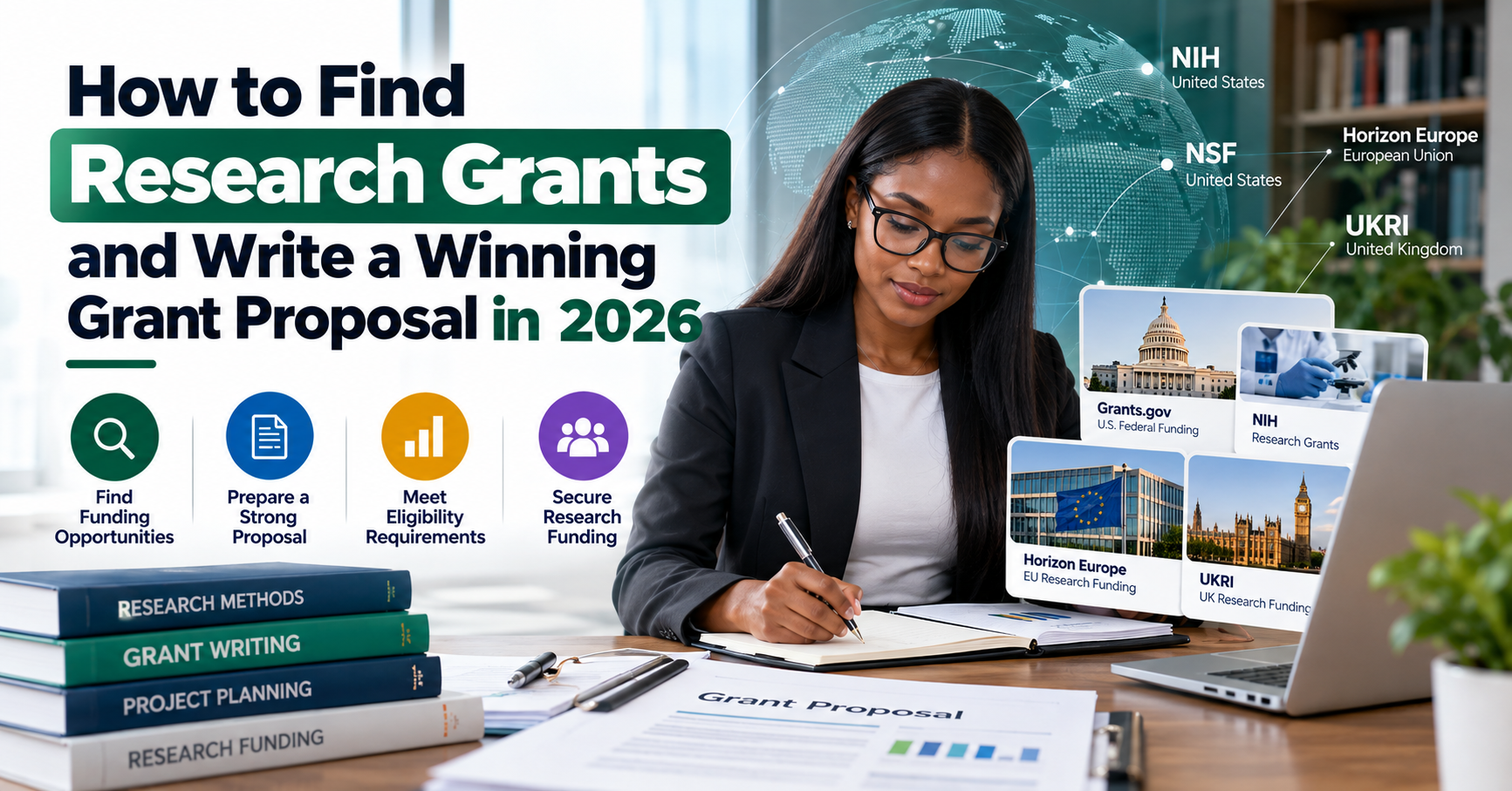
Securing research funding is one of the most important challenges facing university researchers, postgraduate students, scientists, engineers, academic institutions, and innovation-focused professionals.
Whether you are conducting research in artificial intelligence, healthcare, engineering, environmental science, education, agriculture, or the social sciences, research grants can provide essential financial support for projects that generate new knowledge and address important problems.
However, obtaining research funding requires more than having an interesting research idea. Applicants must identify suitable funding opportunities, meet eligibility requirements, demonstrate the significance of their proposed work, develop a credible research methodology, and prepare a competitive grant proposal.
In 2026, researchers can explore funding through government agencies, international research programs, universities, foundations, professional associations, and private organizations.
This comprehensive guide explains how to find research grants and write a strong research grant proposal in 2026, including where to search, how to assess eligibility, how to prepare budgets, and how to improve proposal quality.
If you need assistance with grant research, proposal organization, or academic grant writing, explore professional research grant support services on Paperza.
What Is a Research Grant?
A research grant is financial support awarded by a government agency, university, foundation, research institution, company, or other funding organization to support a defined research project or activity.
Research grants may cover eligible project expenses such as research personnel, equipment, laboratory materials, fieldwork, data collection, travel, software, and dissemination activities.
Unlike ordinary commercial loans, research grants generally do not require repayment when recipients comply with the award terms.
However, grant recipients must meet applicable financial, reporting, research, ethical, and administrative obligations.
Common Types of Research Grants
Individual research grants: Funding for eligible researchers conducting specific research projects.
Collaborative research grants: Funding for research teams or institutions working together on shared research objectives.
Early-career researcher grants: Opportunities designed for eligible new investigators, postdoctoral researchers, or emerging academics.
Doctoral and postgraduate research funding: Scholarships, fellowships, and project-based funding supporting advanced research training.
Innovation and commercialization grants: Funding for qualifying technology development, applied research, and commercialization activities.
Institutional research grants: Funding awarded to eligible universities, research centers, and organizations.
The availability and requirements of each funding type depend on the funder and specific funding call.
Why Research Grants Matter for Researchers
Research funding can make it possible to conduct projects that would otherwise be difficult to undertake.
Support Scientific Discovery
Grants provide resources for experiments, research equipment, data collection, technical analysis, and other activities needed to investigate important questions.
Enable Research Collaboration
Many funding schemes encourage partnerships between universities, research organizations, industries, and international collaborators.
Support Early-Career Researchers
Some programs provide opportunities for doctoral researchers, postdoctoral scholars, and early-career investigators to develop independent research experience.
Advance Technological Innovation
Funding can support projects addressing engineering challenges, healthcare technologies, climate adaptation, energy systems, and other scientific priorities.
Strengthen Research Capacity
Successful projects can create research infrastructure, develop specialized expertise, and support knowledge exchange.
Research grants should be pursued for their genuine scientific and societal value rather than as a way to obtain credentials without undertaking the funded work.
Step 1: Identify Your Research Funding Needs
Before searching for grant opportunities, define the project you intend to fund.
A clear understanding of your research requirements will help you identify suitable funding programs.
Start by answering these questions:
- What research problem are you investigating?
- Why is the problem important?
- What are the main research objectives?
- What methodology will you use?
- What outcomes do you expect?
- How long will the project take?
- What financial resources are required?
- Will the project involve collaborators or institutional partners?
Example Research Project
Research Area: Artificial Intelligence and Healthcare
Proposed Topic: Privacy-Preserving Machine Learning for Predicting Hospital Readmission Risk
Research Objective: Develop and evaluate a machine learning approach designed to protect sensitive patient information while supporting clinically meaningful predictions.
Potential Funding Needs: Research personnel, computing resources, permitted data access, model development, and evaluation activities.
A well-defined research project makes it easier to identify funding opportunities aligned with your goals.
Step 2: Find Legitimate Research Grant Opportunities in 2026
Researchers can discover grants through official funding databases, research councils, university funding offices, and international funding programs.
The most suitable platform depends on your country, discipline, career stage, institution, and research objectives.
1. Grants.gov — United States
Grants.gov is an official U.S. government platform for finding federal grant opportunities.
Researchers and eligible organizations can search for funding announcements by agency, keyword, funding category, and other available filters.
The platform also provides grant application and registration guidance.
Best for: Identifying U.S. federal funding opportunities.
Not every grant is open to individual researchers or organizations outside the United States.
2. National Institutes of Health (NIH)
The NIH Grants and Funding portal provides information about biomedical, behavioral, and health-related research funding.
Researchers can explore funding announcements, identify relevant participating institutes, and review submission requirements.
As of 2026, Grants.gov is the official source for published NIH notices of funding opportunities, while NIH provides dedicated search and filtering tools.
Best for: Biomedical, clinical, health sciences, and relevant interdisciplinary research.
3. U.S. National Science Foundation (NSF)
The National Science Foundation supports research in many areas of science, engineering, and education.
NSF provides official funding opportunities, proposal preparation guidance, and information about its review and award process.
Best for: Eligible fundamental scientific, engineering, and educational research.
4. Horizon Europe — European Union
Horizon Europe is the European Union's major research and innovation funding program.
Researchers can explore research grants, fellowships, collaborative projects, and innovation opportunities.
Funding calls and application information are available through the official EU Funding and Tenders Portal.
Best for: Research institutions, collaborative projects, and eligible researchers seeking European research funding.
5. UK Research and Innovation (UKRI)
UK Research and Innovation publishes research funding opportunities across disciplines supported by its research councils and related programs.
Researchers can search for opportunities and review eligibility requirements, application procedures, and deadlines.
Best for: Researchers and institutions eligible for UK research funding.
6. University Research Funding Offices
Many universities maintain research development offices that identify grant opportunities and assist eligible researchers with applications.
University research administrators may also help interpret funding rules, calculate budgets, and manage institutional approvals.
7. Research Foundations and Professional Associations
Some charitable foundations, professional societies, and industry organizations provide research awards, fellowships, and grants.
Researchers should confirm each organization's legitimacy and the specific conditions of any funding opportunity.
Step 3: Check Grant Eligibility Before Applying
One of the most common mistakes in grant applications is preparing a proposal without confirming eligibility.
Every research grant has specific requirements.
Important Eligibility Factors
Applicant status: Some grants are available to individual researchers, while others require applications from universities or legally registered institutions.
Country eligibility: Certain funding schemes restrict participation to particular countries or institutions.
Research discipline: The proposed project must match the funder's eligible research areas.
Career stage: Some programs support doctoral students, postdoctoral scholars, or established investigators.
Institutional affiliation: Applicants may need an eligible host organization.
Project duration: Proposed activities must fit within the permitted funding period.
Budget limits: Funding requests must comply with the grant's financial restrictions.
Partner requirements: Collaborative programs may require specific institutional or international partners.
For example, NIH funding notices contain dedicated eligibility sections, and applicants must satisfy both the program-specific requirements and applicable general policies.
Never assume a grant is internationally accessible simply because its application website is public.
Step 4: Understand What Grant Reviewers Look For
Funding agencies assess proposals against specific evaluation criteria.
Although the criteria differ between programs, reviewers commonly examine the research's significance, scientific approach, feasibility, applicant capability, and expected outcomes.
Scientific Importance
Does the project address a meaningful research question or practical problem?
Originality and Contribution
Will the research generate new knowledge, improve existing methods, or provide valuable findings?
Methodological Quality
Are the proposed procedures scientifically appropriate and adequately explained?
Feasibility
Can the project realistically be completed within the proposed budget and timeline?
Research Team Qualifications
Do the investigators have the expertise, resources, and experience needed to conduct the work?
Expected Outcomes and Impact
What benefits, findings, outputs, or wider contributions may result from the project?
A strong grant application addresses the specific evaluation criteria listed by the funder rather than relying on general statements about the importance of research.
Step 5: Write a Clear and Compelling Research Grant Proposal
A research grant proposal explains what you intend to investigate, why it matters, how the research will be conducted, and why the funder should consider supporting it.
The structure depends on the funding opportunity, but many proposals contain the following elements.
1. Research Project Title
The title should clearly communicate the proposed investigation.
Avoid exaggerated claims, overly broad wording, and unnecessary technical complexity.
Example:
"Development of Explainable Machine Learning Models for Early Detection of Cardiovascular Risk"
2. Executive Summary or Project Abstract
The abstract provides a concise overview of the proposed project.
It should identify the research problem, objectives, methodology, expected outputs, and significance.
Avoid presenting anticipated outcomes as if they have already been demonstrated.
3. Background and Problem Statement
Describe the research context and explain the problem the project addresses.
Use credible academic literature, reliable statistics, and relevant evidence to demonstrate why the research matters.
4. Research Objectives
State the specific outcomes the project is designed to achieve.
Objectives should be realistic, measurable where appropriate, and consistent with the proposed methodology.
5. Literature Review
Summarize and critically evaluate relevant research.
Explain existing knowledge, limitations, unresolved questions, and how your project will contribute.
6. Research Methodology
Describe the methods that will be used to achieve the objectives.
Depending on your discipline, this may include:
- Research design.
- Data sources and sampling.
- Experimental procedures.
- Data collection methods.
- Analytical techniques.
- Software, equipment, or laboratory resources.
- Validation procedures.
- Ethical safeguards.
- Risk mitigation strategies.
A credible methodology should allow reviewers to understand whether the proposed work can realistically produce the intended results.
7. Expected Outcomes
Identify the research outputs you reasonably expect to deliver.
These may include scientific findings, research datasets, prototypes, technical reports, publications, policy recommendations, or other appropriate outputs.
Avoid promising discoveries or results that cannot be guaranteed.
8. Research Impact
Explain the potential scientific, economic, educational, technological, environmental, or societal significance of the work.
Where the funder requires a specific impact pathway, address that requirement directly.
9. Project Timeline
Provide a realistic sequence of activities, milestones, and deliverables.
10. Budget and Budget Justification
Explain the costs necessary to complete the project and demonstrate that they are allowable under the grant rules.
For professional help improving proposal structure, academic language, or budget presentation, explore research grant proposal preparation services on Paperza.
Step 6: Develop a Realistic Research Budget
A research budget should clearly explain how the requested funds will support project activities.
Depending on the funding program, eligible expenses may include:
| Budget category | Possible expenses |
| Personnel | Research assistants, technical staff, or eligible investigator effort |
| Equipment | Approved scientific equipment and instruments |
| Materials | Laboratory consumables and research supplies |
| Data collection | Surveys, fieldwork, data access, or participant-related expenses |
| Computing | Eligible cloud computing, software, or data-processing costs |
| Travel | Approved research travel, field visits, or collaboration meetings |
| Dissemination | Eligible publication, reporting, or knowledge-sharing costs |
| Institutional costs | Permitted indirect costs or overhead |
The exact categories and allowable amounts depend on the funding rules.
Example Illustrative Budget
For a hypothetical 12-month research project requesting $50,000:
| Expense | Estimated cost |
| Research personnel | $20,000 |
| Equipment and computing | $10,000 |
| Data collection | $8,000 |
| Software and analysis | $4,000 |
| Travel and collaboration | $3,000 |
| Dissemination and reporting | $2,000 |
| Contingency, only if permitted | $3,000 |
| Total | $50,000 |
This example is illustrative, not a budget approved by any funding agency.
Some grants prohibit general contingency allocations or impose restrictions on specific expenses.
Always consult the funder's budget rules.
Step 7: Create a Practical Research Timeline
Funders need confidence that the proposed activities can be completed within the award period.
For a hypothetical 12-month project, the timeline might look like this:
| Period | Research activities |
| Months 1–2 | Project planning, literature review, ethics approvals |
| Months 3–4 | Method development and data preparation |
| Months 5–7 | Experiments or data collection |
| Months 8–9 | Analysis, validation, and interpretation |
| Months 10–11 | Reporting, dissemination, and manuscript preparation |
| Month 12 | Final deliverables and required reporting |
A timeline should be based on the actual research methods, staffing, dependencies, and administrative requirements.
Include contingency planning where appropriate without inventing unrealistic deadlines.
Step 8: Demonstrate Research Team Expertise
Funding organizations often assess whether the applicant or research team can successfully complete the proposed work.
Relevant evidence may include academic qualifications, previous research accomplishments, technical expertise, professional experience, and documented collaborations.
Strengthen Your Research Profile
Maintain accurate records of:
- Educational qualifications.
- Research publications.
- Previous research projects.
- Relevant research funding.
- Technical skills.
- Professional roles.
- Research collaborations.
- Awards or scholarly recognition.
A well-organized research CV can make it easier for evaluators to understand your qualifications.
However, a long publication list or extensive CV does not replace a sound proposal.
Collaborate Where Necessary
Some projects require expertise across different disciplines.
For example, a healthcare AI project may benefit from collaboration among computer scientists, clinical researchers, and data governance specialists.
Include only genuine collaborators who have agreed to participate.
Step 9: Address Research Ethics, Data Management, and Compliance
Research funders may require applicants to explain how the project will address ethical and legal obligations.
Requirements may involve:
Human participants: Relevant ethics approval, informed consent, and participant protections.
Personal information: Data privacy, access controls, and secure handling of personal data.
Animal research: Applicable ethical approvals and animal welfare protections.
Research integrity: Accurate reporting, responsible authorship, and the prevention of fabrication, falsification, and plagiarism.
Data management: Secure storage, access arrangements, retention, and sharing practices.
Open science: Compliance with any applicable public access, data sharing, or research output policies.
Artificial intelligence: Responsible AI use and compliance with funder-specific disclosure or data-security requirements.
Always follow the specific funding agency's latest rules.
Step 10: Follow the Funder's Application Instructions
A competitive scientific proposal can still encounter problems if it does not comply with submission requirements.
Before submitting, check:
- The correct funding opportunity number.
- Applicant and institutional eligibility.
- Registration requirements.
- Submission deadlines and time zones.
- Application forms.
- Required document formats.
- Page and word limits.
- Budget restrictions.
- Research ethics documentation.
- Institutional signatures or approvals.
- Evaluation criteria.
Special Considerations for NIH and NSF
NIH requires applications to respond to a particular notice of funding opportunity and follow the applicable instructions.
For NSF, proposals generally must follow the effective Proposal and Award Policies and Procedures Guide and the requirements of the specific funding opportunity.
Institutional registration can take time, so applicants should coordinate with their university or organization's research administration office well before the deadline.
Step 11: Review and Improve Your Grant Proposal
Before submitting, assess the proposal from a reviewer's perspective.
Is the Research Problem Clear?
A reviewer should be able to understand the problem and why it matters.
Are the Objectives Specific?
Avoid objectives that are too broad, unclear, or unrelated to the available resources.
Is the Methodology Convincing?
Explain why the selected methods are suitable and how the project will address research risks.
Is the Budget Justified?
Every cost should relate to actual project activities and meet the applicable grant rules.
Does the Project Match the Funding Call?
The proposal should directly respond to the funder's priorities and assessment criteria.
Is the Writing Professional?
Use clear headings, concise paragraphs, accurate references, and consistent terminology.
Consider obtaining feedback from knowledgeable colleagues or qualified grant-writing professionals.
You can also explore professional grant proposal editing and research funding support on Paperza.
Step 12: Submit Your Research Grant Application
Once the proposal and supporting documents are ready, follow the official submission procedure.
Some funding programs require submission through an institutional representative rather than directly by the principal investigator.
Others permit individual applicants to submit through designated portals.
Before the Deadline
Confirm that all documents have been uploaded successfully and that the application has passed any required system validations.
Submit early enough to resolve technical problems.
Retain the submission confirmation and relevant reference numbers.
After Submission
The funder may conduct administrative eligibility checks, scientific peer review, budget assessment, and other required evaluations.
Applicants may receive funding decisions, requests for clarification, or feedback on unsuccessful proposals.
Neither meeting the eligibility requirements nor submitting a strong proposal guarantees an award.
Common Reasons Research Grant Proposals Are Rejected
Weak Alignment With Funding Priorities
A proposal may be scientifically valuable but unsuitable for the funding program.
Unclear Research Objectives
Ambiguous or unrealistic objectives make it difficult for reviewers to assess the project.
Insufficient Research Justification
Applicants may fail to explain the research gap or significance of the proposed work.
Poor Methodological Design
Weak sampling, inadequate validation, or unclear analytical procedures can undermine scientific credibility.
Unrealistic Budgets
Excessive, unsupported, or prohibited expenses may create serious concerns.
Limited Evidence of Feasibility
A project may lack appropriate resources, partnerships, expertise, or realistic milestones.
Missing Required Documents
Incomplete application packages or formatting errors can prevent further consideration.
Generic Proposal Writing
Proposals copied between different funding opportunities without adapting to the specific evaluation criteria are often less persuasive.
Unsupported Impact Claims
Reviewers may question exaggerated economic benefits, guaranteed scientific breakthroughs, or predictions without credible supporting evidence.
How to Improve Your Chances of Research Grant Funding in 2026
Successful grant preparation requires a strategic, evidence-based approach.
Start early: Allow adequate time for project development, institutional approvals, budgeting, and review.
Read the full funding notice: Understand the funder's priorities, eligibility conditions, and evaluation criteria.
Contact program officers when appropriate: Some agencies encourage applicants to discuss whether their ideas fit the funding opportunity.
Use credible preliminary evidence: Relevant prior findings or pilot studies can help establish feasibility where appropriate.
Build the right team: Include qualified collaborators when the project requires expertise beyond your own.
Present realistic outcomes: Avoid guaranteeing scientific results or social impacts that cannot be assured.
Seek independent feedback: Ask knowledgeable colleagues to evaluate the proposal before submission.
Revise unsuccessful applications carefully: Where resubmission is permitted, use reviewer feedback to address weaknesses.
No single strategy guarantees research funding, but careful preparation can make an application clearer and more competitive.
Frequently Asked Questions About Research Grants in 2026
1. Where can I find research grants in 2026?
Researchers can search official sources such as Grants.gov, NIH, NSF, Horizon Europe, UKRI, university research offices, and recognized research foundations.
2. Can independent researchers apply for research grants?
Some grants allow applications from individuals, while others require eligible universities or organizations. Always check the specific opportunity's eligibility requirements.
3. Can international researchers apply for U.S. research grants?
Some U.S. programs permit certain foreign applicants or international partnerships, while others impose eligibility restrictions. The official funding notice determines who can apply.
4. What makes a strong research grant proposal?
A strong proposal clearly defines the research problem, explains its importance, presents appropriate methods, demonstrates feasibility, provides a justified budget, and aligns with the funding criteria.
5. Do I need a PhD to apply for research funding?
Not every funding opportunity requires a PhD. Eligibility depends on the grant program, career stage, institution, and applicant qualifications.
6. Can I use AI tools when writing a grant proposal?
AI-assisted writing may be permitted under some funding programs, but applicants must follow the funder's current policies, protect confidential information, and verify all content. Rules vary between organizations.
7. How long does research grant approval take?
Grant review timelines vary considerably depending on the funding organization, program, evaluation process, and award procedures.
8. Can I hire a professional grant proposal writer?
Yes. Legitimate services can assist with funding research, proposal organization, editing, methodology presentation, and budgeting. Applicants remain responsible for the accuracy of their applications and must follow the funder's rules concerning external assistance.
9. Does hiring a grant writer guarantee funding?
No. Funding decisions are made by the relevant organization through its evaluation and award process.
10. Can I apply for multiple research grants?
Sometimes, yes. Applicants must follow each funder's policies regarding overlapping applications, duplicate funding, disclosure, and submission restrictions.
Research Grant Application Checklist for 2026
Before submitting your application, confirm that:
- The funding opportunity is legitimate and currently open.
- Your institution and research team satisfy eligibility requirements.
- The proposed research aligns with the funder's priorities.
- The research question and objectives are clearly defined.
- The literature review establishes a meaningful research need.
- The methodology is appropriate and feasible.
- Expected outcomes are realistic.
- The project timeline is achievable.
- The budget is accurate and justified.
- Research ethics requirements are addressed.
- Required collaborators have agreed to participate.
- The application follows the required format.
- All references and supporting documents are accurate.
- Institutional approvals are obtained where required.
- Submission is completed before the official deadline.
Conclusion: Find the Right Grant and Prepare a Strong Research Proposal
Finding research grants and writing a competitive proposal in 2026 requires careful planning, credible research, and a clear understanding of funding requirements.
The process begins with identifying a meaningful research problem and matching it with a suitable funding opportunity.
A strong proposal should then demonstrate scientific significance, methodological quality, feasibility, realistic budgeting, and alignment with the funder's evaluation criteria.
Whether you are an early-career researcher, university lecturer, postgraduate student, scientist, engineer, or research professional, taking time to prepare an accurate and compelling application can improve the quality of your funding submission.
Need Professional Research Grant Proposal Support?
Paperza connects researchers and professionals with freelance service providers offering research-related assistance.
If you need help identifying relevant grant opportunities, structuring your proposal, improving academic language, or preparing supporting documents, explore:
Research Grant Writing and Funding Proposal Support on Paperza
Review the provider's listed services and discuss your research needs before placing an order.
Professional assistance does not guarantee funding, eligibility, or grant approval.
Discover research opportunities, prepare credible proposals, and explore professional research support on Paperza.
Official Research Funding Resources
- Grants.gov — U.S. Federal Grant Opportunities
- NIH — Research Funding Opportunities
- NIH — Writing a Grant Application
- NIH — Grant Writing Tips
- NSF — Research Funding
- NSF — Proposal and Award Policies
- European Commission — Research and Innovation Funding
- Horizon Europe — How to Apply
- UKRI — Funding Opportunities
Editorial note: Grant opportunities, eligibility requirements, funding limits, and submission deadlines change. Always verify the current official funding announcement before applying.
I will do grant writing, grant proposals, grant research, and grant applicati
Are you looking for funding opportunities or professional grant writing support? I provide grant writing, grant proposal development, grant research, and application assistance...
View Related Service >NEED PROFESSIONAL ASSISTANCE?
I will do grant writing, grant proposals, grant research, and grant applicati
Are you looking for funding opportunities or professional grant writing support? I provide grant writing, grant proposal development, grant...