EB-2 NIW Requirements in 2026: How to Build a Strong National Interest Waiver Case
By Paperza Editorial Team
|
28 Oct 2026
|
19 min read
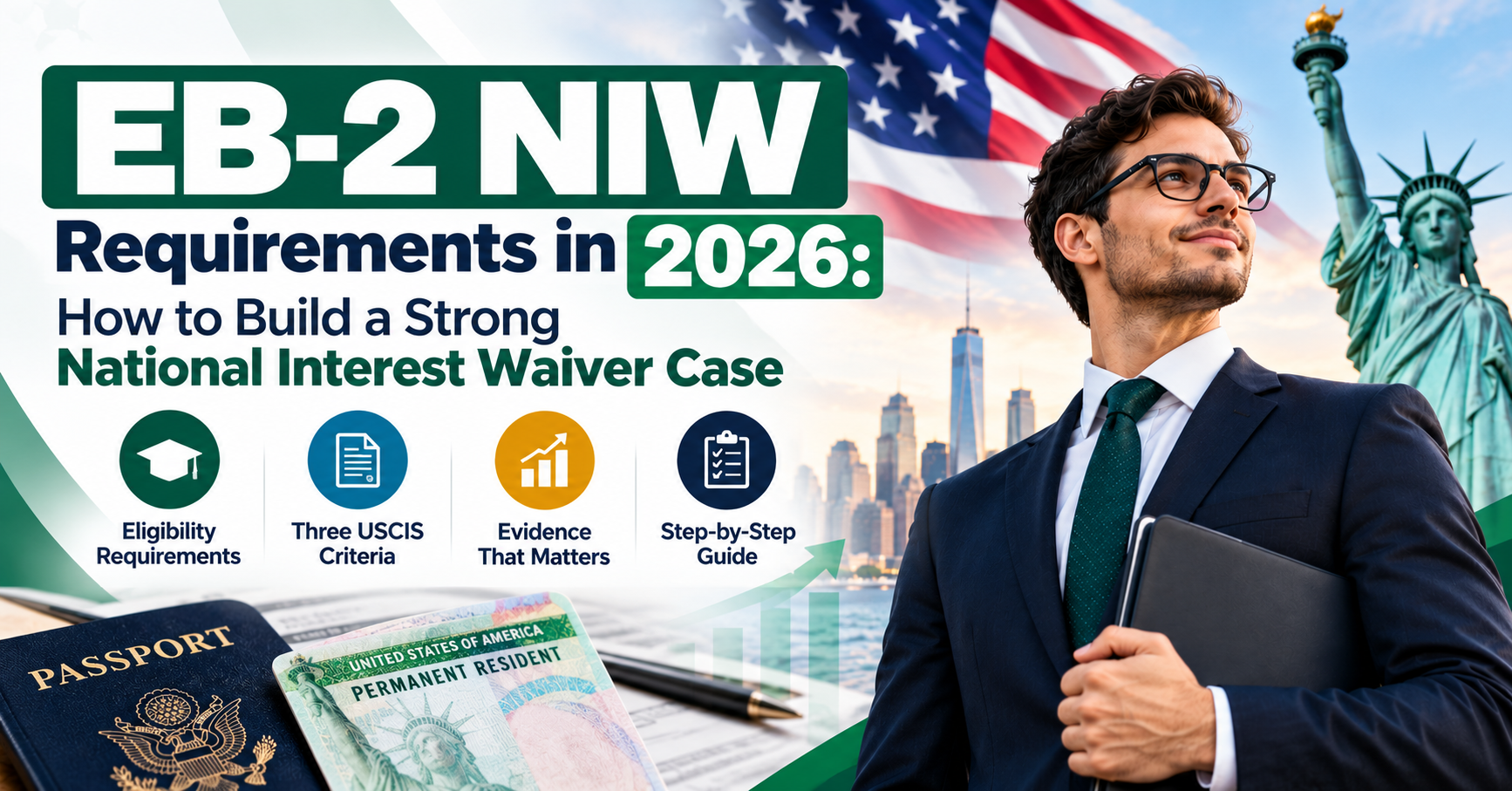
The EB-2 National Interest Waiver (NIW) is an important U.S. employment-based immigration pathway for qualified researchers, engineers, technology professionals, entrepreneurs, healthcare specialists, business professionals, and other individuals whose proposed work may benefit the United States.
Unlike the standard employer-sponsored EB-2 process, the National Interest Waiver allows eligible applicants to request an exemption from the job offer and permanent labor certification requirements.
This makes EB-2 NIW particularly attractive to professionals who want to pursue U.S. permanent residence based on their qualifications and a proposed endeavor that serves the national interest.
However, holding an advanced degree, publishing research papers, or operating a successful business does not automatically qualify someone for an EB-2 NIW.
Applicants must first establish eligibility for the underlying EB-2 immigrant classification and then demonstrate that their proposed endeavor satisfies the three-part National Interest Waiver framework.
In this comprehensive 2026 guide, we explain the EB-2 NIW eligibility requirements, the three USCIS evaluation factors, the evidence that matters, common petition weaknesses, and practical steps for organizing a credible case.
If you are preparing your academic or professional achievements for an immigration evidence portfolio, explore EB-2 NIW professional profile and documentation support on Paperza.
What Is the EB-2 National Interest Waiver?
The EB-2 category is the second-preference employment-based immigrant classification.
It generally covers professionals holding advanced degrees or their equivalents and individuals who demonstrate exceptional ability in the sciences, arts, or business.
Ordinarily, employer-sponsored EB-2 immigration involves a qualifying job offer and, in many cases, permanent labor certification.
The National Interest Waiver allows USCIS to waive these requirements when the applicant establishes that doing so would be in the United States' national interest.
Main Benefits of EB-2 NIW
Self-petitioning: Applicants may file their own Form I-140 without requiring an employer to submit the petition.
No permanent labor certification: A granted National Interest Waiver removes the usual PERM labor certification requirement.
No mandatory job offer: Applicants can propose qualifying work without first obtaining a specific U.S. employment offer.
Broad professional applicability: Potential applicants include researchers, entrepreneurs, engineers, physicians, technology professionals, and specialists in other fields.
Pathway to permanent residence: An approved EB-2 NIW petition can support a later green card application, subject to visa availability and other immigration requirements.
An approved I-140 petition does not itself grant a green card, lawful status, or unrestricted employment authorization.
Who Qualifies for EB-2 NIW in 2026?
EB-2 NIW eligibility involves two separate assessments.
First, applicants must qualify for the EB-2 classification through an advanced degree or exceptional ability.
Second, they must demonstrate that granting a National Interest Waiver is justified under the applicable three-prong test.
Route 1: Advanced Degree Professionals
An applicant may qualify for the underlying EB-2 classification by possessing an advanced degree, such as a qualifying master's degree, doctorate, or foreign equivalent.
Another possibility is a U.S. bachelor's degree or foreign equivalent followed by at least five years of progressive post-baccalaureate experience in the specialty.
USCIS examines whether the educational qualifications and experience meet the applicable requirements.
Under its January 2025 policy clarification, USCIS also considers whether the proposed occupation is a profession and whether the claimed progressive experience is relevant to the required specialty.
Simply holding a master's degree does not establish eligibility for the National Interest Waiver itself.
Route 2: Exceptional Ability
Applicants without a qualifying advanced degree may potentially establish EB-2 eligibility by demonstrating exceptional ability in the sciences, arts, or business.
Exceptional ability means expertise significantly above that ordinarily encountered in the relevant field.
USCIS regulations identify six categories of evidence, of which applicants generally must initially satisfy at least three.
These include:
- An official academic record showing a degree, diploma, certificate, or similar award related to the area of exceptional ability.
- Letters documenting at least ten years of full-time experience in the occupation.
- A professional license or certification.
- Evidence of salary or other remuneration demonstrating exceptional ability.
- Membership in professional associations.
- Recognition for achievements and significant contributions by peers, government entities, professional organizations, or business organizations.
Comparable evidence may be considered where the regulatory standards do not readily apply to the occupation.
Meeting three categories does not automatically establish exceptional ability. USCIS evaluates the evidence as a whole to determine whether the applicant meets the required level of expertise.
Understanding the Three EB-2 NIW Requirements
The central legal framework for a National Interest Waiver comes from the precedent decision Matter of Dhanasar.
Under this framework, USCIS may grant a waiver as a matter of discretion when the applicant demonstrates all three requirements:
- The proposed endeavor has both substantial merit and national importance.
- The applicant is well positioned to advance the proposed endeavor.
- On balance, waiving the job offer and labor certification requirements would benefit the United States.
Each requirement addresses a different question.
A strong petition should explain the proposed work, establish the applicant's ability to carry it forward, and demonstrate why the waiver is justified.
Prong 1: Demonstrate Substantial Merit and National Importance
The first prong evaluates the proposed endeavor rather than simply the importance of the applicant's profession.
What Is a Proposed Endeavor?
A proposed endeavor is the specific work, project, initiative, research program, or professional activity the applicant intends to pursue in the United States.
For example, stating that an applicant intends to work as a software engineer is generally less informative than describing a specific plan to develop and implement cybersecurity technologies addressing critical infrastructure vulnerabilities.
The endeavor should explain what the applicant intends to do, how it will be carried out, and why the expected impact matters.
What Is Substantial Merit?
Substantial merit can arise in areas such as:
- Scientific research and innovation.
- Technology and engineering.
- Business and entrepreneurship.
- Healthcare and public health.
- Education.
- Environmental sustainability.
- Cultural or artistic development.
- Other fields with meaningful value.
Substantial merit does not necessarily require an immediate economic benefit.
Scientific, educational, cultural, technological, and societal benefits can also be relevant.
What Is National Importance?
National importance concerns the potential broader implications of the specific endeavor.
USCIS may evaluate whether the proposed work has implications extending beyond the applicant's immediate employer, individual clients, or limited local activities.
A project does not necessarily need nationwide physical operations to have national importance.
Relevant considerations may include its potential impact on an industry, significant economic implications, scientific advancement, public health, technological development, or another area of broader significance.
Evidence That May Support Prong 1
Depending on the endeavor, useful documentation could include:
- A clearly written proposed endeavor statement.
- Credible government or industry reports.
- Published research identifying the underlying problem.
- Evidence of industry or societal needs.
- Documentation of potential applications and beneficiaries.
- Relevant independent studies.
- A credible professional or business plan.
- Evidence connecting the specific proposed work to broader implications.
General statements such as "artificial intelligence is important to the United States" are not enough by themselves.
The petition should establish why the applicant's particular AI endeavor has substantial merit and national importance.
Prong 2: Show That You Are Well Positioned to Advance the Endeavor
The second prong focuses on the applicant's qualifications, achievements, capabilities, and demonstrated progress.
USCIS considers whether the applicant is positioned to move the proposed endeavor forward.
It does not require proving that the proposed endeavor is guaranteed to succeed.
Education and Professional Experience
Relevant degrees, specialized training, professional certifications, and documented work experience may demonstrate the knowledge needed to pursue the endeavor.
Research Publications and Scholarly Contributions
For research-oriented applicants, scholarly publications may provide evidence of technical expertise and progress in a relevant field.
However, publication counts alone do not establish NIW eligibility.
The connection between the publications and the proposed endeavor is important.
Citations and Research Influence
Citation records may help demonstrate that other researchers have engaged with or relied on the applicant's work.
The value of this evidence depends on context, including relevance, independence, and the substance of the influence.
USCIS has not established a universal minimum citation count for NIW applicants.
Patents, Products, and Innovations
Patents, technical developments, deployed systems, and other innovations may demonstrate relevant achievements.
A patent by itself does not necessarily show that the applicant is well positioned. Evidence of meaningful development, adoption, licensing, or use may provide additional context.
Professional Leadership and Employment History
Documented roles in significant projects, research programs, or business initiatives may demonstrate experience relevant to the proposed endeavor.
Applicants should explain actual responsibilities and accomplishments rather than relying only on impressive job titles.
Evidence of Progress and External Interest
Letters of interest, research collaborations, customer engagement, funding commitments, pilot projects, and established partnerships may help show that the applicant has taken credible steps toward the proposed work.
For assistance organizing legitimate research, professional achievements, and supporting evidence, explore academic and professional documentation services on Paperza.
Prong 3: Explain Why Waiving the Job Offer and Labor Certification Requirements Benefits the United States
The third prong requires applicants to demonstrate that, on balance, it would benefit the United States to waive the usual job offer and labor certification requirements.
This analysis considers the circumstances of the applicant and the proposed endeavor.
Depending on the case, relevant considerations may include:
- Whether the nature of the endeavor makes traditional job sponsorship or labor certification impractical.
- The potential benefits of the applicant's proposed work.
- The urgency or significance of the proposed contribution.
- Whether the United States would benefit from the applicant's contributions even if other qualified U.S. workers are available.
- Evidence showing that allowing the applicant to pursue the endeavor serves the broader national interest.
Applicants should not assume that self-employment, entrepreneurial activity, or the desire for professional independence automatically satisfies this prong.
Instead, explain why the specific circumstances justify the requested waiver.
How to Write a Strong EB-2 NIW Proposed Endeavor Statement
A well-developed proposed endeavor statement is an important part of many NIW petitions.
It should clearly connect the applicant's planned activities with identifiable benefits and supporting evidence.
1. Define the Problem
Explain the scientific, economic, technological, healthcare, educational, or business problem the endeavor addresses.
Identify credible evidence demonstrating that the problem exists.
2. Describe the Proposed Solution
Explain the applicant's intended work in specific and realistic terms.
Avoid vague claims about transforming an entire industry without explaining the proposed activities.
3. Identify the Intended Beneficiaries
Explain who may benefit from the endeavor, such as U.S. organizations, research institutions, industries, communities, healthcare systems, or the broader public.
4. Demonstrate Broader Importance
Show how the proposed work could have implications beyond a single employer or ordinary professional assignment.
5. Present an Implementation Strategy
Where appropriate, describe milestones, technical methods, collaborators, resources, and anticipated activities.
6. Connect Past Achievements to Future Work
Explain how the applicant's previous education, experience, research, and professional accomplishments demonstrate the ability to pursue the proposed endeavor.
7. Support Assertions With Verifiable Evidence
Use credible documentation rather than unsupported predictions or speculative figures.
EB-2 NIW Requirements for Researchers and Scientists
Research professionals may present evidence demonstrating how their expertise and planned work relate to important scientific or technological challenges.
Relevant supporting material can include:
- Research degrees and academic credentials.
- Peer-reviewed publications.
- Research projects and documented findings.
- Independent citations and scholarly use.
- Competitive research funding.
- Relevant collaborations.
- Patents or implemented discoveries.
- Evidence of progress toward the proposed endeavor.
A researcher focusing on energy storage, for example, might propose developing more efficient battery technologies for particular U.S. energy applications.
Their petition would need to explain both the broader significance of the intended work and the evidence showing they are positioned to advance it.
A large number of papers or citations does not replace the Dhanasar analysis.
EB-2 NIW Requirements for Software Engineers and AI Professionals
Technology professionals may qualify where their educational or professional background satisfies the underlying EB-2 standard and their proposed endeavor meets the NIW requirements.
Potential fields include:
- Artificial intelligence and machine learning.
- Cybersecurity.
- Cloud computing.
- Data infrastructure.
- Critical systems engineering.
- Robotics.
- Semiconductor technologies.
- Advanced manufacturing.
An AI engineer, for example, might propose developing privacy-preserving machine learning systems for sensitive healthcare applications.
The case would need to explain the endeavor's broader importance, the engineer's relevant abilities, and why the requested waiver is justified.
Working in a high-demand technology field alone is not sufficient.
EB-2 NIW Requirements for Entrepreneurs
Entrepreneurs can pursue National Interest Waivers when they meet the applicable statutory and regulatory requirements.
However, business ownership and revenue generation do not automatically establish eligibility.
An entrepreneur should explain the specific proposed U.S. business endeavor, the potential broader implications, and their ability to execute the plan.
Evidence That May Help Entrepreneurs
Depending on the business and the applicant's circumstances, relevant evidence may include:
- A detailed and credible business plan.
- Documented funding or investment.
- Relevant professional experience.
- Product development and technical milestones.
- Customer or partner interest.
- Intellectual property.
- Contracts or commercial adoption.
- Evidence supporting broader economic or industry implications.
USCIS's January 2025 NIW guidance emphasizes that general predictions of job creation and economic benefits are not enough by themselves.
Entrepreneurial petitions must be assessed based on the actual evidence and individual circumstances.
What Makes a Strong EB-2 NIW Recommendation Letter?
Letters of support can be useful when they explain specific aspects of the applicant's work and their ability to pursue the proposed endeavor.
A strong letter generally identifies the recommender's relevant expertise and professional relationship with the applicant.
It should explain firsthand knowledge of the applicant's achievements, describe meaningful contributions, and connect those contributions with the proposed work.
Independent and Interested Recommenders
Independent experts may provide useful perspectives on professional influence or technical contributions.
Collaborators, supervisors, customers, and other knowledgeable individuals may provide firsthand evidence about work completed, results achieved, or progress made.
The credibility and substance of a letter matter more than the mere number of recommendations.
Avoid Generic Letters
Statements that an applicant is hardworking, talented, or deserving of immigration approval provide limited evidentiary support without specific facts.
Letters should be truthful, individualized, and consistent with the documentary record.
How to Organize an EB-2 NIW Evidence Portfolio
An organized petition should help the adjudicator understand the applicant's eligibility and the factual basis for each NIW prong.
One practical approach is to arrange the evidence into distinct sections.
Section A: Underlying EB-2 Eligibility
Include relevant academic degrees, credential evaluations where needed, professional experience evidence, or exceptional ability documentation.
Section B: Proposed Endeavor and National Importance
Provide the proposed endeavor statement and credible supporting evidence about its substantial merit and broader implications.
Section C: Qualifications and Ability to Advance the Endeavor
Include relevant accomplishments, technical work, research contributions, professional achievements, collaborations, and evidence of progress.
Section D: Justification for the Waiver
Explain why the facts support waiving the normal job offer and labor certification requirements.
Section E: Supporting Documentation
Organize exhibits with clear labels and references.
All documents should be authentic, accurate, and relevant.
Applicants should never manufacture awards, citations, professional memberships, research papers, patents, employment records, or recommendation letters for immigration purposes.
Step-by-Step EB-2 NIW Petition Preparation Process
Step 1: Evaluate the Applicant's Qualifications
Determine whether the applicant may meet the advanced degree or exceptional ability requirements.
Step 2: Identify the Proposed U.S. Endeavor
Define the specific work the applicant intends to pursue and ensure it corresponds to their qualifications and realistic future plans.
Step 3: Analyze All Three Dhanasar Prongs
Evaluate the evidence supporting national importance, the applicant's ability to advance the endeavor, and the justification for waiving the normal employment requirements.
Step 4: Collect Supporting Evidence
Gather degrees, employment verification, publications, letters, project documents, and other relevant materials.
Step 5: Prepare the Proposed Endeavor Statement
Write a specific, coherent account of the planned activities and their anticipated broader implications.
Step 6: Obtain Appropriate Supporting Letters
Seek factual letters from qualified individuals who can explain relevant achievements, progress, or professional impact.
Step 7: Prepare Form I-140 and Required Documents
Follow the current official USCIS instructions for the immigrant petition, required supporting forms, and applicable fees.
Step 8: Submit the Petition
File through the appropriate USCIS process and retain proof of submission.
Step 9: Respond to USCIS Requests if Issued
USCIS may request additional evidence or issue a Notice of Intent to Deny where appropriate.
Any response should directly address the identified concerns with accurate evidence and legal analysis.
Step 10: Complete the Permanent Residence Process When Eligible
An approved NIW petition is not the final step toward permanent residence.
Applicants may need to pursue adjustment of status or immigrant visa processing, depending on their circumstances, visa availability, and other requirements.
If you need legitimate assistance arranging your professional records and supporting documents, review EB-2 NIW profile preparation and research support services on Paperza.
For individualized legal advice, petition strategy, or representation, consult a qualified U.S. immigration attorney or another properly authorized legal representative.
Common Reasons EB-2 NIW Petitions Receive RFEs or Are Denied
1. An Unclear Proposed Endeavor
A petition that describes only the applicant's occupation may fail to explain the specific work they intend to advance.
2. Weak Evidence of National Importance
A field may be important, but the applicant must explain the broader implications of their particular proposed endeavor.
3. Reliance on Education Alone
Advanced degrees can establish underlying EB-2 eligibility but do not automatically satisfy the NIW three-prong test.
4. Limited Connection Between Achievements and Future Plans
Past accomplishments are more useful when their relevance to the proposed endeavor is clearly established.
5. Unsupported Business Projections
Speculative revenue estimates, general economic claims, or unsubstantiated employment projections may provide limited evidence.
6. Generic Recommendation Letters
Letters lacking specific details may fail to demonstrate the applicant's achievements or ability to advance the endeavor.
7. Inadequate Third-Prong Analysis
Applicants should explain why granting the waiver is beneficial rather than assuming that professional experience or job-market demand resolves the issue.
EB-2 NIW vs EB-1A: Key Differences
EB-2 NIW and EB-1A both provide potential self-petition options, but they apply different eligibility standards.
| Feature | EB-2 NIW | EB-1A |
| Underlying eligibility | Advanced degree or exceptional ability | Extraordinary ability |
| Primary assessment | Proposed endeavor and three NIW prongs | Regulatory evidence and sustained acclaim |
| Job offer | Waiver may be granted | Not required |
| PERM labor certification | Waived if NIW granted | Not required |
| Self-petition | Permitted | Permitted |
| Permanent residence | Subject to visa availability | Subject to visa availability |
Neither classification guarantees approval or immediate permanent residence.
A professional may qualify for one, both, or neither, depending on their achievements and circumstances.
Frequently Asked Questions About EB-2 NIW in 2026
Can I apply for EB-2 NIW without a PhD?
Yes. A PhD is not universally required. Applicants may qualify through an appropriate advanced degree, a bachelor's degree plus qualifying progressive experience, or exceptional ability.
Can I apply for EB-2 NIW without a job offer?
Yes. The NIW permits eligible applicants to request a waiver of the normal job offer requirement.
How many publications are required for EB-2 NIW?
USCIS does not impose a universal minimum publication count. Publications can support particular aspects of a petition, but their significance depends on the proposed endeavor and supporting evidence.
Do I need 100 or 500 Google Scholar citations?
No. There is no universal USCIS citation threshold for NIW eligibility.
Can someone without research publications qualify?
Potentially, yes. NIW eligibility is not restricted to academic researchers. Applicants may provide other relevant evidence based on their field and proposed endeavor.
Can entrepreneurs qualify for EB-2 NIW?
Yes, if they establish underlying EB-2 eligibility and satisfy the three NIW requirements using appropriate evidence.
Is a business plan mandatory for every NIW case?
No. A business or professional plan may be useful depending on the proposed endeavor, but it is not a universal standalone requirement.
How long does EB-2 NIW processing take?
Processing times vary. USCIS publishes processing-time information, and premium processing may be available for eligible Form I-140 NIW petitions. A faster I-140 decision does not guarantee immediate green card availability.
Can I apply for EB-2 NIW from outside the United States?
Yes. Eligible individuals can pursue an immigrant petition from abroad. The subsequent immigrant visa process depends on the applicant's circumstances and visa availability.
Can I use professional services to prepare my NIW documents?
Yes. Legitimate research, editing, formatting, and documentation assistance may be appropriate. Immigration legal advice and representation should be provided only by properly authorized professionals.
EB-2 NIW Evidence Checklist for 2026
Use this checklist to review your petition materials:
- Evidence of an advanced degree or exceptional ability.
- A clearly defined proposed U.S. endeavor.
- Evidence supporting substantial merit.
- Evidence supporting national importance.
- Relevant educational and professional records.
- Documentation of achievements and progress.
- Credible supporting letters, where appropriate.
- Evidence of interest, adoption, funding, or collaboration, where relevant.
- A well-supported explanation of the third NIW prong.
- Properly organized, authentic exhibits.
- Correct petition forms, filing instructions, and applicable fees.
- Current visa availability and immigration-process requirements checked.
Conclusion: Building a Strong EB-2 NIW Case in 2026
A strong EB-2 National Interest Waiver petition requires more than an impressive CV, academic qualifications, professional memberships, or research publications.
The applicant must first establish EB-2 eligibility and then demonstrate that their proposed endeavor has substantial merit and national importance, that they are well positioned to advance it, and that granting the waiver would benefit the United States.
The most persuasive cases connect professional qualifications, demonstrated achievements, credible supporting evidence, and a realistic proposed endeavor into a coherent explanation.
By understanding these requirements and addressing each element carefully, qualified professionals can prepare more complete and credible NIW petitions.
Explore EB-2 NIW Professional Support on Paperza
Paperza connects clients with freelance professionals providing academic, research, writing, and business-related services.
If you are preparing your professional portfolio or organizing supporting materials for an immigration application, explore:
EB-2 NIW Profile Development and Documentation Support
Research and Professional Evidence Preparation Support
Review the individual service descriptions and confirm the provider's qualifications and scope of work before ordering.
Professional documentation assistance cannot guarantee USCIS approval and does not replace authorized immigration legal advice.
Official Sources and Further Reading
Disclaimer: This article is for general educational purposes and does not constitute immigration legal advice. Eligibility and outcomes depend on individual circumstances and applicable law. Verify current USCIS requirements and consult a qualified U.S. immigration attorney or other authorized legal professional for individualized advice.
I will draft expert opinion letters for eb1a and eb2 niw petitions
Are you preparing an EB1A or EB2 NIW petition and need a professionally drafted expert opinion letter? I provide personalized expert opinion letter drafting services to help...
View Related Service >NEED PROFESSIONAL ASSISTANCE?
I will draft expert opinion letters for eb1a and eb2 niw petitions
Are you preparing an EB1A or EB2 NIW petition and need a professionally drafted expert opinion letter? I provide personalized expert...