EB-2 NIW for Tech Professionals and Researchers: Evidence Checklist for 2026
By Paperza Editorial Team
|
9 Nov 2026
|
19 min read
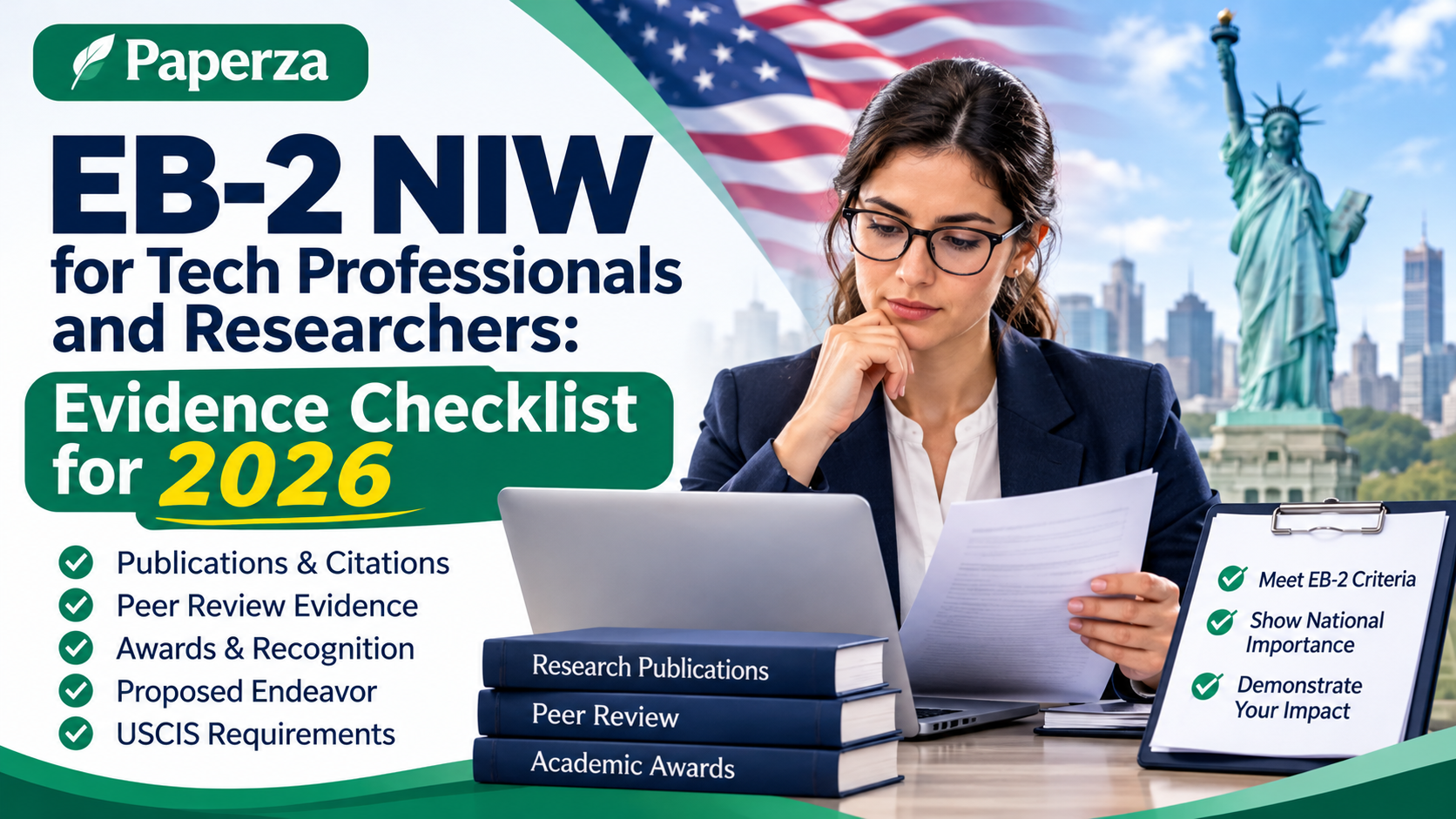
The EB-2 National Interest Waiver (NIW) is an employment-based U.S. immigration pathway that may allow qualified professionals to seek permanent residence without an employer-sponsored job offer or the labour certification process.
For technology professionals, engineers, scientists, entrepreneurs, and academic researchers, the EB-2 NIW can be an important option when their proposed work has substantial merit and national importance to the United States.
However, having a master's degree, publishing research papers, working in technology, or receiving professional awards does not automatically qualify someone for an NIW.
Applicants must first establish eligibility for the underlying EB-2 classification and then demonstrate that their proposed endeavor satisfies the three-prong test established in Matter of Dhanasar.
This 2026 guide explains the eligibility requirements, evidence to prepare, and practical checklist for technology professionals and researchers considering an EB-2 NIW petition.
1. What Is the EB-2 National Interest Waiver?
The EB-2 category is a U.S. employment-based immigrant visa classification for certain professionals holding advanced degrees and individuals who demonstrate exceptional ability in the sciences, arts, or business.
Ordinarily, an employment-based second-preference petition involves a job offer and labour certification. A National Interest Waiver allows USCIS to waive these requirements when the applicant demonstrates that doing so would be in the national interest of the United States.
An important advantage is that eligible applicants may self-petition using Form I-140 rather than depending on an employer to sponsor the petition.
Nevertheless, self-petitioning does not mean automatic approval. The applicant remains responsible for presenting sufficient evidence to establish every applicable eligibility requirement.
2. Who Qualifies for EB-2 NIW in 2026?
There are two principal ways to qualify for the underlying EB-2 classification.
A. Advanced Degree Professional
An applicant may qualify through an advanced degree if they hold:
- A U.S. advanced degree or a foreign equivalent degree; or
- A U.S. bachelor's degree or foreign equivalent, followed by at least five years of progressive post-baccalaureate experience in the specialty.
The degree and experience must satisfy the applicable regulatory requirements.
For example, a computer scientist with a relevant master's degree may qualify under the advanced-degree route. An engineer with a bachelor's degree and five years of qualifying progressive experience in the specialty may also potentially qualify.
A foreign degree should be evaluated for its U.S. equivalency where necessary. Applicants should not assume that every postgraduate diploma or professional certificate is equivalent to a U.S. advanced degree.
B. Exceptional Ability
Applicants who do not qualify through the advanced-degree route may be able to establish exceptional ability in the sciences, arts, or business.
The regulations provide six evidentiary criteria. An applicant generally needs to satisfy at least three:
- An official academic record relating to the area of exceptional ability.
- Letters documenting at least ten years of full-time experience in the occupation.
- A licence or certification to practise the profession or occupation, where applicable.
- Evidence of a salary or other remuneration demonstrating exceptional ability.
- Membership in professional associations.
- Recognition for achievements and significant contributions to the industry or field by peers, government entities, or professional or business organisations.
Meeting three criteria is not necessarily the end of the analysis. USCIS may also evaluate whether the overall evidence establishes that the applicant possesses a degree of expertise significantly above that ordinarily encountered in the field.
For an NIW petition, the applicant must also establish a connection between the claimed exceptional ability and the proposed endeavor.
Important: Qualifying for EB-2 through an advanced degree or exceptional ability does not automatically establish eligibility for the National Interest Waiver. The NIW requirements must be demonstrated separately.
3. Understand the Three EB-2 NIW Prongs
The three-prong framework comes from the Administrative Appeals Office decision in Matter of Dhanasar, 26 I&N Dec. 884 (AAO 2016).
Applicants should organise their evidence around these three questions.
Prong 1: Does the Proposed Endeavor Have Substantial Merit and National Importance?
The first prong concerns the specific work the applicant intends to pursue in the United States.
It is not enough to state that technology, artificial intelligence, healthcare, engineering, cybersecurity, or scientific research is important.
The applicant must explain their particular proposed endeavor and demonstrate its potential significance.
Examples of possible endeavors include:
- Developing artificial intelligence systems that address important healthcare or industrial challenges.
- Advancing cybersecurity technologies that improve the protection of critical infrastructure.
- Developing software systems that improve access to essential services.
- Conducting research into energy efficiency, advanced materials, or medical technologies.
- Developing engineering solutions that improve infrastructure resilience.
- Creating scientific innovations with potential applications beyond a single employer or organisation.
Evidence that may support this prong:
- A detailed proposed endeavor statement.
- Research or technology development plans.
- Government reports identifying relevant national priorities.
- Industry reports explaining the importance of the problem being addressed.
- Scientific publications supporting the proposed work.
- Evidence of potential economic, technological, public-health, educational, or societal benefits.
- Letters from relevant organisations explaining the importance of the endeavor.
- Evidence of prospective adoption, implementation, licensing, or wider use.
The key is to explain how the specific proposed work may have broader implications for a field, region, industry, or the public.
USCIS has clarified that the general importance of an occupation, a national worker shortage, or broad claims about job creation do not independently establish national importance.
Prong 2: Is the Applicant Well Positioned to Advance the Proposed Endeavor?
The second prong focuses on the applicant's qualifications, achievements, experience, resources, and realistic ability to advance the proposed work.
This is where a strong professional and research portfolio becomes particularly important.
Applicants should demonstrate not only what they have achieved but also how those achievements relate to their proposed endeavor.
Evidence that may support this prong includes:
- Academic qualifications.
- Professional licences and certifications.
- Research publications.
- Citation records.
- Peer-review invitations and completed reviews.
- Patents and intellectual property.
- Evidence that other researchers or organisations have used the applicant's work.
- Awards and competitive grants.
- Media coverage of relevant achievements.
- Leadership roles in significant projects.
- Employment and project records.
- Letters from recognised experts.
- Evidence of funding, partnerships, contracts, or prospective users.
- A credible plan for continuing the proposed work in the United States.
For researchers, evidence of publication, citation impact, peer review, research leadership, and independent recognition may help establish professional credibility.
For technology professionals, relevant evidence may include software products, technical leadership, patents, open-source contributions, industry adoption, commercial deployments, and documented project outcomes.
The evidence should establish a logical connection between the applicant's past record and the proposed future endeavor.
Prong 3: Would It Benefit the United States to Waive the Job Offer and Labour Certification Requirements?
The third prong asks whether, on balance, the United States would benefit from waiving the normal job-offer and labour-certification requirements.
Applicants should explain why allowing them to advance the proposed endeavor without those requirements would be beneficial.
Potential supporting evidence may include:
- The nature of the proposed endeavor makes a traditional job offer or labour certification impractical.
- The applicant's work may benefit the United States even if other qualified U.S. workers are available.
- The proposed endeavor may provide time-sensitive benefits.
- The applicant has specialised knowledge or experience that is particularly relevant to the proposed work.
- The proposed work involves research, entrepreneurship, collaboration, or multiple projects that may not fit neatly within a single employer-sponsored position.
The argument should be specific to the applicant's circumstances. Simply stating that the applicant wants to work independently or that the United States needs skilled professionals is not enough.
4. EB-2 NIW Evidence Checklist for Technology Professionals
Technology professionals should build an evidence portfolio that demonstrates their technical expertise, documented achievements, and ability to advance a nationally important endeavor.
The following documents may be useful, depending on the applicant's background.
A. Education and Professional Qualifications
- Bachelor's degree certificate.
- Master's degree certificate, if applicable.
- PhD certificate, if applicable.
- Academic transcripts.
- Foreign degree equivalency evaluation, where appropriate.
- Relevant technical certifications.
- Professional licences, where applicable.
- Evidence of specialised training.
B. Employment and Technical Experience
- Updated professional CV.
- Employment verification letters.
- Job descriptions showing relevant responsibilities.
- Evidence of progressive professional experience.
- Records of technical leadership.
- Documentation of significant projects.
- Contracts or project completion records.
- Evidence of promotions or increased responsibility.
C. Technology and Innovation Portfolio
- Patents or patent applications.
- Software products and technical platforms.
- Documented system deployments.
- Open-source contributions.
- Technical reports and architecture documents.
- Evidence of product adoption.
- Licensing agreements.
- Commercial partnerships.
- Evidence of measurable improvements resulting from the applicant's work.
For software engineers and AI professionals, a GitHub profile or technical portfolio may be useful when it demonstrates original work, meaningful contributions, and real-world impact.
A profile link alone is usually less persuasive than documentation explaining the applicant's specific contributions and their significance.
D. Publications and Professional Recognition
- Peer-reviewed journal articles.
- Conference papers.
- Technical publications.
- Citation reports.
- Evidence of independent recognition.
- Awards and professional honours.
- Invitations to speak at relevant conferences.
- Media coverage of significant work.
- Evidence of participation in recognised technical communities.
Not every technology professional needs academic publications. The evidence should reflect the nature of the proposed endeavor and the applicant's actual achievements.
5. EB-2 NIW Evidence Checklist for Researchers and Academics
Researchers often have an academic record that can support an NIW petition. However, a publication list alone does not demonstrate all three NIW prongs.
The applicant should explain the significance of their research, demonstrate how others have recognised or used it, and connect their academic work to the proposed endeavor.
A. Academic Qualifications
- Bachelor's degree certificate.
- Master's degree certificate.
- PhD certificate, if applicable.
- Academic transcripts.
- Degree equivalency evaluation, where appropriate.
- Research training certificates.
- Relevant academic appointments.
B. Research Publications
- Published journal articles.
- Conference proceedings.
- Book chapters.
- Research reports.
- Review articles.
- Technical publications.
- DOI links and publication records.
- Evidence of journal quality and relevance.
The applicant should provide accurate publication details and avoid overstating the significance of journals or conferences.
C. Citation Evidence
- Google Scholar profile.
- Citation report.
- Total citation count.
- h-index, where relevant.
- Highly cited publications.
- Evidence of independent citations.
- Examples of other researchers discussing or building upon the applicant's work.
Citation numbers should be presented accurately and in context. There is no universal minimum citation count that guarantees NIW eligibility.
D. Peer Review and Editorial Activities
- Journal peer-review invitations.
- Completed peer-review records.
- Editorial board appointments.
- Conference reviewing activities.
- Reviewer recognition certificates.
- Evidence of repeated reviewing assignments.
- Documentation from recognised journals or professional organisations.
Peer-review evidence may help demonstrate recognition and professional standing. However, a reviewer certificate alone does not establish that the applicant satisfies the NIW requirements.
E. Research Impact and Contributions
- Evidence that other researchers have adopted the applicant's methods.
- Evidence of practical implementation.
- Research collaborations.
- Patents arising from research.
- Technology transfer records.
- Research grants.
- Institutional recognition.
- Evidence of contributions to important scientific or technological challenges.
A strong portfolio explains why the work matters, who has benefited from it, and how it supports the proposed endeavor.
6. Recommendation Letters: What Should They Demonstrate?
Recommendation letters can strengthen an NIW petition when they provide specific, credible, and independently supported information.
A useful letter should explain:
- Who the recommender is and their relevant expertise.
- How they know the applicant or their work.
- Which specific achievements they are discussing.
- Why those achievements are important.
- How the applicant's work relates to the proposed endeavor.
- What potential impact the applicant's future work may have.
Independent letters from experts who have not directly supervised or employed the applicant can be particularly useful when they provide a credible assessment of the applicant's contributions.
However, letters should not simply repeat generic statements such as:
- The applicant is highly talented.
- The applicant is one of the best researchers.
- The applicant will benefit the United States.
- The applicant is an exceptional professional.
Such statements are more useful when supported by specific examples and documentary evidence.
Letters should be truthful, independently written, and consistent with the rest of the petition. Applicants should never manufacture endorsements or misrepresent a recommender's relationship with them.
7. Prepare a Clear Proposed Endeavor Statement
The proposed endeavor statement is a central part of the petition because it explains what the applicant intends to accomplish in the United States.
It should be specific enough for USCIS to understand the applicant's plans and assess their potential importance.
A useful statement generally addresses:
1. The proposed work: What exactly will the applicant do?
2. The problem: What important problem or opportunity will the endeavor address?
3. The national relevance: Why could the work matter to the United States beyond the applicant's personal career or a single employer?
4. The applicant's qualifications: What education, experience, research, or technical achievements prepare the applicant to undertake the work?
5. The implementation plan: How does the applicant intend to advance the endeavor?
6. The expected outcomes: What realistic results or broader benefits could the work produce?
For example, a software engineer should avoid describing the proposed endeavor only as "working as a software developer."
A more meaningful statement would identify the particular technology, problem, intended users, development plan, and potential wider impact.
The statement must describe genuine intentions and realistic plans. It should not promise results that the applicant cannot substantiate.
8. What Changed in USCIS NIW Guidance and Why It Matters in 2026
On January 15, 2025, USCIS issued Policy Alert PA-2025-03, updating its guidance on EB-2 eligibility and National Interest Waiver petitions.
The update clarified several important areas:
Underlying EB-2 eligibility: Applicants must first establish that they qualify as advanced-degree professionals or individuals of exceptional ability before USCIS considers the waiver request.
Professional experience: USCIS clarified how it evaluates whether an occupation is a profession and whether five years of post-baccalaureate experience is in the relevant specialty.
Exceptional ability: The relationship between the applicant's area of exceptional ability and proposed endeavor must be established.
National importance: USCIS provided additional guidance on evaluating the specific proposed endeavor rather than relying on broad claims about the importance of an industry or occupation.
Recommendation letters and business plans: USCIS clarified how it considers these documents when determining whether an applicant is well positioned to advance the proposed endeavor.
Entrepreneurs: The guidance explains that business ownership or general claims about job creation do not automatically establish NIW eligibility. Evidence should demonstrate the applicant's role, progress, resources, and the potential significance of the proposed business endeavor.
The three-prong Matter of Dhanasar framework remains the basis of the NIW analysis. The 2025 guidance clarified how USCIS evaluates evidence under that framework; applicants preparing cases in 2026 should use the current USCIS Policy Manual rather than relying solely on older online checklists.
9. Common EB-2 NIW Mistakes to Avoid
Mistake 1: Treating a Master's Degree as Automatic Qualification
An advanced degree may establish the underlying EB-2 classification, but it does not independently satisfy the NIW requirements.
Better approach: Build separate arguments for EB-2 eligibility and all three NIW prongs.
Mistake 2: Relying Only on Publications
A large number of research papers does not automatically establish national importance or the applicant's ability to advance a specific endeavor.
Better approach: Explain the significance of the research and provide evidence of citations, adoption, implementation, or recognition where available.
Mistake 3: Making General Claims About Technology
Statements such as "AI is important to the United States" or "cybersecurity is a national priority" may provide context, but they do not establish the national importance of an individual's specific endeavor.
Better approach: Connect the applicant's proposed work to a clearly identified problem and provide evidence of its potential broader impact.
Mistake 4: Submitting Generic Recommendation Letters
Letters that contain praise without specific examples may carry limited evidentiary value.
Better approach: Use detailed letters that explain actual contributions, their significance, and the connection to the proposed endeavor.
Mistake 5: Failing to Connect Past Achievements to Future Work
An applicant may have an impressive CV but still fail to explain how their experience prepares them to advance the proposed endeavor.
Better approach: Build a clear connection between qualifications, achievements, proposed work, and expected outcomes.
Mistake 6: Presenting Unsupported Business or Research Plans
A proposed project or business plan should be realistic and supported by relevant evidence.
Better approach: Include a credible implementation plan, relevant experience, partnerships, resources, progress, or other documentation where available.
Mistake 7: Assuming Every Evidence Category Is Mandatory
There is no universal requirement that every NIW applicant must have a patent, a particular number of publications, a specific citation count, or a certain number of recommendation letters.
Better approach: Select evidence based on the applicant's actual background, proposed endeavor, and the legal questions that must be addressed.
10. Practical EB-2 NIW Evidence Checklist for 2026
Use this checklist to organise your initial documentation.
Personal and Academic Records
- Valid passport and identity information.
- Updated professional CV.
- Bachelor's degree certificate.
- Master's or PhD certificate, if applicable.
- Academic transcripts.
- Degree equivalency evaluation, where appropriate.
- Relevant professional licences or certifications.
Professional Experience
- Employment verification letters.
- Evidence of relevant progressive experience.
- Job descriptions and responsibilities.
- Project records.
- Leadership and management evidence.
- Technical or research achievements.
Research and Technical Evidence
- Journal publications.
- Conference papers.
- Citation records.
- Google Scholar profile, where relevant.
- Peer-review records.
- Editorial appointments, where applicable.
- Patents and intellectual property.
- Evidence of research or technology adoption.
- Awards and grants.
- Media coverage of significant work.
Proposed Endeavor
- Clearly defined proposed endeavor.
- Detailed statement of intended work.
- Explanation of substantial merit.
- Evidence supporting national importance.
- Implementation or research plan.
- Relevant government or industry reports.
- Evidence of potential users, partners, or beneficiaries.
Recommendation and Supporting Documents
- Independent expert recommendation letters, where appropriate.
- Letters from relevant institutions or organisations, where available.
- Evidence supporting the recommenders' expertise.
- Supporting documents for important claims.
- Consistent information across the CV, letters, and petition.
Petition Preparation
- Underlying EB-2 eligibility established.
- Prong 1 argument supported.
- Prong 2 argument supported.
- Prong 3 argument supported.
- Evidence organised by legal issue.
- Proposed endeavor statement completed.
- Form I-140 and required supporting documents reviewed.
- Applicable filing fees and current USCIS instructions verified.
This checklist is a planning tool, not an official USCIS mandatory document list. The evidence needed will depend on the applicant's qualifications, proposed endeavor, and individual circumstances.
11. Can You Qualify for EB-2 NIW Without a PhD or Many Publications?
Yes, potentially.
A PhD is not a universal requirement for EB-2 NIW. Applicants may qualify through an advanced degree or the exceptional-ability route, provided they satisfy the applicable requirements.
Similarly, there is no universal minimum number of publications or citations required for every NIW applicant.
A technology professional with a relevant advanced degree, significant technical achievements, documented project impact, and a credible proposed endeavor may have evidence worth evaluating even without a substantial academic publication record.
A researcher with publications and citations may also have a potentially strong profile, but the evidence must still address the three NIW prongs.
The strength of a petition depends on the complete record, not a single qualification or achievement.
12. Get Professional Support With Your EB-2 NIW Profile
Preparing an EB-2 NIW petition requires more than collecting certificates and writing a professional biography. Applicants must organise evidence around the applicable immigration requirements and explain how their achievements support a specific proposed endeavor.
Researchers may need help presenting publications, citation records, peer-review activities, and research contributions. Technology professionals may need support documenting technical projects, innovation, leadership, and professional impact.
Paperza provides services that may help applicants organise and strengthen relevant professional and research evidence:
- Research and Professional Evidence Support — explore support for presenting relevant professional achievements and supporting evidence.
- EB-2 NIW and Immigration Profile Support — explore assistance related to preparing and organising an immigration-focused professional profile.
Before ordering, review each service description and confirm that the specific assistance you need is included.
Important: Paperza services do not guarantee an immigration outcome. USCIS makes the final eligibility decision. For legal advice, petition strategy, and representation, consult a qualified U.S. immigration attorney or accredited representative where appropriate.
Frequently Asked Questions
1. Is EB-2 NIW available to software engineers and IT professionals?
Potentially, yes. Software engineers, AI specialists, cybersecurity professionals, data scientists, and other technology professionals may qualify if they meet the underlying EB-2 requirements and demonstrate that their proposed endeavor satisfies the three NIW prongs.
2. Do I need a PhD to qualify for EB-2 NIW?
No. A PhD is not mandatory. Applicants may qualify through a relevant advanced degree, a bachelor's degree followed by at least five years of qualifying progressive post-baccalaureate experience in the specialty, or the exceptional-ability route.
3. How many publications or citations are required for EB-2 NIW?
There is no universal minimum number of publications or citations that guarantees eligibility. USCIS evaluates the totality of the evidence and its relevance to the applicant's qualifications, proposed endeavor, and NIW requirements.
4. Can I apply for EB-2 NIW without a job offer?
Yes. The purpose of the National Interest Waiver is to request a waiver of the job-offer and labour-certification requirements when the applicant establishes that the waiver is in the national interest.
5. Does EB-2 NIW guarantee a U.S. green card?
No. Approval of the I-140 petition does not itself guarantee immediate permanent residence. Applicants must also satisfy the applicable visa availability, admissibility, and subsequent adjustment-of-status or immigrant-visa requirements.
6. Is the 2025 USCIS NIW guidance still relevant in 2026?
Yes. USCIS issued the policy update on January 15, 2025, and it remains an important part of the guidance for evaluating NIW petitions. Applicants should always check the current USCIS Policy Manual and filing instructions before submitting.
Conclusion
The EB-2 National Interest Waiver can provide a valuable immigration pathway for qualified technology professionals and researchers whose proposed work may benefit the United States.
For 2026 applicants, the most important preparation step is to build an evidence-based case around the underlying EB-2 classification and the three Matter of Dhanasar prongs.
A strong portfolio should do more than list degrees, publications, awards, or professional experience. It should explain what the applicant intends to accomplish, why the work matters, what evidence demonstrates their ability to advance it, and why waiving the job-offer and labour-certification requirements would benefit the United States.
Start by evaluating your qualifications, defining your proposed endeavor, and organising evidence that directly supports each requirement.
Official reference: USCIS Policy Manual – Volume 6, Part F, Chapter 5.
I will draft professional recommendation letters for eb1a and eb2 niw
Professional EB1A & EB2 NIW Recommendation Letter Writing Services. Are you preparing an EB1A Extraordinary Ability or EB2 National Interest Waiver (NIW) petition and need...
View Related Service >NEED PROFESSIONAL ASSISTANCE?
I will draft professional recommendation letters for eb1a and eb2 niw
Professional EB1A & EB2 NIW Recommendation Letter Writing Services. Are you preparing an EB1A Extraordinary Ability or EB2 National...