O-1A vs EB-1A: Key Differences in Evidence, Sponsorship and Career Goals
By Paperza Editorial Team
|
7 Nov 2026
|
12 min read
Professionals with exceptional achievements in science, technology, business, education, athletics, and other qualifying fields may have more than one route to pursue a U.S. immigration opportunity. Two pathways that are frequently compared are the O-1A visa and the EB-1A immigrant category.
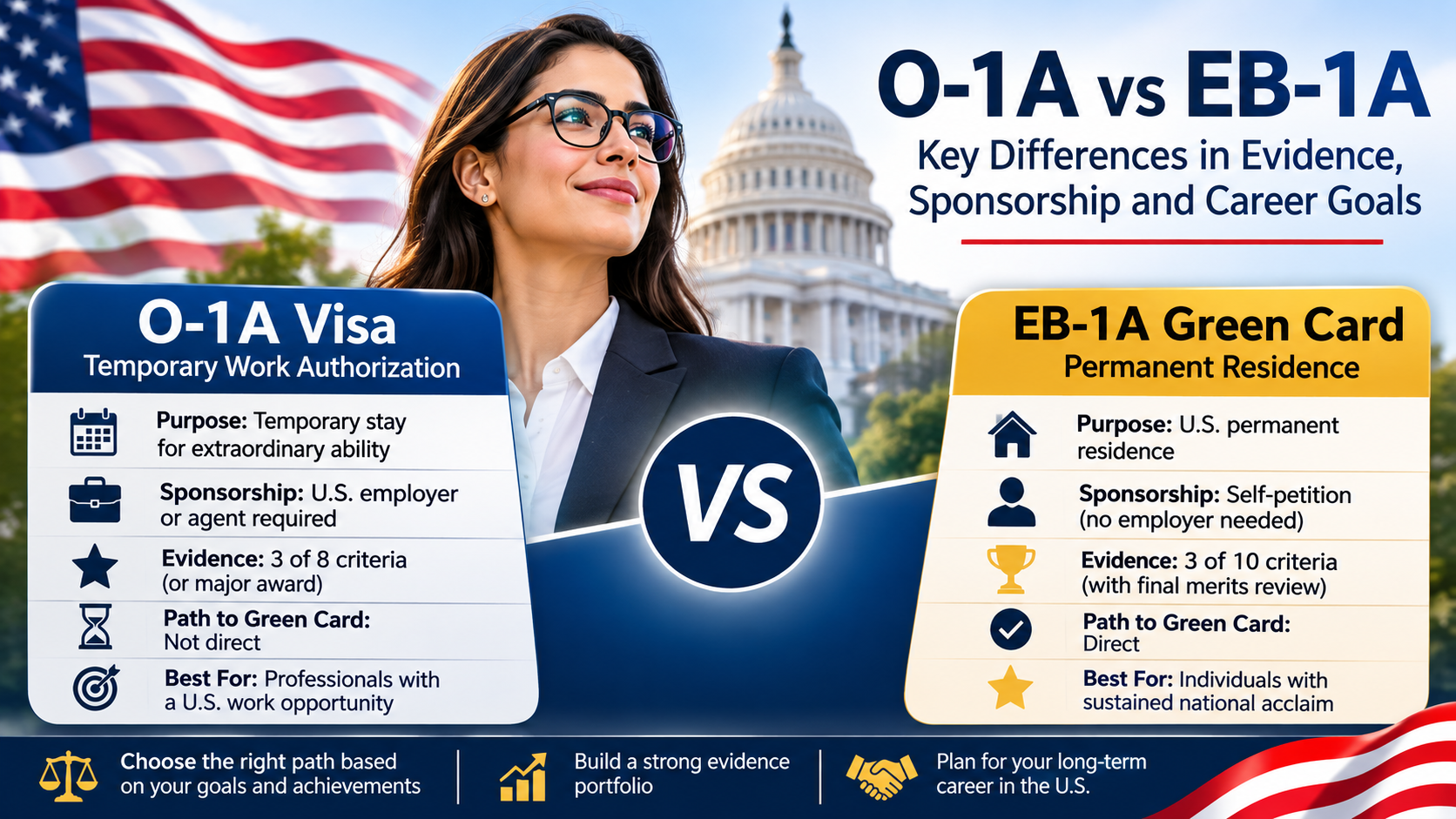
Both are designed for individuals who can demonstrate extraordinary ability and sustained recognition in their fields. However, they serve different immigration purposes. The O-1A is a temporary, employment-based nonimmigrant classification, while EB-1A is an immigrant category for individuals seeking permanent residence.
Understanding the differences in eligibility evidence, sponsorship, career flexibility, and long-term goals can help professionals decide which route to explore.
1. What Is the O-1A Visa?
The O-1A is a U.S. nonimmigrant visa classification for individuals with extraordinary ability in the sciences, education, business, or athletics.
Applicants must demonstrate sustained national or international acclaim and show that they are coming to the United States temporarily to continue working in their area of extraordinary ability.
Unlike an immigrant petition, an O-1A petition is connected to proposed work in the United States. A qualifying U.S. employer or agent must generally file the petition. A foreign employer may use a U.S. agent to file on its behalf.
The O-1A is therefore particularly relevant to professionals who have a defined U.S. work opportunity, professional engagement, project, or business-related activity that fits within their area of extraordinary ability.
GovInfo+1
2. What Is the EB-1A Green Card Category?
EB-1A is an employment-based first-preference immigrant classification for individuals with extraordinary ability in the sciences, arts, education, business, or athletics.
Its purpose is different from the O-1A: it provides a pathway to lawful permanent residence in the United States.
One of its most significant features is that an eligible individual may self-petition by filing Form I-140. A permanent job offer and labor certification are not required. However, the applicant must demonstrate an intention to continue working in their area of extraordinary ability in the United States.
EB-1A is intended for individuals who can establish sustained national or international acclaim and show that their achievements have been recognized in their field.
LII / Legal Information Institute+1
3. O-1A vs EB-1A: The Main Differences
Although the two categories share an extraordinary-ability foundation, they are not interchangeable.
| Feature | O-1A | EB-1A |
| Immigration purpose | Temporary work authorization | Permanent residence |
| Classification | Non immigrant | Immigrant |
| Main petition | Form I-129 | Form I-140 |
| Who files? | U.S. employer or qualifying U.S. agent | Applicant may self-petition |
| Permanent job offer | Not necessarily a traditional permanent offer, but qualifying proposed work is required | Not required |
| Labor certification | Not required | Not required |
| Evidence standard | Extraordinary ability and sustained acclaim | Extraordinary ability and sustained acclaim, with immigrant-category requirements |
| Career connection | Must continue work in the area of extraordinary ability | Must intend to continue work in the area of extraordinary ability |
| Long-term objective | Temporary U.S. professional work | Lawful permanent residence |
The most important distinction is the immigration objective: O-1A is designed for temporary professional activity, while EB-1A is a permanent immigration category.
4. Differences in Evidence Requirements
Both categories require substantial documentation. Applicants often use similar types of evidence, but the evidence must be evaluated under the specific requirements of the category being pursued.
O-1A evidence requirements
For O-1A, a petition generally needs to demonstrate either a major, internationally recognized award or evidence satisfying at least three of the regulatory evidentiary criteria.
Examples include:
- Nationally or internationally recognized awards.
- Membership in associations requiring outstanding achievements.
- Published material about the applicant and their work.
- Participation as a judge of the work of others.
- Original scientific, scholarly, or business-related contributions.
- Authorship of scholarly articles.
- Employment in a critical or essential capacity for distinguished organizations.
- High salary or other significantly high remuneration.
Meeting three criteria does not automatically guarantee approval. USCIS also evaluates whether the evidence, considered as a whole, demonstrates the required level of extraordinary ability and recognition.
USCIS+1
EB-1A evidence requirements
EB-1A also allows applicants to qualify through a major, internationally recognized award or by satisfying at least three of ten regulatory criteria.
These include:
- Receipt of nationally or internationally recognized prizes or awards.
- Membership in associations that require outstanding achievements.
- Published material about the applicant.
- Judging the work of others.
- Original contributions of major significance.
- Authorship of scholarly articles.
- Display of work at artistic exhibitions or showcases, where applicable.
- Leading or critical roles for distinguished organizations.
- High salary or significantly high remuneration.
- Commercial success in the performing arts, where applicable.
The EB-1A process also involves a final merits assessment. USCIS considers the evidence in its entirety to determine whether the applicant has sustained acclaim and belongs to the small percentage who have risen to the very top of their field. Simply meeting three criteria is not enough by itself.
LII / Legal Information Institute+1
Why the quality of evidence matters
A strong portfolio should not simply contain a large number of certificates, publications, memberships, or recommendation letters. It should explain what each achievement demonstrates and why it is meaningful within the applicant's professional field.
For example:
- A publication should be supported by evidence of authorship, its relevance, and the professional significance of the work.
- A peer-review activity should be documented with credible proof that the applicant was invited to evaluate the work of others.
- An award should be supported by information about its selection process, recognition, and standing.
- A leadership role should demonstrate the applicant's actual responsibilities and the reputation of the organization.
Professionals who need help organizing their professional achievements can explore professional profile and evidence development support on Paperza.
5. Sponsorship: Who Must File the Petition?
Sponsorship is one of the clearest differences between O-1A and EB-1A.
O-1A requires a qualifying petitioner
An O-1A beneficiary cannot ordinarily file the petition independently in the same way an EB-1A applicant can.
The petition must generally be submitted by:
- A U.S. employer.
- A U.S. agent.
- A U.S. agent acting for a foreign employer.
The petition must also include the required details about the proposed work or engagements. Depending on the arrangement, supporting documentation may include contracts, an itinerary, and an advisory opinion or consultation where required.
This structure makes the O-1A useful for professionals who have a U.S. employer, agent, or qualifying professional engagements.
EB-1A allows self-petitioning
EB-1A does not require an employer to sponsor the applicant. An eligible individual may file Form I-140 independently.
This can be attractive to founders, researchers, consultants, senior technology professionals, business leaders, and other accomplished individuals who want to pursue permanent residence without depending on a particular employer.
However, self-petitioning does not remove the need to provide convincing evidence. Applicants must still satisfy the legal requirements and demonstrate that they intend to continue working in their area of extraordinary ability in the United States.
LII / Legal Information Institute+2
6. Which Route Offers More Career Flexibility?
Career flexibility depends on the applicant's professional circumstances and the immigration category.
O-1A: The petition is connected to the petitioner and the work described in the filing. Changes in employment, engagements, or work arrangements may require an amended or new petition, depending on the circumstances. It is important to review the immigration implications before changing the arrangement.
EB-1A: The applicant does not need a permanent job offer from a particular employer to qualify. This can provide greater independence when planning a long-term professional career. Nevertheless, the applicant must genuinely intend to continue working in the area of extraordinary ability.
For entrepreneurs and independent professionals, this distinction can be particularly important. Someone planning to build a company, work across multiple projects, or develop an independent professional practice may want to consider how each category fits their actual plans.
7. Can O-1A Be a Stepping Stone to EB-1A?
Some professionals consider the O-1A as an initial route to work in the United States while preparing for a future EB-1A petition.
This may be a reasonable strategy in suitable circumstances, but it is important to understand that O-1A approval does not automatically qualify someone for EB-1A.
The two petitions are assessed under their respective legal requirements. Evidence that supports an O-1A case may also be relevant to an EB-1A case, but the applicant must still establish eligibility for the immigrant category.
For example, a professional may use the time spent working in the United States to continue building a credible record of:
- Scholarly or professional publications.
- Peer-review and judging activities.
- Recognized awards.
- Original contributions with demonstrable significance.
- Leadership roles and professional recognition.
- Independent evidence of influence within the field.
The goal should be to build genuine professional achievements, not merely accumulate documents for an immigration application.
8. Which Professionals Should Consider O-1A?
O-1A may be worth exploring if you:
- Have a qualifying U.S. employer or agent.
- Have a defined professional opportunity in the United States.
- Want temporary authorization to work in your area of extraordinary ability.
- Have a strong record of professional achievements and recognition.
- Are not yet ready to pursue an immigrant petition or prefer a temporary work arrangement.
It can be relevant to researchers, engineers, technology professionals, business executives, entrepreneurs, consultants, and athletes whose work fits the applicable requirements.
9. Which Professionals Should Consider EB-1A?
EB-1A may be worth exploring if you:
- Have sustained national or international recognition.
- Can document significant achievements in your field.
- Have evidence that meets the regulatory criteria and supports the final merits assessment.
- Want to pursue U.S. permanent residence.
- Prefer not to depend on a permanent employer-sponsored job offer.
- Intend to continue working in your area of extraordinary ability in the United States.
Professionals considering this route should carefully assess the strength, credibility, and significance of their evidence before filing.
10. How to Build a Strong O-1A or EB-1A Evidence Portfolio
Whether you are considering O-1A or EB-1A, a well-organized evidence portfolio can make it easier to present your professional record clearly.
Start by identifying your strongest achievements and matching them to the relevant regulatory criteria.
Publications and research
Academic and research professionals should organize their published work, authorship records, journal information, citation evidence, and documentation showing the relevance of their contributions.
If you need help strengthening your publication record, you can explore research and publication support on Paperza.
Peer review and judging activities
Peer-review work can be relevant to the judging criterion when it demonstrates that the applicant has evaluated the work of others in the same or an allied field.
Keep credible records of invitations, completed reviews, editorial confirmations, and other supporting documentation. The value of the evidence depends on its authenticity and how well it demonstrates the applicant's professional recognition.
Awards and professional recognition
Document the award, awarding institution, selection standards, eligibility requirements, and evidence of the award's recognition within the field.
A certificate alone may not adequately explain the significance of an award.
Recommendation and expert letters
Letters from independent experts can help explain the importance of an applicant's achievements. Strong letters should identify specific contributions, explain their significance, and provide a credible basis for the writer's assessment.
Letters should support documentary evidence rather than replace it.
Petition preparation and organization
A well-prepared petition should have a logical structure, a clear explanation of how the evidence relates to the applicable criteria, and properly organized supporting exhibits.
Applicants seeking help with preparing and organizing supporting documentation can review petition documentation support on Paperza.
All evidence must be genuine and accurately represented. Do not purchase fabricated publications, reviews, awards, memberships, employment records, or recommendation letters. Immigration filings must reflect the applicant's actual achievements and professional history.
11. Common Mistakes When Choosing Between O-1A and EB-1A
Several mistakes can weaken an otherwise promising immigration strategy.
Choosing based only on the number of criteria. Meeting three evidentiary criteria is not an automatic approval. The overall strength and significance of the evidence matter.
Assuming O-1A approval guarantees EB-1A approval. The categories have different legal requirements and immigration objectives.
Ignoring the sponsorship structure. O-1A generally requires a qualifying petitioner, while EB-1A permits self-petitioning.
Submitting evidence without explaining its importance. A portfolio should show not only what the applicant has done but also why the achievements matter in the relevant field.
Treating every publication or membership as exceptional. The credibility, recognition, selection standards, and significance of each item must be considered.
Selecting a route without a long-term plan. Temporary work authorization and permanent residence are different goals. The choice should reflect the applicant's actual professional and immigration plans.
12. Final Thoughts: O-1A or EB-1A?
There is no universal answer to whether O-1A or EB-1A is better. The right option depends on the applicant's achievements, available evidence, proposed U.S. work, sponsorship arrangements, and long-term objectives.
O-1A may be suitable for an accomplished professional with a qualifying U.S. petitioner and a temporary work opportunity. EB-1A may be more appropriate for someone with a strong record of extraordinary ability who wants to pursue permanent residence without a permanent job offer.
The most important first step is to evaluate your professional profile against the actual requirements of each category. A careful assessment can help identify the stronger route, the evidence already available, and any genuine gaps that need to be addressed.
Frequently Asked Questions
1. Is EB-1A better than O-1A?
Neither category is automatically better. EB-1A is an immigrant category for permanent residence, while O-1A is a temporary work classification. The better option depends on the applicant's professional achievements and immigration goals.
2. Can I apply for EB-1A without an employer?
Yes. EB-1A allows eligible individuals to self-petition using Form I-140. A permanent job offer and labor certification are not required, but the applicant must intend to continue working in their area of extraordinary ability in the United States.
3. Does O-1A require employer sponsorship?
An O-1A petition generally must be filed by a qualifying U.S. employer or U.S. agent. A foreign employer must use a U.S. agent to file.
4. Can the same publications and awards be used for both O-1A and EB-1A?
Potentially, yes. The same genuine achievements may support both petitions, but they must be presented in accordance with the specific requirements of each category.
5. Does having three EB-1A criteria guarantee approval?
No. Meeting at least three criteria is only part of the evidentiary analysis. USCIS also evaluates the totality of the evidence to determine whether the applicant meets the extraordinary-ability standard.
I will draft compelling personal statement for eb1a and uk global talent visa
Are you preparing an EB1A or UK Global Talent Visa application and need a compelling, professionally written personal statement? I provide personalized statement writing services...
View Related Service >NEED PROFESSIONAL ASSISTANCE?
I will draft compelling personal statement for eb1a and uk global talent visa
Are you preparing an EB1A or UK Global Talent Visa application and need a compelling, professionally written personal statement? I provide...