
Article Title: 10 Common Reasons Research Papers Get Rejected by Academic Journals (And How to Avoid Them)
By Paperza Editorial Team
|
16 Oct 2026
|
1 min read
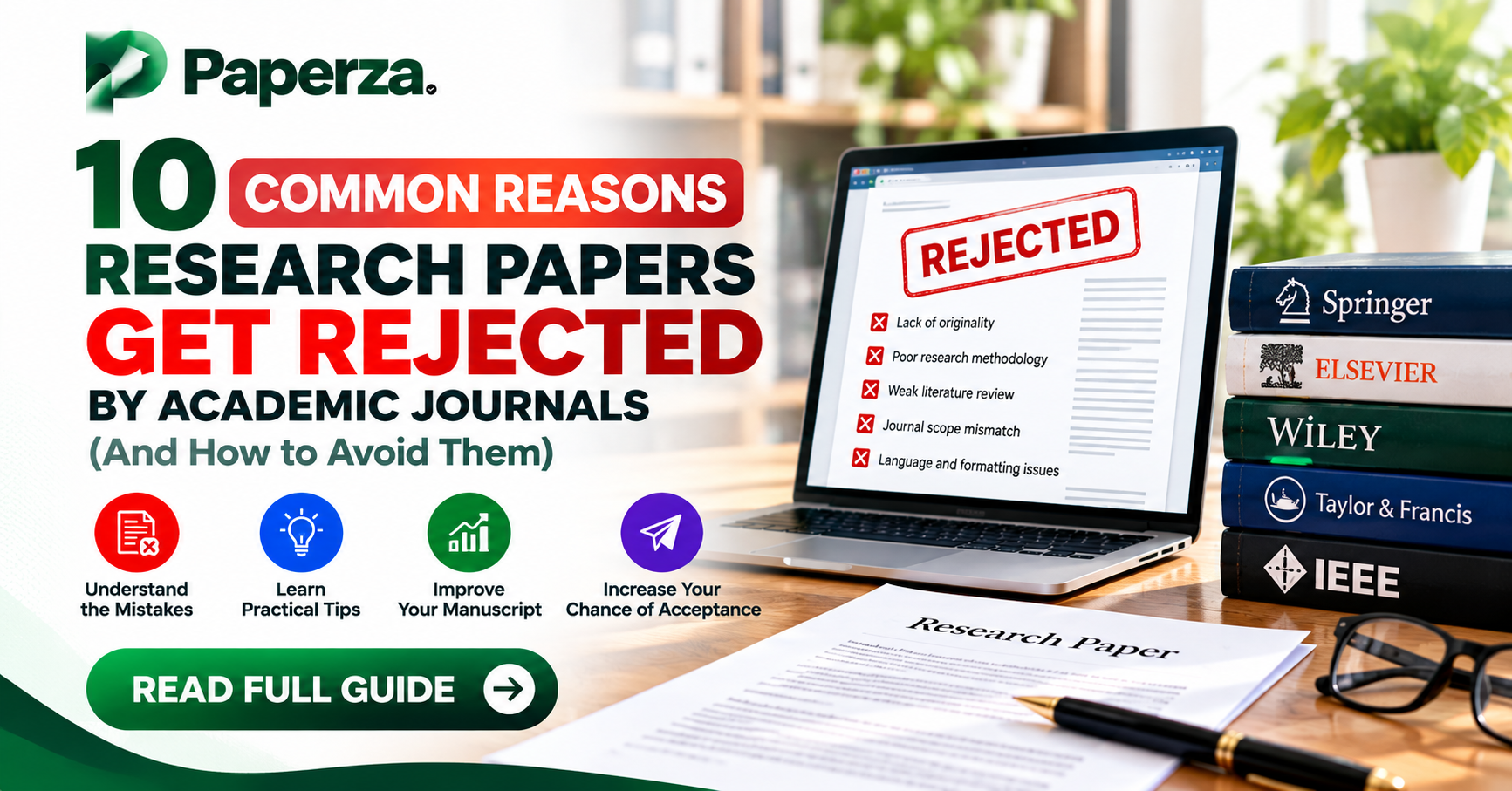
Getting a research paper rejected by an academic journal can be frustrating, especially after months of research, writing, and revisions. However, manuscript rejection is a common part of academic publishing, even for experienced researchers.
Understanding why journals reject manuscripts can help postgraduate students, PhD candidates, lecturers, and independent researchers prepare stronger submissions.
Here are ten common reasons research papers get rejected and practical ways to avoid them.
1. Choosing the Wrong Journal
One of the most common reasons for immediate rejection is submitting a manuscript to a journal outside its research scope.
For example, a paper focused on artificial intelligence in healthcare may not suit a journal dedicated exclusively to mechanical engineering.
How to avoid it: Review the journal's aims and scope, recently published articles, and accepted manuscript types before submitting.
2. Lack of Research Originality
Academic journals generally expect manuscripts to contribute meaningful new knowledge, methods, evidence, or perspectives.
A paper that repeats existing research without a clear contribution may struggle during editorial screening.
How to avoid it: Explain the research gap, highlight your study's contribution, and demonstrate how your findings advance existing knowledge.
3. Weak Research Methodology
An unclear or inappropriate methodology can raise concerns about the reliability of a study.
Common problems include inadequate sampling, insufficient methodological detail, inappropriate statistical analysis, and unsupported assumptions.
How to avoid it: Clearly describe your research design, data collection, analytical methods, and relevant limitations.
4. Poor Academic Writing
Even valuable research can be difficult to evaluate when a manuscript contains unclear arguments, inconsistent terminology, grammatical errors, or poorly organized paragraphs.
How to avoid it: Revise your manuscript for clarity, logical flow, academic tone, and consistency. Professional academic editing may help improve readability without changing the research findings.
5. Inadequate Literature Review
A literature review should establish what is already known, identify relevant gaps, and explain why the present study matters.
Relying on unrelated or insufficient sources can weaken the manuscript's foundation.
How to avoid it: Include relevant scholarly literature, evaluate previous findings critically, and connect the literature to your research objectives.
6. Incorrect Manuscript Formatting
Journals often specify requirements for manuscript structure, word limits, references, figures, tables, and supplementary documents.
Failure to follow these requirements can lead to administrative delays or rejection during initial checks.
How to avoid it: Carefully read the journal's instructions for authors and prepare every required submission document.
7. Weak Results and Discussion
A manuscript may be rejected when the results are poorly presented or the discussion fails to explain their significance.
Overstating findings can also undermine credibility.
How to avoid it: Present results clearly, interpret them using appropriate evidence, compare them with existing research, and acknowledge limitations.
8. Referencing and Citation Problems
Incomplete references, incorrect citations, irrelevant sources, and unsupported statements can reduce manuscript quality.
Citation manipulation and plagiarism may also lead to serious research integrity concerns.
How to avoid it: Verify every reference, follow the required citation style, acknowledge sources properly, and use reference management software when appropriate.
9. Missing Ethical Declarations
Depending on the research, journals may require ethics approval, informed consent, funding disclosures, conflict-of-interest statements, or data availability information.
Missing or inaccurate declarations can prevent a manuscript from progressing.
How to avoid it: Review the journal's research ethics policies and provide accurate documentation before submission.
10. Ignoring Reviewer and Editor Feedback
When a journal requests revisions, incomplete responses or unsupported disagreements may reduce the likelihood of eventual acceptance.
How to avoid it: Address reviewer comments systematically, explain manuscript changes, and provide respectful, evidence-based responses where you disagree.
A revision request is an opportunity to strengthen the manuscript, not a guarantee of acceptance.
How to Improve Your Chances Before Submission
Before submitting your research paper, complete this checklist:
- Confirm the journal matches your research topic.
- Clearly explain your study's originality and contribution.
- Review the methodology, results, and conclusions.
- Edit the manuscript for clarity and academic quality.
- Verify citations, references, and ethical declarations.
- Follow all journal formatting and submission guidelines.
These steps cannot guarantee publication, but they can help prevent avoidable submission problems.
How Paperza Can Help
At Paperza, we support researchers, postgraduate students, and academic professionals throughout manuscript preparation and journal submission.
Our services include:
- Academic manuscript editing and proofreading
- Journal selection and indexing verification
- Manuscript formatting and reference checking
- Submission cover letter preparation
- Journal submission guidance
- Reviewer comment and revision support
Our goal is to help researchers submit clear, professionally prepared manuscripts that meet the requirements of their selected journals.
Need professional assistance before submitting your research paper?
Visit Paperza.com to explore our academic editing and publication support services.
All manuscript acceptance decisions remain with independent journal editors and reviewers.
Frequently Asked Questions
Can a rejected research paper be submitted to another journal?
Yes. In most cases, authors can revise a rejected manuscript and submit it to another suitable journal, provided it is no longer under consideration at the previous journal and applicable publication policies are followed.
Does manuscript editing guarantee journal acceptance?
No. Editing improves clarity and presentation, but acceptance depends on research quality, originality, journal suitability, and independent editorial assessment.
What is the difference between desk rejection and rejection after peer review?
A desk rejection occurs during initial editorial screening, often before external review. Rejection after peer review follows evaluation by external reviewers and an editorial decision.
Conclusion
Research paper rejection can result from several factors, including poor journal selection, weak methodology, insufficient originality, writing problems, and failure to follow submission requirements.
By addressing these issues before submission, researchers can improve manuscript quality and reduce avoidable rejection risks.
Paperza provides academic editing, journal selection, and manuscript submission support to help researchers prepare their work with greater confidence.
I will assist with scopus journal selection and manuscript submission
Are you looking for Scopus-indexed Q1, Q2, Q3, or Q4 journals for your research paper? I provide professional Scopus journal selection, manuscript submission assistance, and...
View Related Service >NEED PROFESSIONAL ASSISTANCE?
I will assist with scopus journal selection and manuscript submission
Are you looking for Scopus-indexed Q1, Q2, Q3, or Q4 journals for your research paper? I provide professional Scopus journal selection,...