
How to Get Peer Review Opportunities With IEEE, Springer and Elsevier in 2026
By Paperza Editorial Team
|
29 Oct 2026
|
16 min read
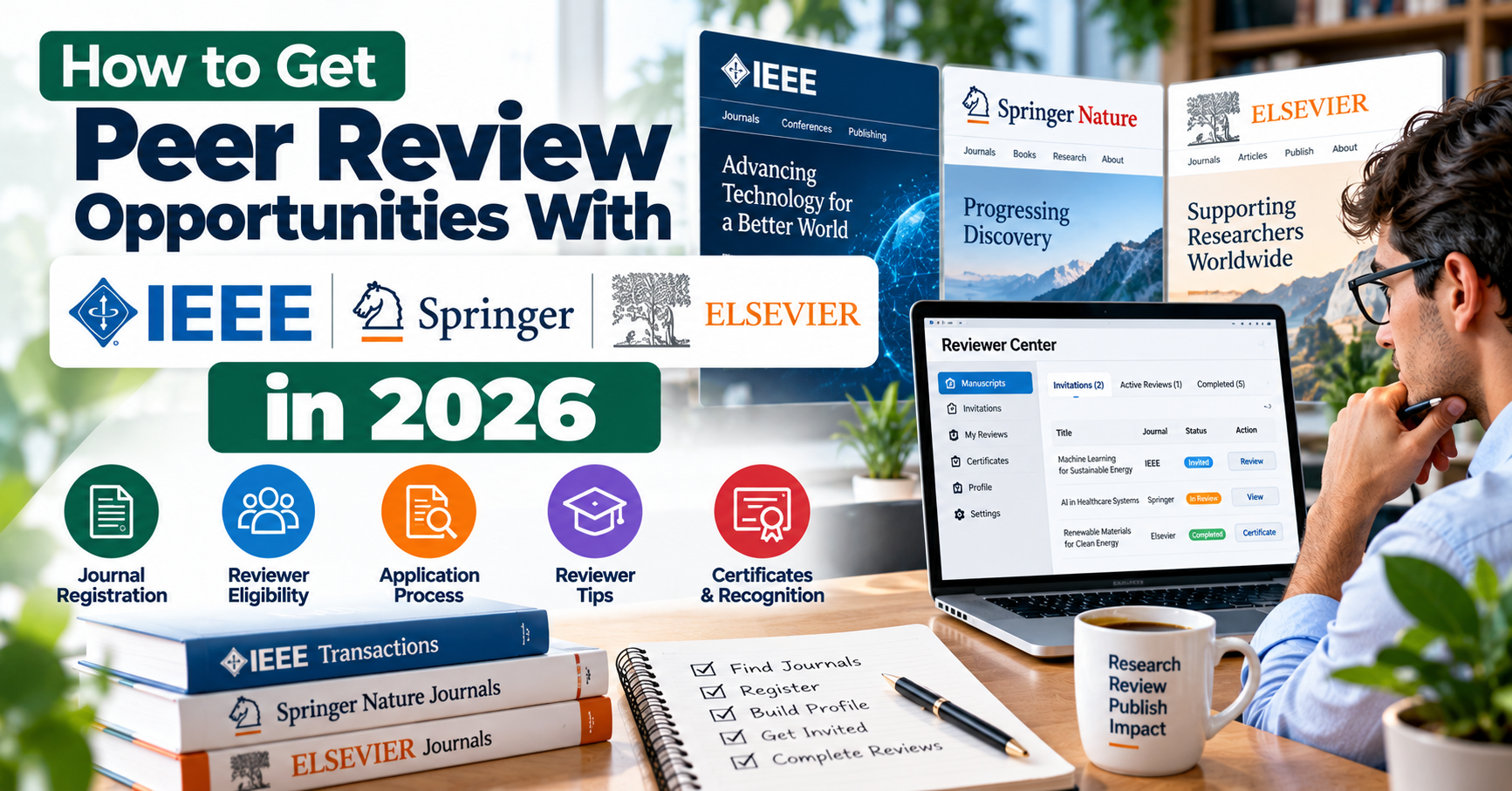
Becoming a peer reviewer for internationally recognized academic publishers such as IEEE, Springer Nature, and Elsevier is a valuable opportunity for researchers, university lecturers, scientists, engineers, and qualified industry professionals who want to contribute to scholarly publishing.
Academic peer reviewers evaluate research manuscripts, assess scientific methodology, identify weaknesses, and provide constructive recommendations to journal editors.
Beyond contributing to research quality, genuine peer review experience can help researchers develop editorial judgment, expand professional networks, and document scholarly service.
However, many researchers struggle to understand how to register as journal reviewers, approach editorial boards, demonstrate their expertise, and receive legitimate manuscript review invitations.
In 2026, the process is increasingly supported by publisher-specific reviewer platforms, editorial management systems, researcher profiles, and structured reviewer recruitment programs.
This guide explains how to get peer review opportunities with IEEE, Springer Nature, and Elsevier in 2026, including official registration methods, eligibility considerations, professional outreach strategies, and ways to document completed peer reviews.
For assistance organizing your academic profile and exploring legitimate reviewer application support, visit Paperza's academic and peer review support service.
What Is Academic Peer Review?
Academic peer review is the evaluation of a scholarly manuscript by qualified researchers or professionals with relevant expertise.
Journal editors invite reviewers to assess whether submitted research meets the publication's scientific, methodological, ethical, and editorial standards.
A peer reviewer may evaluate:
- The originality of the research.
- The significance of the research question.
- The suitability of the methodology.
- The reliability of the analysis and results.
- The relevance of the literature review.
- The strength of the conclusions.
- The clarity of the manuscript.
- Compliance with research ethics and publication standards.
Reviewers typically provide confidential feedback and recommendations, while the journal editor makes the final publication decision.
Peer review is a professional responsibility, not a guaranteed credential or a service that can legitimately be purchased from a publisher.
Why Become a Peer Reviewer in 2026?
Serving as an academic reviewer can offer meaningful professional benefits.
Develop Research Expertise
Evaluating manuscripts exposes reviewers to research methods, emerging questions, and scholarly developments within their areas of specialization.
Strengthen Academic Profiles
Completed reviews can demonstrate scholarly service when accurately documented on a curriculum vitae, researcher profile, or institutional record.
Build Editorial Experience
Reviewers develop skills in scientific evaluation, critical analysis, methodological assessment, and constructive academic communication.
Expand Professional Connections
Responsible participation in editorial activities may help researchers establish professional relationships within their disciplines.
Support Immigration Evidence Where Applicable
For certain U.S. immigration classifications, including EB-1A, qualifying participation in judging the work of others may be relevant evidence.
However, a peer review invitation alone does not establish extraordinary ability or guarantee immigration eligibility. The nature of the activity, evidence of actual participation, and complete immigration record matter.
Who Can Become a Peer Reviewer for IEEE, Springer Nature, or Elsevier?
Reviewer expectations differ between journals and publishers.
Most editors prioritize individuals with demonstrated expertise in the subject of the manuscript.
Relevant qualifications may include:
- A PhD, MD, or other advanced qualification where appropriate.
- An established research or technical specialization.
- Relevant scholarly publications.
- Knowledge of research methodologies.
- Professional or industry experience directly related to the subject.
- Familiarity with academic publication ethics.
- The ability to provide objective and constructive feedback.
A PhD is not a universal requirement imposed across all IEEE, Springer Nature, and Elsevier journals.
However, some specific reviewer recruitment programs set more selective requirements.
For example, Springer Nature's Reviewer Programme describes doctoral-level or equivalent research qualifications and active independent research among its selection expectations.
Early-career researchers may also develop relevant experience through mentorship, subject-area research, and journal-specific opportunities.
Step 1: Build a Credible Academic and Research Profile
Before seeking reviewer invitations, organize evidence of your expertise.
Journal editors need to understand which research subjects you can competently evaluate.
Create or Update Your ORCID Profile
An ORCID identifier connects your scholarly identity with research outputs and professional activities.
Include accurate information about your education, affiliations, publications, and research contributions.
Official website: https://orcid.org
Maintain a Professional CV
Your academic CV should summarize your research areas, qualifications, publications, scholarly activities, and relevant professional appointments.
Use accurate dates and clear descriptions of your achievements.
Maintain Relevant Research Profiles
Depending on your discipline, Google Scholar, ResearchGate, institutional webpages, and professional organization profiles may help demonstrate your research background.
Profiles should reflect genuine achievements rather than fabricated publications, artificial citation activity, or misleading affiliations.
Clearly Define Your Research Expertise
Instead of describing your expertise only as "Computer Science," identify specific areas such as cloud security, federated learning, natural language processing, or software reliability.
Accurate subject keywords can help editors match you with suitable manuscripts.
If you need assistance organizing a legitimate research CV or professional profile, explore academic profile and reviewer-readiness support on Paperza.
Step 2: How to Become an IEEE Journal Reviewer
IEEE publishes research across electrical engineering, electronics, computing, communications, artificial intelligence, and related technical disciplines.
Its official Author Center provides instructions for individuals interested in becoming reviewers.
Register With the Relevant IEEE Journal
According to IEEE's published guidance, prospective reviewers should create an account on the manuscript submission website of the journal for which they would like to review.
When registering:
- Identify an IEEE journal aligned with your professional expertise.
- Visit its official website.
- Access the designated manuscript submission system.
- Create an account using accurate professional information.
- Provide your institutional affiliation and contact details.
- Select research keywords describing your expertise.
- Complete any available reviewer registration details.
IEEE explains that creating an account with appropriate subject keywords can add you to a publication's potential reviewer pool.
Registration does not guarantee an invitation.
Identify Suitable IEEE Journals
Potential journals vary by discipline.
For example, researchers might investigate journals covering cloud computing, artificial intelligence, telecommunications, software engineering, or cybersecurity.
Only volunteer for journals whose subject areas match your genuine qualifications.
Contact the Editorial Office When Appropriate
If a journal provides a reviewer recruitment or editorial contact pathway, you may express interest in reviewing.
Your message should summarize your expertise, relevant publications, and willingness to undertake appropriate reviews.
Avoid sending repeated unsolicited messages or claiming qualifications you do not possess.
Official IEEE Reviewer Registration Guide
Become an IEEE Reviewer — IEEE Author Center
IEEE Access also provides reviewer information and an account-registration pathway.
IEEE Access Reviewer Information
Step 3: How to Become a Springer Nature Peer Reviewer
Springer Nature publishes journals across science, medicine, engineering, business, education, technology, and the humanities.
It provides journal-specific reviewer guidance as well as structured reviewer recruitment opportunities.
Apply Through the Springer Nature Reviewer Programme
Springer Nature operates a Reviewer Programme that brings together researchers with relevant subject expertise.
The programme includes discipline-focused reviewer communities and a Reviewing Editor role.
As described in Springer Nature's 2026 programme information, applicants are evaluated for their qualifications, research experience, and suitability to provide high-quality peer review.
General Application Process
- Visit Springer Nature's official reviewer recruitment page.
- Review the eligibility information.
- Access the official application form.
- Provide accurate academic and professional details.
- Identify relevant subject areas.
- Submit the application for consideration.
- Respond to any official follow-up or onboarding requirements.
Selection is not automatic, and application review times may vary.
Springer Nature Reviewer Resources
Springer Nature provides reviewer tutorials covering manuscript evaluation, ethical responsibilities, and the peer review process.
These resources can help prospective reviewers understand journal expectations.
Official links:
Springer Nature Reviewer Programme
How to Be Considered as a Springer Nature Reviewer
Springer Nature Peer Review Guidance
Can Early-Career Researchers Apply?
Some Springer Nature reviewer initiatives welcome applications from researchers developing their academic careers.
However, individual roles may require doctoral-level or equivalent qualifications, active research experience, and demonstrated academic judgment.
Applicants should review the specific programme's current eligibility standards.
Step 4: How to Get Elsevier Peer Review Opportunities
Elsevier publishes scholarly journals across healthcare, engineering, computer science, energy, business, and numerous other disciplines.
Editors generally select reviewers based on relevant expertise and the needs of the manuscript.
Identify Relevant Elsevier Journals
Start by finding Elsevier journals that regularly publish work closely related to your specialization.
Study recent articles to understand their research scope and methodological approaches.
Build Your Elsevier Researcher Profile
Create or maintain an accurate Elsevier account where relevant and complete reviewer-related profile information in the journal's submission system when available.
Some Elsevier journals use Editorial Manager.
A well-maintained account and accurate subject classifications can help editors understand your areas of expertise.
Explore Elsevier Reviewer Hub
Elsevier Reviewer Hub provides tools for managing peer review activities associated with participating journals.
Through Reviewer Hub, reviewers can access invitation information, manage reviews, view review histories, and obtain recognition documentation where eligible.
Importantly, creating a Reviewer Hub account does not guarantee future invitations or automatically add you to every Elsevier journal's reviewer pool.
Official resources:
Elsevier — How to Conduct a Review
Express Interest Professionally
Where a journal accepts reviewer expressions of interest, submit a concise introduction to the appropriate editorial contact.
Explain your research specialization, relevant publications, and the types of manuscripts you are qualified to assess.
Do not offer to review manuscripts outside your competence merely to obtain a certificate.
Step 5: Write a Professional Email Requesting Reviewer Opportunities
Some journals permit interested researchers to contact editorial offices or editors about potential reviewing opportunities.
A professional inquiry should be brief, specific, and focused on the journal's needs.
Example Reviewer Interest Email
Subject: Expression of Interest in Serving as a Peer Reviewer — [Research Area]
Dear Editor,
I am writing to express my interest in contributing as a peer reviewer for [Journal Name].
My research and professional expertise focuses on [Specific Research Area], particularly [Relevant Specializations].
I have experience in [Brief Description of Relevant Research, Publications, or Technical Work], and I would welcome the opportunity to assist your editorial team by providing objective and constructive manuscript evaluations within my area of expertise.
My academic CV and research profile are available for your consideration.
Thank you for considering my interest.
Kind regards,
[Full Name]
[Academic or Professional Affiliation]
[ORCID or Research Profile Link]
[Professional Email Address]
Only include genuine credentials and affiliations.
Sending a professional inquiry does not create an entitlement to reviewer selection, and editors may be unable to respond to every request.
Step 6: Complete Reviewer Training and Learn Publication Ethics
Peer review requires more than technical subject knowledge.
Reviewers must understand confidentiality, conflicts of interest, responsible scientific criticism, and journal decision procedures.
Important Reviewing Skills
A capable reviewer should be able to:
- Identify the manuscript's research question and contribution.
- Evaluate whether the methodology is appropriate.
- Examine the reliability of data and results.
- Assess whether conclusions follow from the evidence.
- Identify unsupported claims and relevant limitations.
- Provide clear, respectful, actionable feedback.
- Distinguish major scientific concerns from minor editorial issues.
Use Publisher Training Resources
Springer Nature provides peer review learning materials.
Elsevier offers reviewer guidance and training resources through its researcher education initiatives.
IEEE provides detailed reviewer expectations and ethical guidance.
Training can strengthen reviewer readiness but does not guarantee recruitment.
Artificial Intelligence and Confidentiality
Publisher policies on AI-assisted reviewing must be followed carefully.
IEEE's reviewer guidance prohibits using AI tools to generate or draft peer review reports.
Manuscripts under review are confidential, and reviewers must not upload unpublished materials into unauthorized AI systems.
Reviewers must exercise independent professional judgment and comply with the target journal's current rules.
Step 7: Accept and Complete Your First Peer Review Properly
Receiving an invitation is an important opportunity, but accepting it creates a professional obligation.
Before agreeing to review, consider:
- Whether the manuscript matches your expertise.
- Whether any conflict of interest exists.
- Whether you can meet the deadline.
- Whether you understand the journal's policies.
- Whether you can maintain confidentiality.
If the assignment is unsuitable, decline promptly rather than submitting an inadequate review.
How to Structure a Peer Review Report
A useful report often includes the following elements.
Manuscript Summary: Briefly explain the research objective, approach, and principal contribution.
Major Comments: Identify substantial scientific or methodological concerns that should be addressed.
Minor Comments: Explain issues involving clarity, terminology, formatting, or presentation.
Confidential Comments to the Editor: Provide information appropriate to the journal's designated confidential channel when needed.
Overall Recommendation: Submit the recommendation through the journal's required evaluation system.
Reviewers should support their observations with clear reasoning and avoid personal criticism.
Editorial decisions are ultimately made by the journal.
Step 8: Obtain Legitimate Peer Review Certificates and Recognition
Many researchers want documented proof of their completed reviewing activities.
The availability and format of reviewer recognition vary between publishers and journals.
Elsevier Reviewer Certificates
Elsevier Reviewer Hub provides access to reviewer recognition records and certificates for qualifying completed reviews associated with supported journals.
Springer Nature Reviewer Recognition
Springer Nature provides various recognition mechanisms, including reviewer documentation and features associated with its reviewer programmes.
IEEE Reviewer Documentation
IEEE journals may offer reviewer acknowledgment or confirmation according to the publication's procedures.
Ask the journal or consult its reviewer guidance to determine what documentation is available.
Record Reviews on ORCID
Where supported, completed peer review activities may be recorded on ORCID through approved recognition workflows.
Because peer review may be confidential, researchers should not publicly disclose manuscript titles, authors, or private editorial information unless the journal permits it.
Important: A certificate should represent a genuine review or recognized reviewer activity. An invitation that was never accepted or a review that was never completed should not be presented as completed judging experience.
Step 9: Build Long-Term Relationships With Journal Editors
Consistent, high-quality reviewing can help researchers build a credible record of scholarly service.
Editors value reviewers who provide useful assessments, communicate professionally, respect deadlines, and maintain confidentiality.
To remain a dependable reviewer:
- Accept only suitable assignments.
- Submit reviews within the agreed timeframe.
- Provide constructive and evidence-based feedback.
- Avoid conflicts of interest.
- Respond promptly to editorial communications.
- Keep your research keywords and affiliations current.
- Continue developing expertise in your discipline.
The goal should be to make a meaningful contribution to scholarly publishing, not simply to accumulate invitations.
Can Peer Review Experience Support an EB-1A Visa Application?
Peer review can be relevant to the EB-1A extraordinary ability category.
One of the USCIS evidentiary criteria concerns participation as a judge of the work of others in the same or an allied field.
Properly documented manuscript reviews may support that criterion when the applicable requirements are satisfied.
Relevant evidence may include:
- An invitation from the journal editor.
- Confirmation of accepting the assignment.
- Proof that the review was completed.
- Reviewer acknowledgments or certificates.
- Relevant evidence identifying the nature of the review activity.
However, satisfying the judging criterion does not automatically establish extraordinary ability.
USCIS also conducts a broader evaluation of the applicant's professional recognition and achievements.
Applicants should use truthful, verifiable documentation and seek qualified legal advice concerning the immigration significance of their activities.
Common Mistakes When Seeking Peer Review Invitations
Applying to Journals Outside Your Expertise
Editors need reviewers with appropriate technical knowledge.
Unrelated applications can reduce credibility and result in unsuitable assignments.
Using an Incomplete Academic Profile
A profile without clear research interests, relevant experience, or professional information can make it difficult for editors to assess reviewer suitability.
Claiming Publications or Qualifications You Do Not Possess
False qualifications, fabricated publications, and misleading affiliations can damage academic credibility and lead to professional consequences.
Paying for Guaranteed Reviewer Invitations
Legitimate editorial selection is based on expertise and journal needs.
Be cautious of individuals offering guaranteed reviewer appointments, fabricated certificates, or unauthorized access to publisher systems.
Accepting More Reviews Than You Can Complete
Missed deadlines and superficial assessments can harm authors, journals, and the reviewer's professional reputation.
Ignoring Confidentiality Rules
Unpublished manuscripts and confidential editorial information must be handled according to the journal's policies.
Frequently Asked Questions About Peer Review Opportunities in 2026
1. How do I become an IEEE journal reviewer?
Identify a suitable IEEE journal, create an account on its manuscript submission website, and provide accurate research keywords and professional information. IEEE explains that this can place you in the journal's potential reviewer pool.
2. Can I apply to become a Springer Nature reviewer?
Yes. Springer Nature provides an official Reviewer Programme application process, subject to its eligibility and selection requirements.
3. How do I get Elsevier peer review invitations?
Develop relevant expertise, maintain accurate researcher and journal submission profiles, and express interest through appropriate editorial channels where permitted. Elsevier Reviewer Hub helps manage reviews but does not guarantee invitations.
4. Do I need a PhD to become a journal reviewer?
Not universally. Some journals recognize equivalent professional expertise, but specific reviewer programmes may require doctoral-level or equivalent research qualifications.
5. Can researchers receive peer review certificates?
Yes. Some publishers and journals provide certificates or acknowledgments for qualifying completed reviewing work. Availability depends on the publisher and journal.
6. Can peer review experience help with EB-1A eligibility?
Qualifying completed peer review activities may support the USCIS judging criterion, but they do not guarantee eligibility or petition approval.
7. How many peer reviews should I complete?
There is no universally required number for academic reviewers, and USCIS does not prescribe a fixed peer review count for EB-1A. Focus on authentic, substantive reviewing activity.
8. Can I pay someone to obtain a guaranteed reviewer invitation?
Reviewer selection should remain under the control of legitimate editors and publishers. No third-party service can ethically guarantee an official invitation or manufacture completed review evidence.
Peer Reviewer Readiness Checklist for 2026
Before applying for reviewer opportunities, ensure you have:
- An accurate and updated academic CV.
- A professional email address.
- An ORCID identifier.
- Evidence of relevant expertise.
- Accurate research keywords.
- A list of suitable journals.
- Familiarity with peer review ethics.
- Time to complete review assignments.
- Genuine publications or professional achievements, where applicable.
- A system for documenting completed reviews appropriately.
Conclusion: Start Building Genuine Peer Review Experience in 2026
Getting peer review opportunities with IEEE, Springer Nature, and Elsevier requires preparation, relevant expertise, professional credibility, and responsible participation in scholarly publishing.
Researchers should begin by strengthening their academic profiles, identifying suitable journals, understanding the publishers' official recruitment processes, and completing relevant reviewer training.
IEEE provides journal-level reviewer registration, Springer Nature offers structured reviewer recruitment opportunities, and Elsevier provides systems for reviewer activity management and recognition.
Although reviewer invitations are not guaranteed, building a credible research profile and demonstrating professional reliability can help researchers become suitable candidates for editorial consideration.
Explore Academic Reviewer and Research Support Services on Paperza
Paperza connects researchers, professionals, and academic clients with freelancers offering research-related services.
If you need help preparing your research portfolio, organizing a professional academic CV, or understanding relevant reviewer application procedures, explore these services:
Explore Academic Peer Review Support
Explore Research Profile and Reviewer Readiness Support
Explore Academic Manuscript and Research Support
Review each provider's actual service description and choose assistance appropriate to your academic objectives.
Third-party services cannot guarantee editorial appointments, publisher invitations, completed reviews, or official reviewer certificates.
Build your academic credibility through genuine scholarly contribution. Explore relevant research services on Paperza.
Official Sources and Further Reading
I will help get peer review opportunities with ieee, springer elsevier
IEEE, Springer Nature & Elsevier Peer Review Opportunities Are you looking for journal peer review invitations from reputable academic publishers? At Paperza, we help qualified...
View Related Service >NEED PROFESSIONAL ASSISTANCE?
I will help get peer review opportunities with ieee, springer elsevier
IEEE, Springer Nature & Elsevier Peer Review Opportunities Are you looking for journal peer review invitations from reputable academic...