O-1A Visa Requirements in 2026 for Researchers, Tech and Business Professionals
By Paperza Editorial Team
|
30 Oct 2026
|
17 min read
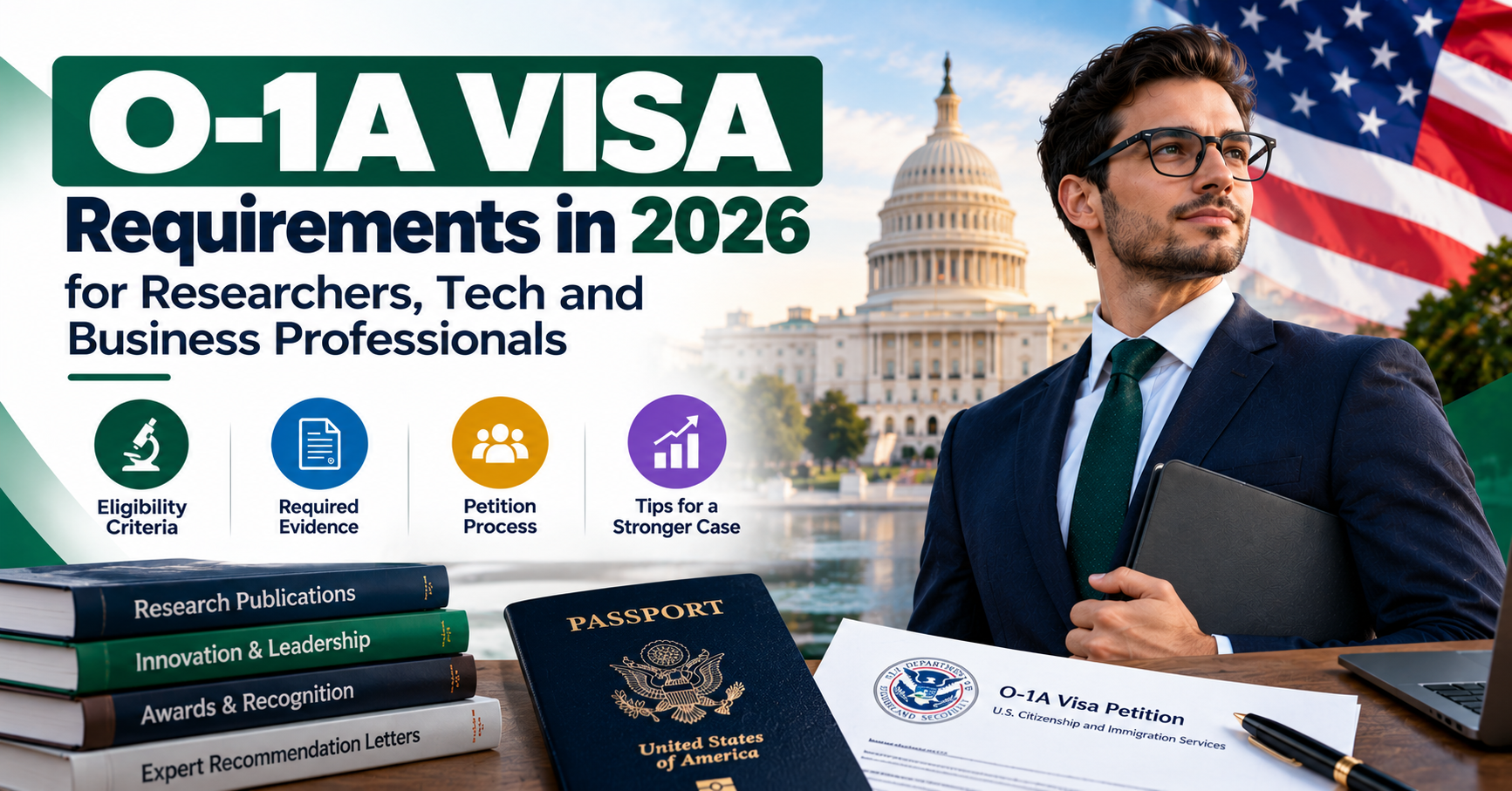
The O-1A visa is a U.S. temporary work visa classification for individuals who demonstrate extraordinary ability in science, education, business, or athletics.
For accomplished researchers, artificial intelligence specialists, software engineers, technology executives, entrepreneurs, and business professionals, the O-1A visa can provide an opportunity to work in the United States based on exceptional professional achievements.
Unlike visa classifications that rely primarily on academic qualifications or a conventional professional position, O-1A focuses on documented recognition and accomplishments within the applicant's field.
However, qualifying for an O-1A visa requires more than professional experience, an advanced degree, research publications, or an impressive curriculum vitae.
Applicants must demonstrate sustained national or international acclaim and show that they are among the small percentage of individuals at the very top of their field.
In this comprehensive guide, we explain O-1A visa requirements in 2026, including eligibility, the eight USCIS evidence criteria, documentation for researchers and technology professionals, employer sponsorship, application procedures, and common mistakes.
If you are evaluating your professional achievements, explore O-1A visa profile and immigration documentation support on Paperza.
What Is the O-1A Extraordinary Ability Visa?
The O-1A classification is designed for individuals who possess extraordinary ability in:
- Sciences.
- Education.
- Business.
- Athletics.
It is part of the broader O-1 nonimmigrant visa category administered by U.S. Citizenship and Immigration Services (USCIS).
The O-1B classification separately covers qualifying extraordinary ability in the arts and extraordinary achievement in the motion picture or television industry.
An O-1A beneficiary must intend to continue working in their area of extraordinary ability in the United States.
Benefits of the O-1A Visa
The O-1A classification offers several potential advantages.
No annual numerical cap: The O-1A classification is not subject to the H-1B annual lottery or numerical cap.
Flexible professional fields: It covers qualified individuals in research, science, technology, education, business, and athletics.
Initial approval period: O-1 classification may initially be approved for the period necessary to accomplish the specified event or activity, up to three years.
Extension opportunities: Eligible O-1 petitions may be extended, subject to applicable rules.
No universal degree requirement: USCIS does not require all O-1A beneficiaries to possess a PhD or master's degree.
Potential family accompaniment: Eligible spouses and unmarried children under 21 may seek O-3 dependent classification.
Unlike EB-1A or EB-2 NIW, O-1A is a temporary nonimmigrant classification and does not itself grant permanent residence.
Who Qualifies for the O-1A Visa in 2026?
O-1A applicants must demonstrate extraordinary ability supported by extensive documentation of recognized achievements.
Potential beneficiaries include professionals across several fields.
1. Academic Researchers and Scientists
Researchers may demonstrate extraordinary ability through influential scientific contributions, scholarly publications, recognized awards, peer review activity, distinguished research appointments, and documented professional recognition.
2. Artificial Intelligence and Machine Learning Experts
AI professionals may present evidence of influential technological innovations, significant research, recognized industry contributions, important product development, and leadership in distinguished organizations.
3. Software Engineers and Cybersecurity Specialists
Technology professionals may rely on qualifying achievements involving advanced software systems, cybersecurity innovation, engineering leadership, original technical contributions, and other significant professional accomplishments.
4. Entrepreneurs and Startup Founders
Entrepreneurs may qualify where their evidence demonstrates extraordinary business-related achievements, industry recognition, important innovations, or other accomplishments satisfying the applicable criteria.
Owning a startup alone does not establish O-1A eligibility.
5. Business Executives and Industry Professionals
Executives, consultants, financial technology professionals, and industry leaders may present evidence of distinguished organizational roles, major business contributions, awards, professional recognition, and qualifying remuneration.
The key issue is not simply the applicant's occupation but the level of achievement and recognition demonstrated.
The Eight O-1A Visa Evidence Criteria Explained
Under 8 CFR 214.2(o)(3)(iii), applicants generally must demonstrate either a qualifying major internationally recognized award or evidence satisfying at least three of eight regulatory criteria.
Where the listed criteria do not readily apply to the beneficiary's occupation, appropriately justified comparable evidence may be considered.
Criterion 1: Nationally or Internationally Recognized Awards
Applicants may submit evidence of nationally or internationally recognized prizes or awards for excellence in their field.
Relevant evidence may include:
- Award certificates.
- Official descriptions of the award.
- Selection criteria.
- Details of the judging process.
- Information about the awarding organization.
- Evidence of the award's professional recognition.
The reputation, competitiveness, and purpose of the award matter.
A purchased certificate or ordinary participation award does not automatically satisfy this criterion.
Criterion 2: Membership in Associations Requiring Outstanding Achievements
This criterion concerns memberships in professional associations that require outstanding achievements, as judged by recognized national or international experts.
Possible evidence includes official membership records, selection requirements, and documentation explaining the association's admission process.
For example, an advanced professional membership may be relevant if admission genuinely requires qualifying outstanding achievements evaluated by recognized experts.
Ordinary paid memberships generally do not satisfy this criterion merely because the association is well known.
Criterion 3: Published Material About the Applicant
Applicants may submit professional or major trade publications, or major media material, discussing their work and achievements.
Examples may include independent industry features, professional journal profiles, and substantial media coverage of important innovations.
The documentation should satisfy the regulatory requirements concerning the material and its publication.
Provide relevant publication details, including the title, date, author, and necessary translations.
Self-written articles and paid promotional profiles should not be misrepresented as independent editorial coverage.
Criterion 4: Participation as a Judge of Others' Work
This criterion involves participation in judging the work of others in the same or an allied field.
Examples may include:
- Reviewing research manuscripts for journals.
- Serving on qualifying conference review panels.
- Evaluating technical competitions.
- Judging professional awards.
- Participating in recognized expert assessment activities.
For academic researchers, completed journal peer reviews can be relevant.
Useful documents may include reviewer invitations, editorial acknowledgments, and confirmation that the reviews were actually completed.
An invitation without evidence of participation may not establish the criterion.
Criterion 5: Original Contributions of Major Significance
Applicants may demonstrate original scientific, scholarly, or business-related contributions of major significance.
For researchers and technology professionals, evidence may include:
- Influential research discoveries.
- Technological innovations adopted by others.
- Important software or engineering developments.
- Significant improvements to established processes.
- Independent expert recognition.
- Documented industry adoption.
- Relevant patents supported by evidence of impact.
An invention, patent, research publication, or software product does not automatically establish major significance.
The petition should explain how the contribution has meaningfully influenced the relevant field.
Criterion 6: Authorship of Scholarly Articles
Applicants may submit evidence of authorship of scholarly articles in their field, published in professional journals or other major media.
Relevant materials can include:
- Published research articles.
- Journal publication details.
- Authorship records.
- DOI information.
- Evidence demonstrating the scholarly nature of the work.
There is no universal USCIS requirement to publish a specific number of Scopus, Web of Science, IEEE, Springer Nature, or Elsevier articles.
Research publications may satisfy this criterion, but USCIS also evaluates the complete record.
Criterion 7: Critical or Essential Role for Distinguished Organizations
Applicants may present evidence of employment in a critical or essential capacity for organizations or establishments with distinguished reputations.
Examples may involve:
- Leading an important engineering initiative.
- Performing a critical technical function.
- Managing an influential business program.
- Making essential contributions to a distinguished research organization.
Supporting evidence may include employer letters, organizational information, project results, and documentation explaining the importance of the applicant's responsibilities.
A prestigious job title alone is not sufficient.
The evidence should demonstrate the significance of the actual role and the organization's distinguished reputation.
Criterion 8: High Salary or Other Remuneration
Applicants may demonstrate that they have commanded or will command a high salary or other remuneration for services.
Relevant documentation may include:
- Employment contracts.
- Payslips.
- Tax records.
- Compensation agreements.
- Reliable industry salary surveys.
- Comparable remuneration information.
The compensation should be evaluated in the context of the relevant profession and market.
A large salary amount alone does not automatically satisfy the criterion.
Is Meeting Three O-1A Criteria Enough?
No. Meeting three criteria does not automatically guarantee O-1A approval.
USCIS considers whether the supporting evidence establishes the extraordinary ability standard.
A petition may initially meet three evidentiary categories but still fail to demonstrate sustained national or international acclaim and recognition placing the individual among the small percentage at the top of their field.
For example, an applicant might present scholarly publications, completed peer reviews, and a critical organizational role.
USCIS must evaluate whether the evidence, considered together, establishes the required level of extraordinary ability.
The quality, relevance, credibility, and significance of the achievements matter.
O-1A Visa Requirements for Researchers and Scientists
Researchers often ask whether publications, citations, peer reviews, or academic awards can support an O-1A petition.
These achievements may be relevant, but their evidentiary value depends on the individual case.
Research Publications
Scholarly publications may demonstrate expertise and satisfy the authorship criterion when the applicable requirements are met.
Citation Records
Citation evidence may help explain the influence of a researcher's publications.
USCIS does not establish a universal minimum citation count.
Peer Review Activity
Documented participation in reviewing scholarly manuscripts may support the judging criterion.
The reviewing work should be genuine and appropriately documented.
Research Awards
Recognized competitive research awards may support the awards criterion, depending on their significance and selection standards.
Research Impact
Evidence that other experts have adopted, applied, or relied on an applicant's research may help demonstrate important contributions.
Researchers should focus on verifiable accomplishments rather than artificial citation increases or purchased credentials.
O-1A Visa Requirements for AI and Technology Professionals
USCIS clarified its O-1 guidance on January 8, 2025, including examples relevant to individuals working in critical and emerging technologies.
This clarification is useful for accomplished professionals in artificial intelligence, machine learning, software engineering, and related fields.
Relevant Evidence for Technology Professionals
Depending on the applicant's achievements, useful documentation may include:
- Important technical innovations.
- Recognized contributions to open-source projects.
- Research or industry publications.
- Patents and documented commercial applications.
- Critical roles in distinguished technology companies.
- Recognized technical awards.
- Evidence of independent adoption of innovations.
- Relevant professional remuneration.
Do Software Engineers Need Research Publications?
Not necessarily.
Although scholarly publications can support one of the O-1A criteria, USCIS recognizes that certain occupations may not readily align with every regulatory category.
Comparable evidence may be appropriate when properly justified under the regulations.
For example, evidence of significant work presented at a major industry event may be evaluated where scholarly publication criteria do not readily apply to the occupation.
The applicant must still demonstrate extraordinary ability.
O-1A Visa Requirements for Entrepreneurs and Business Professionals
Entrepreneurs and business professionals may qualify based on recognized achievements within their fields.
However, O-1A eligibility is not established simply by registering a company, securing clients, or generating revenue.
Evidence for Entrepreneurs
Potentially relevant evidence includes:
- Significant industry awards.
- Independent media recognition.
- Distinguished leadership positions.
- Original business contributions of major significance.
- Important product innovations.
- Qualifying remuneration.
- Independent recognition from relevant industry experts.
USCIS's January 2025 guidance also explains that a separate legal entity owned by the beneficiary may file an O-1 petition on the beneficiary's behalf.
This can be relevant to founders who operate qualifying companies.
However, the beneficiary cannot simply file an O-1 petition personally in their individual capacity.
A valid petitioning employer or agent arrangement and the applicable supporting requirements remain necessary.
Does the O-1A Visa Require Employer Sponsorship?
An O-1A petition generally must be filed by:
- A U.S. employer.
- A U.S. agent.
- A foreign employer through a U.S. agent.
Unlike EB-1A and EB-2 NIW immigrant petitions, O-1A does not provide ordinary individual self-petitioning.
However, an eligible separate legal entity owned by the beneficiary may act as petitioner where the applicable requirements are satisfied.
Important Petition Documents
Depending on the petition arrangement, documents may include:
- Form I-129.
- Supporting extraordinary ability evidence.
- Written contracts or a summary of oral agreement terms.
- A description of the proposed U.S. activities.
- Dates and locations of work, as required.
- An itinerary where applicable.
- A consultation or advisory opinion from the relevant peer group or other qualifying organization, unless an exception applies.
Applicants should consult current USCIS filing instructions because the documentary requirements depend on the facts.
How to Prepare a Strong O-1A Evidence Portfolio
Preparing a persuasive petition involves organizing authentic achievements and explaining their relevance.
Step 1: Define Your Professional Field
Identify the area in which you claim extraordinary ability.
Avoid defining the field so broadly that your accomplishments become difficult to evaluate or so narrowly that the definition appears artificial.
Step 2: Identify Qualifying Achievements
Evaluate which of the eight criteria are genuinely supported by your accomplishments.
Step 3: Gather Verifiable Documentation
Collect publications, awards, review acknowledgments, contracts, organizational records, and other credible evidence.
Step 4: Explain the Importance of Each Achievement
Do not rely entirely on certificates or numerical metrics.
Explain the achievement's context, recognition, and significance.
Step 5: Prepare Expert Recommendation Letters
Where appropriate, obtain letters from credible individuals who can explain specific achievements and their significance.
Letters should reflect genuine knowledge and factual evidence, not generic praise.
Step 6: Document the Proposed U.S. Work
Explain how the beneficiary will continue working in their area of extraordinary ability.
Step 7: Review the Petition as a Whole
Assess whether the complete record demonstrates sustained acclaim and recognition at the required level.
If you need help organizing your professional profile, research accomplishments, or supporting documents, explore O-1A professional evidence preparation support on Paperza.
For individual legal assessment, petition strategy, or immigration representation, consult a qualified U.S. immigration attorney or another properly authorized representative.
O-1A Visa Application Process in 2026
The O-1A process generally begins with the qualifying petitioner preparing and submitting a petition to USCIS.
Step 1: Establish a Valid Petitioning Arrangement
Identify the U.S. employer or agent, or other qualifying petitioning entity.
Step 2: Gather Supporting Evidence
Prepare evidence of extraordinary ability and the required employment or activity documentation.
Step 3: Obtain the Required Consultation
An advisory opinion from an appropriate peer group or organization is generally required, subject to applicable exceptions.
Step 4: File Form I-129
The petitioner submits Form I-129 with the required O classification materials and applicable fees.
Step 5: USCIS Reviews the Petition
USCIS may approve the petition, deny it, or request additional evidence.
Step 6: Complete Visa Processing if Required
Beneficiaries outside the United States generally must complete the appropriate visa application process at a U.S. consular post, unless an applicable exception applies.
Step 7: Begin Authorized Work
Employment must comply with the approved petition and applicable immigration conditions.
An approved petition does not automatically authorize unrestricted employment for unrelated organizations.
How Long Is an O-1A Visa Valid?
An O-1 petition may initially be approved for the time needed to accomplish the stated event or activities, up to three years.
Extensions for continuing or completing the same event or activity may generally be granted in increments of up to one year.
Different rules may apply where a new event or activity supports a new petition.
There is no universal lifetime maximum period of O-1 classification, but each extension or new petition must satisfy the applicable requirements.
Beneficiaries should also distinguish between the USCIS petition validity period, authorized period of stay, and the visa stamp's expiration date.
O-1A vs EB-1A vs EB-2 NIW
The O-1A, EB-1A, and EB-2 NIW classifications serve different immigration purposes.
| Feature | O-1A | EB-1A | EB-2 NIW |
| Immigration category | Temporary nonimmigrant | Employment-based immigrant | Employment-based immigrant |
| Main standard | Extraordinary ability | Extraordinary ability | EB-2 qualifications plus National Interest Waiver |
| Individual self-petition | Not ordinarily permitted | Permitted | Permitted |
| Qualifying employer or agent petitioner | Required | Not required | Not required if NIW granted |
| Permanent residence directly granted | No | No, an additional process is required | No, an additional process is required |
| Primary purpose | Temporary U.S. work | Immigrant classification | Immigrant classification with job offer and labor certification waiver |
Professionals may explore different pathways depending on their achievements, proposed U.S. activities, and immigration circumstances.
Qualifying for one classification does not automatically establish eligibility for another.
Common O-1A Petition Mistakes to Avoid
Assuming Three Criteria Guarantee Approval
Meeting three evidentiary categories is not the same as demonstrating sustained national or international acclaim.
Using Unverified Awards
An award's significance and selection standards should be documented.
Presenting Ordinary Paid Memberships as Elite Recognition
Membership criteria and expert selection requirements matter.
Submitting Publications Without Context
Research papers can support the authorship criterion, but publication counts alone do not establish extraordinary ability.
Claiming Peer Reviews That Were Never Completed
Reviewer invitations and genuine completed reviews are different forms of evidence.
Ignoring the Petitioning Employer or Agent Requirements
A strong professional profile does not eliminate the need for a valid petitioning arrangement.
Using Fabricated or Misleading Documentation
False media reports, manufactured awards, fabricated publications, manipulated citations, and misleading recommendation letters can lead to serious immigration consequences.
Frequently Asked Questions About O-1A Visa Requirements in 2026
1. What are the main O-1A visa requirements?
Applicants must demonstrate extraordinary ability in science, education, business, or athletics through sustained national or international acclaim, supported by a qualifying major award or at least three applicable evidence criteria, with the overall record establishing the required standard.
2. Can software engineers qualify for O-1A?
Yes. Software engineers may qualify if they demonstrate extraordinary ability and satisfy the applicable petition requirements.
3. Do I need a PhD for an O-1A visa?
No. USCIS does not impose a universal PhD requirement for O-1A.
4. How many research publications or citations do I need?
There is no fixed USCIS publication or citation threshold.
5. Can startup founders apply for O-1A?
Yes. Qualifying entrepreneurs may pursue O-1A through an eligible petitioning arrangement, including certain separate legal entities they own.
6. Can I apply for O-1A without an employer?
An individual cannot ordinarily self-petition for O-1A. However, eligible U.S. agents and certain separate legal entities owned by beneficiaries may file petitions under the applicable rules.
7. Does O-1A lead directly to a green card?
No. O-1A is a temporary nonimmigrant classification. Permanent residence requires a separate qualifying immigration process.
8. Can I obtain O-1A by purchasing awards or citations?
Purchased or fabricated evidence does not establish genuine extraordinary ability and can create serious immigration and fraud-related consequences.
O-1A Evidence Checklist for Researchers, Tech and Business Professionals
Before preparing an O-1A petition, review the following:
- Professional field clearly identified.
- Relevant extraordinary ability achievements documented.
- At least three applicable evidence criteria assessed, or a qualifying major award identified.
- Comparable evidence evaluated where appropriate.
- Supporting documents are authentic and verifiable.
- Professional recognition and impact are explained.
- Recommendation letters are factual and credible.
- Valid petitioning employer or agent identified.
- Proposed U.S. work or activities documented.
- Required consultation and contract documents considered.
- Current USCIS forms and filing instructions checked.
- Entire petition evaluated against the sustained acclaim standard.
Conclusion: Building a Strong O-1A Case in 2026
The O-1A extraordinary ability visa provides an immigration option for accomplished researchers, technology professionals, entrepreneurs, and business leaders seeking to work temporarily in the United States.
A strong petition requires more than impressive job titles, academic degrees, publications, or certificates.
Applicants must establish recognized achievements, demonstrate the required extraordinary ability, and ensure that the proposed U.S. activities and petitioning arrangements satisfy immigration requirements.
Researchers may rely on qualifying scholarly achievements and scientific contributions, while technology and business professionals may present evidence of innovations, distinguished roles, major contributions, and other relevant accomplishments.
The most effective approach is to focus on authentic professional achievements, well-organized evidence, and accurate explanations of their significance.
Explore O-1A Visa Professional Support Services on Paperza
Paperza connects clients with freelance professionals offering research, business, documentation, and professional profile services.
If you need assistance organizing your academic achievements, updating your professional CV, or preparing supporting materials, explore:
O-1A Visa Profile and Professional Evidence Support on Paperza
Review the provider's actual service description, qualifications, and scope of work before placing an order.
Professional documentation support cannot guarantee USCIS approval or replace authorized immigration legal advice.
Build a credible professional profile and explore relevant O-1A support services on Paperza.
Official Sources and Further Reading
Disclaimer: This article provides general educational information, not individualized legal advice. Immigration requirements, fees, and procedures may change. Verify current USCIS guidance and consult a qualified U.S. immigration attorney or other authorized immigration representative before making case-specific decisions.
I will optimize your cv and github portfolio for uk global talent visa
Are you applying for the UK Global Talent Visa (Digital Technology route) and need a professional CV and GitHub portfolio? I will help you optimize your CV and GitHub profile to...
View Related Service >NEED PROFESSIONAL ASSISTANCE?
I will optimize your cv and github portfolio for uk global talent visa
Are you applying for the UK Global Talent Visa (Digital Technology route) and need a professional CV and GitHub portfolio? I will help you...