
How to Find the Right Scopus-Indexed Journal for Your Research Paper in 2026
By Paperza Editorial Team
|
15 Oct 2026
|
1 min read
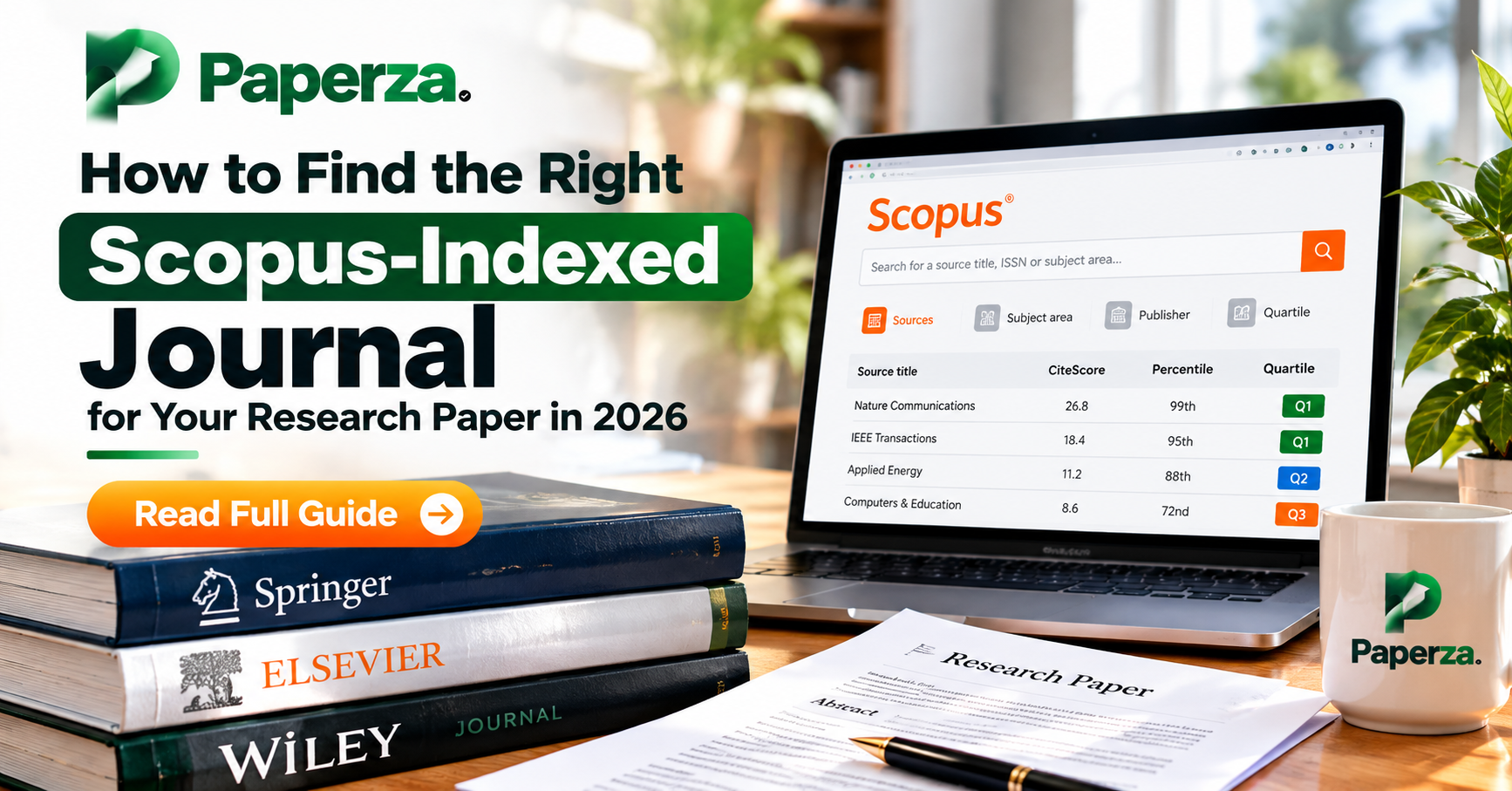
Choosing the right academic journal is one of the most important steps in publishing a research paper. For postgraduate students, researchers, and academic professionals, finding a suitable Scopus-indexed journal requires careful consideration of indexing status, subject relevance, journal rankings, and publication requirements.
This guide explains how to identify reputable Scopus journals and prepare your manuscript for submission in 2026.
1. What Is a Scopus-Indexed Journal?
A Scopus-indexed journal is an academic publication covered by Scopus, Elsevier's abstract and citation database.
Scopus includes journals across engineering, medicine, computer science, business, education, social sciences, and many other disciplines.
Publishing in a suitable indexed journal can improve research discoverability and help researchers reach relevant academic audiences.
However, Scopus indexing does not guarantee manuscript acceptance or future indexing of every article.
2. How to Find and Verify Scopus Journals
The safest approach is to verify a journal through the official Scopus Sources directory.
Follow these steps:
- Visit Scopus Sources.
- Search using the journal title or ISSN.
- Review its subject classification and coverage information.
- Check whether its indexing has been discontinued.
- Visit the journal's official website to review its aims and scope.
Important: Never rely solely on a journal website claiming to be Scopus-indexed. Verify its status independently before submitting your manuscript.
3. Understanding Q1, Q2, Q3, and Q4 Journals
Scopus-related journal rankings are commonly discussed using four quartiles.
| QuartileRanking position | |
| Q1 | Top 25% |
| Q2 | Next 25% |
| Q3 | Next 25% |
| Q4 | Bottom 25% |
Quartiles depend on the ranking system, subject category, and reporting year. Scopus CiteScore quartiles and SCImago SJR quartiles may differ.
Although Q1 journals generally have stronger relative citation performance, the best journal is one that matches your research topic and publication goals, not necessarily the journal with the highest ranking.
4. What to Consider Before Selecting a Journal
Before choosing a publication outlet, evaluate these five factors:
- Research scope: Does the journal publish studies related to your manuscript?
- Indexing status: Is its Scopus coverage current and relevant?
- Publication fees: Are Article Processing Charges (APCs) required?
- Editorial standards: Does the journal explain its peer-review and ethical policies?
- Author guidelines: Can your manuscript meet its formatting and submission requirements?
Be cautious of journals or third-party services promising guaranteed acceptance, unusually fast publication, or indexing without verifiable evidence.
5. Preparing Your Manuscript for Submission
Once you identify a suitable journal, carefully review its author instructions.
Your manuscript should include an appropriate title, abstract, keywords, introduction, methodology, results, discussion, conclusion, and references, as applicable to your research type.
Also verify that:
- References follow the required citation style.
- Tables and figures are properly formatted.
- Ethical declarations and supplementary documents are included when required.
- The manuscript meets the journal's originality and submission policies.
After submission, the journal may conduct editorial screening, external peer review, and revision before reaching a final decision.
6. How Paperza Can Help
At Paperza, we assist researchers, postgraduate students, and academic professionals with the technical and administrative aspects of academic publishing.
Our services include:
- Scopus journal selection and indexing verification
- Q1–Q4 journal matching
- Manuscript editing and formatting
- Journal submission guidance
- Cover letter preparation
- Reviewer-response assistance
Our goal is to help authors make informed journal selection decisions and submit professionally prepared manuscripts.
Need help finding the right Scopus-indexed journal?
Visit Paperza.com to explore our academic research and publication support services.
Journal acceptance, peer-review timelines, and indexing decisions remain under the control of the relevant journals and indexing providers.
Frequently Asked Questions
How do I know whether a journal is Scopus-indexed?
Search for the journal using its title or ISSN in the official Scopus Sources directory and review its coverage status.
Is a Q1 journal better than a Q2 journal?
Not always. Journal scope, editorial standards, and relevance to your research are equally important.
Can Paperza guarantee publication in a Scopus journal?
No. Paperza provides journal selection and submission assistance, while independent journal editors make publication decisions.
Conclusion
Finding the right Scopus-indexed journal in 2026 involves verifying indexing, understanding journal rankings, evaluating publication costs, and matching your manuscript to the journal's research scope.
With careful preparation and appropriate publication support, researchers can avoid common submission mistakes and make better publishing decisions.
I will assist with scopus journal selection and manuscript submission
Are you looking for Scopus-indexed Q1, Q2, Q3, or Q4 journals for your research paper? I provide professional Scopus journal selection, manuscript submission assistance, and...
View Related Service >NEED PROFESSIONAL ASSISTANCE?
I will assist with scopus journal selection and manuscript submission
Are you looking for Scopus-indexed Q1, Q2, Q3, or Q4 journals for your research paper? I provide professional Scopus journal selection,...