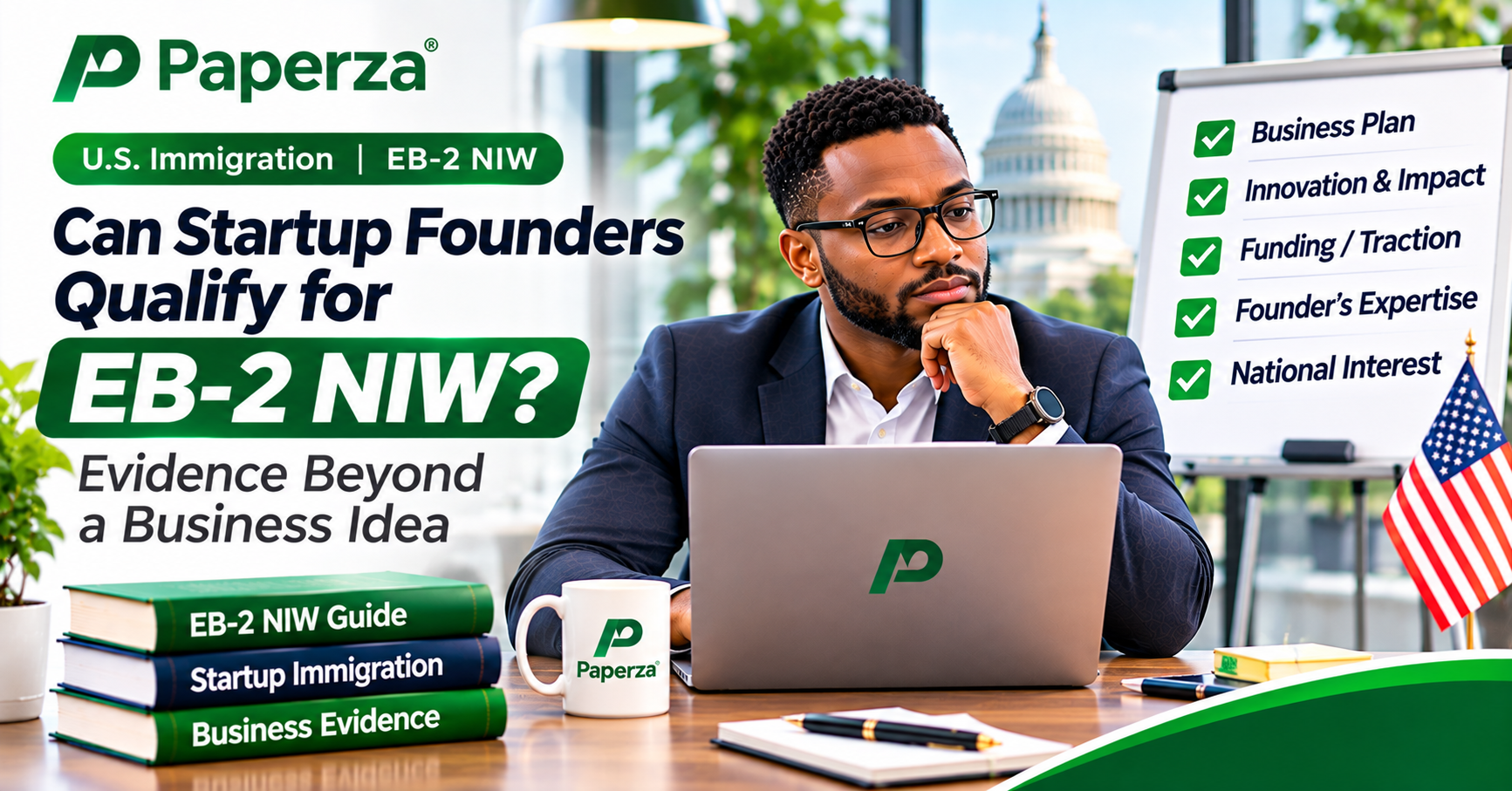
Can Startup Founders Qualify for EB-2 NIW? Evidence Beyond a Business Idea
By Paperza Editorial Team
|
11 Nov 2026
|
14 min read
Starting a business requires innovation, determination, and a clear vision. For international entrepreneurs interested in establishing or expanding a company in the United States, the EB-2 National Interest Waiver (NIW) may offer a potential immigration pathway.
However, an innovative business idea, a registered company, or an ambitious business plan does not automatically qualify a startup founder for EB-2 NIW.
U.S. Citizenship and Immigration Services (USCIS) evaluates whether the entrepreneur meets the underlying EB-2 eligibility requirements and whether the proposed business endeavor satisfies the national interest waiver criteria.
For startup founders, this means demonstrating more than the potential to make money. A persuasive petition should explain the proposed venture's broader importance, the founder's qualifications, and the credible steps already taken toward implementation.
This guide explains how entrepreneurs may qualify for EB-2 NIW, what supporting evidence can strengthen a petition, and why business plans alone are often insufficient.
Founders seeking professional documentation and immigration-related support can also explore Immigration Services on Paperza.
Can Startup Founders Apply for EB-2 NIW?
Yes. Startup founders and entrepreneurs may qualify for EB-2 NIW if they satisfy the applicable legal requirements.
The EB-2 immigrant classification covers qualifying professionals with advanced degrees and individuals of exceptional ability in the sciences, arts, or business.
A National Interest Waiver allows eligible applicants to request a waiver of the usual job offer and labor certification requirements when doing so would benefit the United States.
Unlike many employer-sponsored immigration pathways, EB-2 NIW permits self-petitioning.
This can be particularly relevant to entrepreneurs who intend to develop or operate their own businesses rather than work for a traditional sponsoring employer.
However, establishing a company does not itself establish eligibility for the waiver.
According to the USCIS Policy Manual, entrepreneurs must present credible evidence demonstrating that their proposed endeavors meet the national interest waiver framework.
Understanding the Three EB-2 NIW Requirements
The national interest waiver framework established in Matter of Dhanasar contains three requirements.
1. The Proposed Endeavor Has Substantial Merit and National Importance
The founder must demonstrate that the proposed endeavor has substantial merit and national importance.
Substantial merit can exist in areas such as business, technology, science, healthcare, education, and entrepreneurship.
National importance requires an assessment of the proposed endeavor's prospective impact.
For example, developing a technology that could significantly improve cybersecurity practices across an industry may have broader implications than opening a business that serves only a limited local customer base.
The key question is not simply whether the industry is important, but whether the founder's specific proposed endeavor has sufficiently broad significance.
2. The Founder Is Well Positioned to Advance the Endeavor
USCIS evaluates whether the entrepreneur possesses the education, knowledge, experience, skills, achievements, and practical resources needed to advance the proposed business.
Relevant evidence may include:
- Previous entrepreneurial achievements.
- Relevant academic and professional qualifications.
- Successful product development.
- Existing customers or users.
- Funding or investor interest.
- Strategic partnerships.
- Demonstrated industry experience.
- Progress toward launching or expanding the business.
The founder does not need to prove that the business is guaranteed to succeed.
However, the petition should demonstrate a credible connection between the entrepreneur's background and the proposed endeavor.
3. Waiving the Job Offer and Labor Certification Requirements Benefits the United States
The third requirement considers whether, on balance, it would benefit the United States to waive the normal job offer and labor certification requirements.
For entrepreneurs, relevant considerations may include the nature of the proposed business, the founder's role, and the expected benefits of allowing the individual to pursue the endeavor.
A founder should explain why their particular contribution supports the national interest rather than assuming that entrepreneurship automatically justifies a waiver.
What Evidence Can Strengthen an EB-2 NIW Petition for Startup Founders?
A strong entrepreneurial petition typically combines professional qualifications, credible business documentation, and independent evidence of the venture's potential significance.
The following categories may be particularly useful.
1. A Detailed and Credible Business Plan
A business plan is an important document because it explains what the founder intends to accomplish in the United States.
However, a business plan should not be treated as sufficient evidence on its own.
An effective plan may describe:
- The business problem being addressed.
- The proposed product or service.
- The target market and potential customers.
- The technology or methodology involved.
- The business model.
- Competitor and market analysis.
- Financial projections.
- Expected employment opportunities.
- Development milestones.
- The founder's responsibilities.
- The venture's potential broader impact.
For example, a startup developing AI-powered diagnostic support software might explain the technology, its intended clinical applications, development stage, regulatory considerations, and evidence supporting its potential impact.
Financial projections should be realistic, supported by assumptions, and clearly distinguished from actual business performance.
USCIS generally places greater weight on business plans when relevant claims are corroborated by independent evidence.
2. Evidence of Business Progress and Market Traction
One of the strongest ways to demonstrate that a startup is more than an idea is to document meaningful progress.
Examples include:
Product development: Working prototypes, software applications, technical demonstrations, or completed product milestones.
Customer acquisition: Signed customer agreements, legitimate sales records, subscriptions, or documented customer adoption.
Market validation: Pilot programs, independent product evaluations, user feedback, or commercial testing.
Business operations: Operational records showing that the company has begun implementing its proposed activities.
Strategic partnerships: Agreements with established organizations that support the business's development.
For example, a founder developing software for agricultural supply-chain optimization may present evidence of pilot deployments, partnerships with agricultural organizations, and measurable improvements achieved during testing.
Such evidence can help establish both the founder's ability to advance the venture and the credibility of the proposed endeavor.
3. Evidence of Innovation and Original Contributions
Entrepreneurs working in technology-driven sectors may possess innovations that support their proposed endeavors.
Examples include:
- Proprietary software systems.
- Innovative manufacturing processes.
- New cybersecurity technologies.
- Advanced artificial intelligence applications.
- Medical technology innovations.
- Renewable energy solutions.
- Novel financial technology platforms.
Supporting documents may include patent records, technical reports, product demonstrations, licensing agreements, independent evaluations, and evidence of adoption.
However, innovation alone does not establish national importance.
The petition should explain how the innovation could have broader implications for the relevant field, industry, region, or public.
4. Funding, Investment, and Financial Support
External investment can help demonstrate that credible third parties see potential in a startup.
Relevant evidence may include:
- Executed investment agreements.
- Venture capital funding records.
- Angel investment documentation.
- Startup accelerator acceptance.
- Government grants.
- Research and development funding.
- Bank statements demonstrating available resources.
- Financial commitments from legitimate business partners.
Funding is not mandatory for every entrepreneurial NIW petition, and receiving investment does not automatically establish eligibility.
Nevertheless, credible financial support can help demonstrate that the founder has access to resources needed to advance the endeavor.
Independent investors' evaluations may also provide useful context when supported by evidence of the venture's actual activities.
5. Previous Entrepreneurial Success and Leadership Experience
A founder's professional background can be particularly important under the second NIW requirement.
USCIS may consider whether previous achievements demonstrate the entrepreneur's ability to carry out the proposed venture.
Relevant evidence may include:
Previous business ownership: Documentation showing successful development or management of earlier ventures.
Executive leadership: Evidence of leading important projects, teams, or organizations.
Technical expertise: Qualifications and experience directly connected to the proposed business.
Commercial achievements: Verified revenue growth, successful product launches, or business expansion.
Professional recognition: Awards, industry recognition, or other credible evidence of professional distinction.
For example, an entrepreneur who previously developed and scaled a successful enterprise software company may have a stronger basis for demonstrating readiness to launch a related U.S. venture.
The evidence should establish the individual's actual responsibilities and accomplishments rather than relying solely on job titles.
6. Job Creation and Economic Impact
Some startup founders propose ventures that could create employment opportunities, contribute to regional economic development, or support strategically important industries.
Such potential benefits may be relevant to an NIW petition.
However, USCIS cautions that general statements about creating jobs or contributing to the economy are not sufficient by themselves.
A founder should provide specific, credible information where available.
Useful supporting evidence may include:
- Workforce development plans.
- Realistic hiring projections.
- Existing employment records.
- Economic impact studies.
- Business expansion agreements.
- Evidence of regional industry needs.
- Documented investment in underserved or economically challenged areas.
For example, a manufacturing startup proposing to establish an advanced production facility may explain its anticipated operations, planned workforce, and potential effects on a regional supply chain.
The petition should distinguish between confirmed achievements and projected future outcomes.
7. Letters From Independent Experts and Industry Organizations
Well-supported recommendation letters can help explain the significance of an entrepreneur's work.
Potential recommenders include:
- Recognized industry experts.
- Investors familiar with the venture.
- Business association representatives.
- Research collaborators.
- Technology specialists.
- Relevant government or economic development organizations.
Strong letters should explain the writer's qualifications, their knowledge of the founder or venture, and the factual basis for their conclusions.
For example, a technology industry expert may describe how a startup's software addresses a significant technical problem and explain the evidence supporting its broader potential impact.
Letters should not rely solely on generic praise or unsupported predictions.
Independent documentation that corroborates the letter's claims can improve its evidentiary value.
8. Evidence of National Importance Beyond Local Business Success
This is one of the most important considerations for entrepreneurial EB-2 NIW petitions.
A startup may be commercially successful without necessarily demonstrating national importance under the NIW framework.
For example, opening a profitable restaurant, consulting company, or retail store does not automatically establish that the venture has national importance.
A stronger argument may involve documented potential impacts that extend beyond the company's immediate customers.
These could include:
- Advancing an important technology.
- Addressing a significant public health challenge.
- Improving critical infrastructure.
- Developing innovations with broader industry applications.
- Contributing to strategically important research.
- Supporting meaningful regional economic development.
- Improving processes used by multiple organizations across a field.
The relevant impact must be tied to the founder's specific endeavor.
Simply stating that artificial intelligence, healthcare, cybersecurity, or renewable energy is nationally important does not establish that every business operating in those sectors qualifies.
EB-2 NIW Evidence Checklist for Startup Founders
| Evidence Category | Examples of Supporting Documents |
| EB-2 qualifications | Degrees, credential evaluations, experience letters, exceptional ability evidence |
| Business ownership | Incorporation documents, ownership records, organizational structure |
| Proposed endeavor | Detailed endeavor statement, business plan, development roadmap |
| Product development | Prototypes, technical documentation, product demonstrations |
| Market traction | Customer agreements, pilot results, verified sales records |
| Funding | Investment agreements, grants, financial commitments |
| Professional experience | CV, leadership records, previous business achievements |
| Innovation | Patents, technical reports, independent evaluations |
| Broader impact | Industry research, economic impact evidence, third-party assessments |
| Expert support | Detailed recommendation letters supported by verifiable evidence |
Not every applicant will have every category of evidence. The most useful portfolio is one that directly addresses the applicable legal requirements.
Can a Founder Qualify Without an Existing U.S. Company?
Potentially, yes.
A startup founder does not necessarily need to have an established U.S. company before filing an EB-2 NIW petition.
However, the proposed endeavor must be sufficiently defined, and the founder must provide persuasive evidence demonstrating eligibility.
For an early-stage entrepreneur, useful documentation may include a developed business model, relevant professional achievements, technical progress, prospective customer interest, and credible implementation plans.
An untested idea with no meaningful supporting evidence will generally present a more difficult case.
Can a Founder Qualify Without Venture Capital Funding?
Yes. Venture capital funding is not a mandatory EB-2 NIW requirement.
A bootstrapped entrepreneur may rely on other relevant evidence, including product development, customer adoption, professional expertise, commercial achievements, or strategic partnerships.
USCIS evaluates the evidence as a whole rather than requiring every entrepreneur to follow the same business model.
Common EB-2 NIW Mistakes Startup Founders Should Avoid
1. Submitting Only a Business Plan
A polished business plan may explain the venture's objectives, but unsupported projections do not establish eligibility.
2. Assuming Company Registration Is Sufficient
Incorporating a company demonstrates legal formation, not necessarily substantial merit, national importance, or the founder's ability to advance the endeavor.
3. Making Broad Claims About Economic Benefits
Statements such as "my business will create jobs and improve the U.S. economy" should be supported by specific, credible evidence.
4. Relying on the Importance of an Entire Industry
Operating in a high-priority industry does not automatically make a particular venture nationally important.
5. Ignoring the Founder's EB-2 Qualifications
Applicants must first qualify for the underlying EB-2 classification as advanced degree professionals or individuals of exceptional ability.
6. Providing Unsupported Financial Projections
Revenue forecasts, hiring estimates, and market-share predictions should have a reasonable factual foundation.
7. Using Generic Recommendation Letters
Expert letters should provide detailed, credible explanations supported by independent documentation.
How to Prepare an EB-2 NIW Petition Portfolio as a Startup Founder
A practical approach is to organize the petition around the underlying EB-2 qualification and the three national interest waiver requirements.
Section 1: Professional Qualifications
Present educational records, experience, professional achievements, and evidence establishing eligibility for the EB-2 classification.
Section 2: Proposed Endeavor
Explain the business's objectives, planned activities, and potential significance.
Section 3: Substantial Merit and National Importance
Present relevant market research, technical documentation, impact evidence, and independent evaluations.
Section 4: Ability to Advance the Endeavor
Document the founder's qualifications, past achievements, product progress, partnerships, customer interest, and resources.
Section 5: Justification for the National Interest Waiver
Explain why, considering the overall circumstances, waiving the job offer and labor certification requirements would benefit the United States.
Section 6: Supporting Exhibits
Organize incorporation documents, business plans, financial records, letters, technical evidence, and other supporting materials.
Each exhibit should have a clear purpose and connect to the relevant eligibility requirements.
Where Startup Founders Can Find EB-2 NIW Documentation Support
Preparing an entrepreneurial EB-2 NIW petition may involve several professional tasks, including organizing business documentation, preparing detailed endeavor descriptions, reviewing evidence, and drafting supporting materials.
Startup founders can explore immigration-related professional services on Paperza to identify relevant documentation and professional support offerings.
When choosing a service provider, founders should prioritize accurate documentation, transparent service descriptions, and experience relevant to their needs.
For individualized immigration advice, legal eligibility assessments, petition strategy, or representation before USCIS, consult a qualified U.S. immigration attorney or another properly authorized legal professional.
Frequently Asked Questions
Can startup founders qualify for EB-2 NIW without employer sponsorship?
Yes. Eligible EB-2 NIW applicants may self-petition without employer sponsorship or a permanent job offer.
Is a business plan enough for EB-2 NIW approval?
No. A business plan may support the petition, but USCIS considers the overall evidence, including the founder's qualifications, the endeavor's importance, and progress toward implementation.
Do startup founders need a master's degree for EB-2 NIW?
Not necessarily. Applicants may qualify through the advanced degree classification, including certain bachelor's degree and progressive experience combinations, or through the exceptional ability classification. The applicable requirements must be satisfied.
Does an entrepreneur need to have an operating business before applying?
Not necessarily. However, credible evidence of preparation, relevant experience, and progress toward the proposed endeavor can strengthen the petition.
Can a technology startup qualify for EB-2 NIW?
Potentially. A technology startup may qualify when the founder meets the EB-2 requirements and the specific proposed endeavor satisfies all three national interest waiver criteria.
Does raising venture capital guarantee EB-2 NIW approval?
No. Investment may support an application, but funding alone does not establish national importance or satisfy every NIW requirement.
Final Thoughts
Startup founders can qualify for EB-2 NIW, but a promising business idea is only the beginning.
A persuasive petition must establish the founder's underlying EB-2 qualifications, demonstrate the proposed endeavor's substantial merit and national importance, and provide credible evidence that the founder is well positioned to advance it.
Business progress, customer adoption, innovation, professional achievements, independent expert assessments, and realistic implementation plans can all help create a more substantial evidentiary record.
The strongest entrepreneurial petitions connect a specific business endeavor to credible, documented benefits that extend beyond the founder's personal commercial success.
Ready to organize your EB-2 NIW supporting evidence?
Explore Immigration Services on Paperza to discover professional documentation and immigration-related support services.
Disclaimer: This article is intended for general educational purposes and does not constitute legal advice. EB-2 NIW eligibility is determined on a case-by-case basis, and no particular document or business achievement guarantees approval.
Official sources:
I will draft expert opinion letters for eb1a and eb2 niw petitions
Are you preparing an EB1A or EB2 NIW petition and need a professionally drafted expert opinion letter? I provide personalized expert opinion letter drafting services to help...
View Related Service >NEED PROFESSIONAL ASSISTANCE?
I will draft expert opinion letters for eb1a and eb2 niw petitions
Are you preparing an EB1A or EB2 NIW petition and need a professionally drafted expert opinion letter? I provide personalized expert...